49 works in this view — arrow keys or swipe to move between them.
Dance in Art
Blindman's buff
Unknown artist
- Collection:
- Prints depicting dance
- Source:
- New York Public Library
- Rights:
- Public domain — free to use, share and adapt.
- Recorded as:
- Public Domain
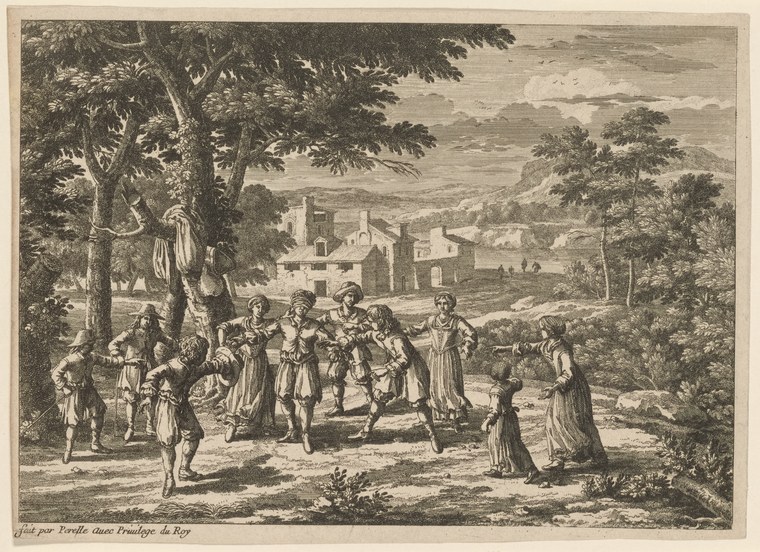
This is one of the few surviving visual records of how Blindman's buff was actually performed in the Renaissance court. It shows that the game was organized, choreographed, and watched—not a chaotic scramble but a formal social ritual. For dancers and historians, it documents the continuity between game, dance, and theater in the period, and the central role of play in courtly social bonding.
What you are looking at
An engraved outdoor gathering in a wooded landscape, with a fortified town visible in the distant background. In the foreground, a group of figures in Renaissance dress stands on a path among tall trees; the composition divides into active dancers in the center and watching figures at the margins. The central figures appear to be engaged in a game or dance, with bent knees and turned bodies suggesting movement and play. The trees frame the scene dramatically, their trunks and foliage rendered with dense hatching typical of 16th-century printmaking. The sky opens above, rendered with parallel lines to suggest clouds and distance. The overall mood is one of courtly leisure and social recreation, with the formal dress and ordered grouping characteristic of a court or noble entertainment.
The dancing
The central figures display the flexed-knee postures and rotated torsos typical of Renaissance dancing, with bodies angled toward one another in social engagement. Several figures have one leg bent and appear to be in mid-step or mid-turn; arms are held at varied heights, some extended, suggesting the arm movements of a formal dance rather than random play. The group clusters around a central point of focus, creating a composition of interlocking bodies rather than a linear progression. One figure at the right edge appears to be turning sharply, the skirts caught in motion. The overall frame suggests multiple participants in coordinated rather than solo movement.
The dance depicted
This is identified in the cartouche as *Blindman's buff*, a parlor game-dance that was popular in Renaissance courts. The image captures the characteristic moment of blindfolded play—the central figures turning and reaching toward one another in the hunt and evasion that defines the game. Blindman's buff occupied an ambiguous space between game and dance in the Renaissance; it involved music, coordinated movement, and the ceremonial courtship rituals embedded in all noble entertainments. The image documents the social form as practiced outdoors, suggesting this was a fashionable diversion for a courtly circle. The print preserves evidence of how the game was staged—as a group activity with onlookers, a mix of active and passive roles, and a narrative of pursuit that made it theatrically legible.
How it was made
This is an engraving, created by hand-incising lines into a copper plate; the characteristic parallel hatching lines and crisp linear forms confirm the technique. The fineness of the line work and the delicate cross-hatching in the foliage and sky indicate a skilled practitioner working with a burin. Engravings were relatively expensive to produce and were distributed to a learned, courtly audience; this level of detail and the sophisticated composition suggest the print was made for collectors of fine prints or as an illustration for a book about courtly conduct or dance. The technique allowed the artist to capture both the grand landscape setting and the fine detail of costume and gesture simultaneously.
About this work
This is a Renaissance engraving documenting *Blindman's buff*, a game-dance practiced in European courts. The print shows the game in action—a group of costumed figures in a wooded landscape, some actively playing and others watching. The work is significant as visual evidence of how this game-dance was staged, staged outdoors, and integrated into noble entertainment. It captures a moment of social play that was both ritualized and genuinely unpredictable, combining the formality of Renaissance court dress with the playful evasion and pursuit that made the game engaging.
The print belongs to a tradition of Renaissance documentation of courtly pastimes—dance, games, and outdoor entertainments that were markers of noble status and education. It sits between the technical and the social: it is both a demonstration of fine printmaking skill and a record of how people actually moved and played.
How to look at it
Attend to the moment the artist has frozen: the instant of active play, with bodies in mid-turn and mid-reach, not a formal static pose. Notice how the composition guides the eye inward to the active players while the framing trees and distant town situate the game in a specific, ordered landscape. The print documents the social structure of the game—some figures actively engaged, others watching and waiting—which was part of its appeal. The formal Renaissance dress and the careful placement of each figure suggests that this was not spontaneous play but a carefully staged entertainment.
The artist
The print is not attributed in the catalogue record; the cartouche reads only 'fecit per [?] Galle Friderici de Roy' (made by [?] Galle for the King's [pleasure or use]), suggesting it was created for a royal or princely patron, possibly in the Netherlands or France in the mid-to-late 16th century. The style and technique align with Flemish and French printmaking of the period, and the inscription suggests court commission rather than independent commercial sale.
The period
In the 16th century, Blindman's buff was a fashionable courtly game documented in manuals of courtly conduct and depicted in paintings and tapestries across Europe. It combined elements of dance, theater, and social games in a way that appealed to Renaissance courts' fascination with refined leisure and the display of grace under playful constraint. The game was often accompanied by music and was understood as a form of courtship ritual—the blindfolding and pursuit enacted a courtship scenario in miniature. Prints documenting courtly entertainments became increasingly popular as the century progressed, serving both as records of court life and as models for imitation in other noble households.
Where it lives
The work is held in the New York Public Library's collection of prints depicting dance. It is catalogued by subject rather than by artist, suggesting it entered the collection as an example of dance documentation rather than as a work by a named master. The inscription indicates it was made for a royal patron, though the specific court and date remain uncertain.
Dance in this work
Questions about this work
What is Blindman's buff?
Blindman's buff is a game in which one player is blindfolded and must catch the other players by touch and sound alone. In the Renaissance court, it became a fashionable game-dance accompanied by music and ritualized movement, and was often understood as a form of courtship play. The game was popular across Europe from at least the 15th century onward.
How do we know this is Blindman's buff and not another dance?
The title is inscribed in the cartouche at the bottom of the print, which reads 'Blindman's buff' (or a variant). The visual composition—with figures in pursuit and evasion, some turned away from the action, and the overall sense of playful struggle—aligns with contemporary descriptions of how the game was performed in court.
Who made this print, and when?
The artist is not identified in surviving records, though the cartouche mentions 'Galle' and a royal patron. The style and technique suggest a Flemish or French printmaker working in the mid-to-late 16th century. The exact date and artist remain uncertain.
Was Blindman's buff considered a dance or a game?
In the Renaissance, the distinction between game and dance was not rigid. Blindman's buff combined music, coordinated movement, and social ritual in ways that made it both. It appears in dancing manuals and is depicted in scenes of courtly entertainment alongside formal dances, suggesting it was understood as part of the same spectrum of courtly movement practices.
More dance artwork





