49 works in this view — arrow keys or swipe to move between them.
Dance in Art
A Práterben: csárdás, bécsi keringö
Unknown artist
- Collection:
- Prints depicting dance
- Source:
- New York Public Library
- Rights:
- Public domain — free to use, share and adapt.
- Recorded as:
- Public Domain
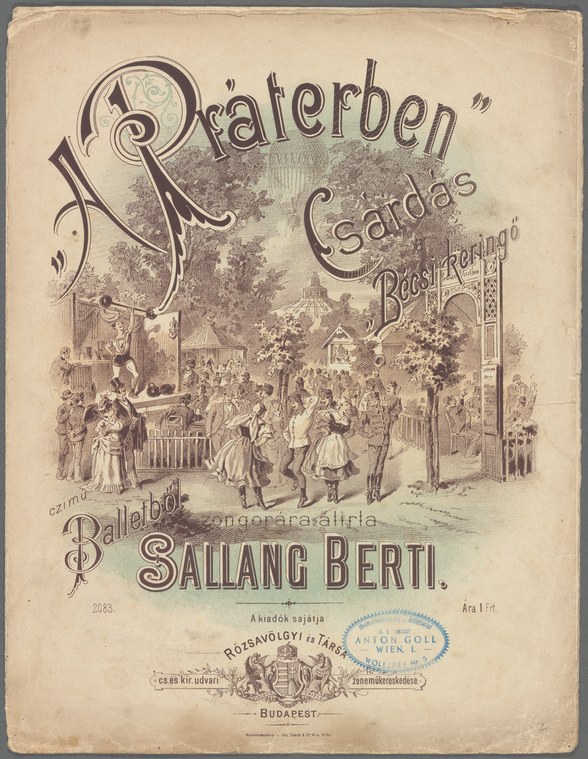
The work provides visual evidence of how the csárdás moved from Hungarian rural culture into European urban ballroom practice—a major 19th-century pattern of dance appropriation and transformation. It also documents the Prater as a dance venue and the waltz as the organizing form of Vienna's public leisure, a relationship that defined European ballroom culture for a century.
What you are looking at
A lively outdoor ballroom scene set in Vienna's Prater gardens, rendered in sepia tones. The composition is divided between foreground dancers and a deeper garden setting: in the immediate view, couples perform in fashionable late 19th-century dress—men in dark suits and women in full skirts—against a backdrop of trees, architectural structures, and crowds of onlookers. The scene captures multiple dance moments simultaneously: pairs in closed ballroom hold dominate the foreground, while the middle and background suggest the continuous social activity of a public garden dance venue. Parasols, top hats, and the density of figures convey the social significance of this public dancing space. The print's title identifies two dances—csárdás and Viennese waltz—both visible in the composition's rhythm.
The dancing
The foreground couples stand in closed ballroom position: bodies angled, the man's right hand on the woman's back, their joined hands held at shoulder height in the frame characteristic of 19th-century Viennese waltz. The women's full skirts are caught mid-movement, suggesting the rotational momentum of the waltz turn. Bodies are upright and formal, with the characteristic épaulement (shoulder carriage) of ballroom dancing of the period. Multiple couples occupy the space, suggesting not isolation but participation in a larger social dance.
The dance depicted
The print advertises two distinct dances: the csárdás (Hungarian folk dance) and the Viennese waltz (Wienerkeringő in Hungarian). The image itself foregrounds the waltz—the couples in the immediate foreground are in waltz position and the setting is Vienna's Prater, the iconic open-air ballroom of Vienna's leisure culture. The csárdás, a slower Hungarian peasant dance with characteristic rhythmic complexity, is likely represented in the background or in the social mix, though the print emphasizes the waltz as the dominant choreographic form. This reflects the late 19th-century absorption of the csárdás into Viennese popular entertainment and ballroom culture.
How it was made
This is a color lithograph (or chromolithograph), a mass-production technique that allowed multiple impressions from stone and the layering of colored inks. The sepia and muted tones suggest chromolithography, which was standard for commercial dance and entertainment prints in the 1880s–1900s. The technique enabled circulation to a broad middle-class audience—this is entertainment advertising and promotional material, not fine art. The publisher's mark (Rozsavölgyi és Társa, Budapest) and the imprint visible at the base indicate Hungarian commercial production, placing this within the Central European popular print industry.
About this work
A chromolithographic advertisement for public dances in Vienna's Prater gardens, showing both the Viennese waltz and the Hungarian csárdás as practiced in late 19th-century Vienna. The print documents a specific moment when the csárdás, long a regional folk form, was being absorbed into the social dance repertoire of metropolitan Europe alongside the increasingly dominant waltz. The image records not a single dance event but a social category: the public garden ballroom as a site of bourgeois leisure, where multiple dance traditions coexisted and performed identity through movement and dress. This is neither high theatrical dancing nor folk performance in its origin context, but rather popular ballroom culture at the threshold of modernity.
How to look at it
Attend first to the foreground couples' closed position and the rotational lines of their bodies—these show the waltz at its characteristic moment of turn. Notice the depth of the composition: the print layers social activity (the couples dancing) against the architectural and natural features of the Prater, suggesting that dancing was one among many activities in this leisure space. The print's title is integral: it names what the image does not make fully legible, confirming that both dances were marketed as coexisting attractions. The fashion—the women's skirts, the men's formal dress—is as much a subject as the movement.
The artist
Unknown artist working in the commercial lithographic industry of Budapest in the late 19th century. The work is promotional material produced by the Rozsavölgyi és Társa publishing house, which specialized in illustrated music and entertainment ephemera. Attribution to a specific artist is not recorded.
The period
In the 1880s–1890s, Vienna's Prater was one of Europe's most famous venues for public ballroom dancing, and the waltz remained its signature dance despite—or because of—new musical and choreographic influences from Eastern Europe. The csárdás, which had become fashionable in Viennese concert music (notably in Brahms and Liszt), was simultaneously being incorporated into ballroom practice. This period saw the peak of the waltz's cultural dominance in Vienna, even as newer dances like the polka and the mazurka competed for attention. The print's dual focus reflects this moment of transition: the Viennese waltz as establishment form and the csárdás as a newly legitimized exotic alternative.
Where it lives
A print from the New York Public Library's collection of prints depicting dance. The work is a commercial chromolithograph produced in Budapest, indicating Central European manufacture and distribution, likely aimed at advertising the Prater's attractions to a Vienna-based middle-class audience or as a souvenir.
Dance in this work
Questions about this work
What is the difference between the Viennese waltz and the csárdás?
The Viennese waltz is a smooth, rotating dance in triple time, danced in a closed position with a continuous flow. The csárdás is a Hungarian folk dance with two distinct sections: a slow, improvisational opening and a faster, more rhythmically complex finale. In this print, the waltz dominates the visual foreground, while the csárdás represents a regional folk tradition that had recently entered fashionable Vienna.
What was the Prater in Vienna?
The Prater was Vienna's largest public park and a major venue for leisure and entertainment. By the late 19th century, open-air ballrooms in the Prater drew large crowds of middle- and working-class dancers. It was famous for its waltz orchestras and its role in making ballroom dancing a public, social activity accessible beyond the aristocracy.
Why would a Hungarian dance be advertised in Vienna?
The csárdás was fashionable among Vienna's cosmopolitan audiences in the late 19th century, partly through its presence in concert music and partly through the cultural diversity of the Austro-Hungarian empire. Marketing both the waltz and the csárdás together suggests they were being offered as complementary attractions, appealing to different tastes and cultural affiliations within the same ballroom audience.
More dance artwork





