49 works in this view — arrow keys or swipe to move between them.
Dance in Art
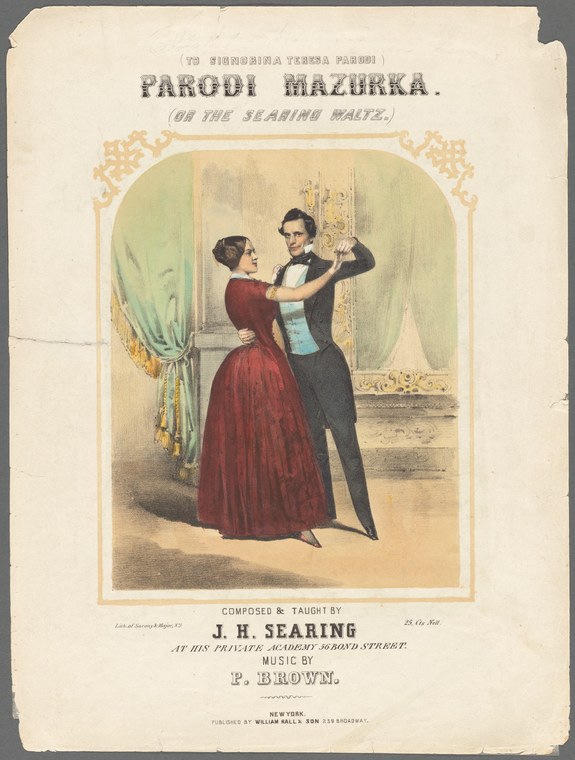
Parodi mazurka (or the Searing waltz) composed & taught by J.H. Searing at his private academy, music by P. Brown
Unknown artist
- Collection:
- Prints depicting dance
- Source:
- New York Public Library
- Rights:
- Public domain — free to use, share and adapt.
- Recorded as:
- Public Domain
This print documents how the mazurka was taught and danced in mid-19th-century America—not as a stage work but as a social practice, learned from printed instruction in private academies. It is evidence of the commercialization of ballroom dance and the role of the dancing master in establishing and enforcing standards of correct partnering and carriage. For dance historians, it shows the visual language used to teach proper frame and posture to students who had no video reference.
What you are looking at
A man in dark formal evening dress—tailcoat, white shirt with collar, and trousers—stands in a drawing room or ballroom with a woman in a crimson silk gown. He supports her right arm with his left hand while his right arm is raised, as if guiding her through a turning movement. The woman leans slightly into the support, her body angled away from him in a graceful curve. Behind them, a window with draped curtains frames a view of moonlit water, suggesting an evening by the sea. The interior is rendered in soft greens and golds; the composition is intimate, focused on the couple's interaction rather than grand spectacle. The artist has chosen a moment of sustained elegance rather than vigorous movement.
The dancing
The couple are in a closed ballroom hold with the man leading and the woman following in a supported turn or sway. His raised right arm and her angled torso suggest a moment of extension and balance within the dance. The woman's posture shows the controlled, elongated carriage typical of 19th-century ballroom dancing—upright spine, engaged core, weight supported by the man's frame. Neither figure shows the pointed toe or lift associated with ballet; the movement appears grounded and horizontal. The two bodies form a unified line of action rather than a static pose.
The dance depicted
This is a mazurka, a Polish couple dance in triple meter that became a fashionable ballroom staple in the 19th century. The title *Parodi Mazurka* suggests this was a published instructional piece, and the subtitle 'or the Searing Waltz' indicates some ambiguity or conflation with waltz technique—common in commercial dance instruction of the period. The image captures the mazurka's characteristic quality of sustained partnered movement with gentle sway and control. The man's guiding arm and the woman's trusting frame suggest instruction or demonstration rather than social dancing; the moonlit setting and romantic tone place this within the parlor-dance tradition where mazurkas were danced as part of an evening's entertainment.
How it was made
This is a hand-colored lithograph or engraving, characteristic of 19th-century dance instruction prints. The soft palette—pale greens, flesh tones, gold highlights, and deep crimsons—and the fine linear work suggest lithography with subsequent hand-coloring. This medium allowed inexpensive mass reproduction, making it ideal for commercial dance instruction materials: a student or household could own multiple prints to study steps and proper carriage. The delicate rendering of fabrics, the careful attention to the couple's positioning, and the romantic framing all mark this as a commercial product designed to sell dance instruction as much as to document actual movement.
About this work
This is a mid-19th-century instructional print for the mazurka, a dance that defined the social ballroom of the Gilded Age. It was composed and taught by J. H. Searing at his private academy in New York and set to music by P. Brown. The image serves as both a visual manual of correct frame, posture, and partnering, and as a marketing document—the romantic scene and elegant figures promise the student that learning this dance will grant entrance to fashionable society. The work sits at the intersection of dance practice and mass-market instruction, a moment when dance manuals shifted from text alone to image-and-text hybrids designed to reach a growing middle-class audience eager for the accomplishments of gentility.
How to look at it
Observe the precision of the man's guiding frame and the woman's responsive posture—this is not a snapshot of movement but a carefully posed demonstration of correct partnering. The moonlit window and romantic setting are deliberate: they sell the dance as an accomplishment that leads to courtship and social success. The artist has chosen a moment of sustained grace rather than a showy step; the emphasis is on how the body should carry itself, not on flashy footwork. Notice how the woman's weight appears centered over the man's support—this was the standard 19th-century ballroom ideal, and the image teaches it through visual example.
The artist
Not recorded. The print was composed and taught by J. H. Searing, a dance instructor with a private academy on Broad Street in New York (as noted on the title). The music was by P. Brown. The artist who drew or lithographed the image is not identified; such commercial dance prints were often produced anonymously by commercial lithography firms under contract to dance masters or music publishers.
The period
The mazurka was a dominant ballroom dance from the 1840s through the 1880s, favored by the European nobility and quickly adopted by American society as a mark of refined taste. Unlike the waltz, which was still somewhat risqué in the early 19th century, the mazurka carried associations with aristocratic Polish tradition and was considered both elegant and morally respectable. The private dancing academy was the primary venue for middle-class dance instruction; public ballrooms existed, but most ballroom dancing occurred in private homes and at subscription assemblies. Searing's academy reflects the growth of professional dance instruction as a business in antebellum and postbellum America.
Where it lives
This is a printed broadside or sheet from the *Prints Depicting Dance* collection held by the New York Public Library. Such prints were typically sold as single sheets or in small packets by music publishers and dancing masters, often to accompany published musical scores of the same dance.
Dance in this work
Questions about this work
What is a mazurka?
A mazurka is a couple dance in triple meter, originally from Poland, that became fashionable in European and American ballrooms from the mid-1800s onward. It is characterized by a distinctive accent pattern and a stately, gliding quality. Unlike the waltz, which involves continuous rotation, the mazurka typically features side-stepping and turning in place, with moments of sustained partnered balance like the one shown in this print.
Why does the title say 'or the Searing Waltz'?
The subtitle reflects the blurred boundaries between ballroom dances in the 19th century, and the commercial practice of renaming or re-branding a dance to appeal to students. Both waltzes and mazurkas involve partnered turning and a romantic mood; Searing may have marketed the same steps or a hybrid version under two names, or the subtitle may indicate that the dance combines mazurka steps with waltz-like sustained turning.
Was this dance performed on stage or only in ballrooms?
The mazurka was primarily a ballroom and salon dance, performed in private homes and at subscription assemblies as part of an evening's social dancing. It did appear in theatrical contexts—particularly in ballet, where choreographers incorporated mazurka steps into romantic and national-dance scenes—but its primary venue and audience was the fashionable ballroom, not the stage.
How would a student have used this print?
A student would have studied the image to learn proper frame, posture, and the partnering relationship. The print would have been used alongside the published musical score and the dancing master's live instruction. It served as a visual reference to be consulted at home, much as a modern dance student might watch a video of a choreographer demonstrating a combination.
More dance artwork





