49 works in this view — arrow keys or swipe to move between them.
Dance in Art
Men dancers and choreographers in prints
Unknown artist
- Collection:
- Prints depicting dance
- Source:
- New York Public Library
- Rights:
- Public domain — free to use, share and adapt.
- Recorded as:
- Public Domain
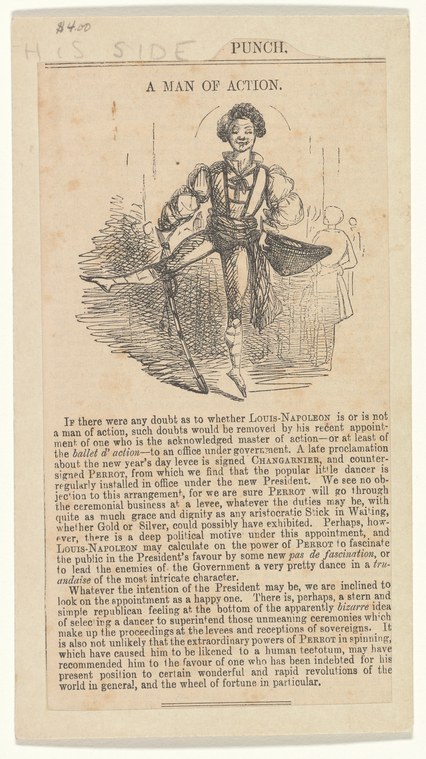
This work is a rare direct image of early 19th-century male theatrical dancing in its social and political context, not as ideal or abstraction but as satirical commentary. It reveals how movement, masculinity, and performance power were understood and mocked in the Georgian print culture that shaped public opinion.
What you are looking at
A single male dancer occupies the center of the composition in a theatrical pose that dominates the print. He wears tailored Regency-era dress: a fitted coat with ornate embroidery or frogging, tight breeches, and what appears to be a decorative sash or belt. His posture is dramatic and active—one leg is bent and raised, the other planted firmly, suggesting mid-movement. His arms are held aloft in an expansive gesture that conveys vitality and control. The figure is rendered in fine linear detail characteristic of engraving, with careful cross-hatching to suggest fabric texture and musculature. The background is lightly sketched with minimal setting—a few figures in the background suggest a drawing room or performance space, but the focus remains entirely on the soloist. The title "A Man of Action" appears above, and substantial printed text fills the lower two-thirds of the page, indicating this is a page from a periodical or satirical publication.
The dancing
The dancer's frame is fully extended and assertive: weight appears to be on the planted leg while the raised knee drives upward dynamically. Both arms are lifted and opened, creating an expansive silhouette. The posture conveys controlled vigor rather than grace—there is a masculine aggression to the pose that matches the title. The body is rendered with anatomical precision, showing musculature and the precise tailoring of high-Regency dress. No partner is present; this is a solo male performance.
The dance depicted
This appears to document a theatrical solo male dance from the early 19th century, likely from a London stage. The Regency-era dress and the satirical framing suggest this may represent a real performer or a type of performance popular in the era. The raised leg and open arm positions do not correspond precisely to any codified ballet technique, suggesting this may be pantomime, theatrical dancing, or the kind of energetic character dance that preceded formalized ballet vocabulary. The print was likely circulated to a broad audience, making the dancer legible as a recognizable public figure or type.
How it was made
This is a copper engraving, identifiable from the fine parallel lines, the precision of the contour, and the characteristic tonal gradation achieved through cross-hatching. The technique allowed for mass reproduction and distribution through periodicals—a key reason satirical and topical imagery of this period survives so abundantly in print. Engraving required significant skill and investment, indicating this dancer or character was considered worthy of that expense; it was not a casual or temporary record but a published commentary on a figure of public interest.
About this work
This engraved page from a 19th-century periodical depicts a male dancer or performer in theatrical dress caught mid-leap or mid-stride, his body fully extended in a pose of dynamic action. The print is titled "A Man of Action" and accompanied by substantial printed commentary, suggesting it functioned as both image and text—likely satirical or editorial in intent. The work documents early 19th-century theatrical performance and masculine movement on the English stage, capturing a moment when dance was transitioning from courtly formality toward more varied and energetic public entertainments. It belongs in a dance history collection both as a record of actual performance practice and as evidence of how dancers and movement were consumed and interpreted by the print-reading public.
How to look at it
Attend to the moment the artist chose to freeze: this is not a posed portrait but a capture of explosive mid-movement, with weight in transition and limbs extended. The precision of the musculature and the clarity of every fold in the coat tell us the artist understood and valued physical detail. The theatrical expansiveness of the pose—the open arms, the raised leg, the forward-facing confidence—reads as both admiring and mocking; this is a figure of power and presence rendered through the conventions of satirical print. The substantial text block below grounds the image in argument, suggesting that the image and text together made an editorial or social point now lost without reading the full caption.
The artist
The artist is not recorded. This page is from the collection of prints depicting dance held by the New York Public Library, suggesting it was significant enough for institutional preservation but not prominent enough to retain clear attribution in modern records. The style and execution are consistent with commercial engraving production for periodicals in the 1810s–1820s.
The period
This engraving dates to an era when theatrical dance in London was dominated by pantomime, comic opera, and balletic spectacle, but when male dancers occupied an ambiguous and often satirized social position. The Regency period saw rapid growth in popular theaters and a corresponding boom in satirical prints targeting performers, fashions, and public figures. The carefully tailored dress and the energetic pose reflect both the actual costume worn on stage and the exaggerated physical type the print culture loved to mock—a figure of theatrical ambition and physical display at a moment when such display was still viewed with suspicion or humor by the educated classes.
Where it lives
Held by the New York Public Library as part of its collection of prints depicting dance. The cataloguing as "Men dancers and choreographers in prints" suggests it was classified thematically by subject matter rather than by artist or publication, a common practice for large institutional print collections. The era label remains unknown, indicating the print's exact date and source publication could not be established with confidence during cataloguing.
Dance in this work
Questions about this work
What kind of dance is this?
The precise dance form is not identifiable from the image alone. The pose does not correspond to codified ballet positions, and the theatrical Regency dress suggests pantomime, comic opera, or character dancing popular on the London stage in the early 1800s. The energetic raised-leg pose and open arm frame suggest a solo male performance designed to display virtuosity and command rather than the refined line of classical ballet.
Was this a real dancer or a caricature?
That cannot be determined from the image. The print's title and the substantial accompanying text suggest it commented on a recognizable public figure or performer, but the satire inherent in the medium and the exaggerated dramatization of the pose mean this is both a record of actual stage practice and a caricatured interpretation of it. The print documents what people saw and how they chose to represent it.
Why is there so much text on this page?
This page is from a periodical—likely a satirical magazine or news publication. The image and text function together as editorial commentary. The engraving would have been accompanied by the printed essay or caption to make its meaning clear to readers. Separating image from text strips away half the work's original impact and purpose.
More dance artwork





