49 works in this view — arrow keys or swipe to move between them.
Dance in Art
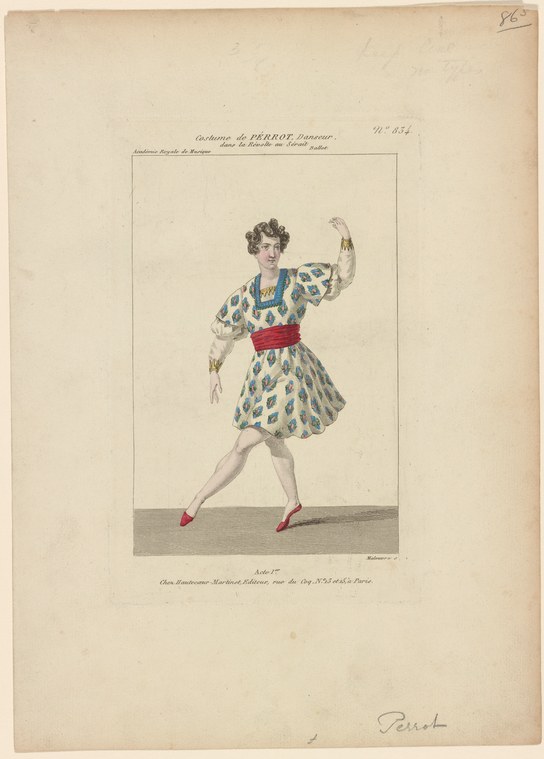
Costume de Pérrot, danseur, dans La révolte au sérail, ballet, act 1er, Académie royale de musique
Unknown artist
- Collection:
- Prints depicting dance
- Source:
- New York Public Library
- Rights:
- Public domain — free to use, share and adapt.
- Recorded as:
- Public Domain
This print is one of the few visual records of how Pierrot was actually danced and costumed in the professional Parisian theater of the early 19th century. For historians of pantomime, commedia dell'arte performance, and theatrical dance beyond the classical ballet canon, such prints are primary evidence of a major performance tradition that is otherwise largely lost to history.
What you are looking at
A solo male dancer in the character of Pierrot stands against a neutral background, caught mid-gesture in a moment of theatrical expression. He wears the traditional costume of the commedia dell'arte figure: a white or cream-colored tunic with a blue-gray patterned fabric (possibly representing scales or diamond shapes) covering the torso and upper arms, creating a distinctive two-toned effect. A deep red or crimson sash cinches the waist. His legs are bare or in flesh-colored hose, and he wears red or crimson slippers. His dark curled hair and pale complexion emphasize the artificiality of the theatrical mask. The dancer's right arm is raised outward in an expressive gesture, palm open, while his left arm extends downward; his weight appears to rest on his right leg while the left is extended, suggesting a moment of dynamic movement or appeal. The composition is a three-quarter figure study set within a simple rectangular frame, emphasizing the clarity of the costume and the precision of the pose.
The dancing
The single dancer demonstrates an open, expansive frame characteristic of early 19th-century pantomime and theatrical dance. The raised right arm with palm opened outward, combined with the extended left leg, creates a diagonal line of energy across the body. The posture is neither fully turned-out in the classical ballet sense nor fully naturalistic; instead, it occupies a middle ground between mime and dance, with the body presented frontally to the audience. The gesture reads as one of expression or entreaty rather than virtuosic movement, suggesting a moment of emotional or comedic punctuation within a narrative.
The dance depicted
This is a costume study for the character of Pierrot in a pantomime-ballet production. Pierrot (also Piero or Pedrolino) was a stock character from the commedia dell'arte tradition who retained immense popularity in French theatrical dance throughout the 18th and 19th centuries. The label identifies this as from *La révolte au sérail* (The Rebellion in the Seraglio), a ballet performed at the Académie royale de musique (the Paris Opéra) with the dancer in the role appearing in Act 1. The movement vocabulary here is decidedly theatrical-gestural rather than balletic—Pierrot was traditionally danced with a mixture of acrobatic, pantomimic, and comic elements, performed in character shoes or soft slippers rather than pointe shoes. The pose captures the character's expressive, often melancholic or comic persona rather than formal classical technique.
How it was made
This is a hand-colored engraving or aquatint, a reproductive print technique that was the standard medium for theatrical documentation and costume publication in early 19th-century Paris. The technique allowed for the precise rendering of costume detail—the patterned fabric, the sash, the careful delineation of drapery—while the hand coloring by a second artisan adds warmth and specificity to the theatrical presentation. This is not a sketch but a finished publication print, likely from a series documenting the performers and characters of the Paris Opéra. The clarity and finish indicate this was created for distribution to patrons, critics, and collectors of theatrical imagery, making it both a record of performance practice and a luxury commodity.
About this work
This is a costume and character study for a male dancer in the role of Pierrot, a centuries-old commedia dell'arte character who was central to French pantomime-ballet tradition. The image documents both the visual spectacle of the role—its distinctive costume with patterned tunic and red accents—and the expressive, non-balletic quality of the performance style. It belongs to a long tradition of theatrical prints that recorded the stars and celebrated roles of the Académie royale de musique and served as mementos of celebrated performances.
The work is valuable not as a record of formal ballet technique but as evidence of an older, more gestural and comedic theatrical tradition that coexisted with classical ballet in the early 19th century. Pierrot dances were hugely popular with audiences but left little written documentation of their movement vocabulary; visual records like this one are crucial to understanding what 19th-century theatrical dance actually looked like beyond the formal classical repertoire.
How to look at it
Observe the pose as a moment of dramatic pause or appeal rather than as ballet in motion. The raised arm and extended leg create a theatrical "attitude" or expressive position, held in a way that addresses the audience directly. Notice that despite the graceful line, there is no sense of classical turn-out or the ethereal weightlessness of Romantic ballet; instead, the dancer remains grounded and characterful, emphasizing personality over pure virtuosity. The detailed costume—the patterned fabric, the vivid sash—was as much a part of the Pierrot tradition as the movement itself; viewers of the period would have recognized the character instantly by dress alone.
The period
In the early decades of the 19th century, the Paris Opéra maintained a dual repertoire: the emerging classical ballet (exemplified by works like *La Sylphide*, 1832) and older pantomime-ballets that drew on commedia dell'arte and Eastern European or Oriental themes. *La révolte au sérail* belongs to the latter category—an exotic pantomime ballet with spectacular costumes and sets. The Pierrot character, though ancient in lineage, was continuously reinvented for new audiences; early 19th-century Pierrot roles combined acrobatic display (tumbling, partnered tricks) with comic or melancholic pantomime. The costume shown here—the patterned tunic and soft slippers—was the standard dress for the character, distinct from the classical ballet dancer's tutu and pointe shoes that were becoming fashionable for female dancers in the same period.
Where it lives
This print is held in the New York Public Library's collection of prints depicting dance. It is part of a substantial archive of theatrical costume prints from the Opéra, created as documentation and mementos for the theater-going public of Paris.
Dance in this work
Questions about this work
What was Pierrot in early 19th-century dance?
Pierrot was a character inherited from Italian commedia dell'arte, perpetually reinvented for new theatrical contexts. In the early 19th-century Parisian Opéra, Pierrot roles combined pantomime, acrobatics, and comedy, performed by male dancers in character costume rather than in classical ballet technique. The character was often melancholic, comic, or roguish, and Pierrot dances were immensely popular with audiences.
How do we know what this dancer actually did on stage?
Prints like this one are among the few visual records we have. Unlike written dance notation (which existed but was rarely used), prints captured both costume and pose. However, a single frozen moment cannot tell us the full vocabulary of movement, speed, or spatial patterning. For that, we must combine costume prints with rare written descriptions, music, and later pantomime traditions that preserved some of Pierrot's repertoire.
Why is this not classical ballet?
Classical ballet—with its emphasis on turn-out, weightlessness, ethereal extension, and abstract movement—was emerging as the dominant theatrical dance form in the 1820s-30s. But older pantomime-ballet traditions, of which Pierrot was a major part, remained popular and employed a different movement vocabulary based on character, narrative, and theatrical expression rather than pure virtuosity.
What does the patterned tunic represent?
The distinctive patterned fabric was the traditional costume of Pierrot, instantly recognizable to audiences. The design—possibly evoking scales or diamond shapes—marked the character visually. Combined with the white or cream base, red sash, and soft slippers, this costume was so standardized that a Pierrot costume could be spotted across a crowded theater.
More dance artwork





