49 works in this view — arrow keys or swipe to move between them.
Dance in Art
Images of ethnic dancing from illustrated books and series
Unknown artist
- Collection:
- Prints depicting dance
- Source:
- New York Public Library
- Rights:
- Public domain — free to use, share and adapt.
- Recorded as:
- Public Domain
This work is crucial for understanding how non-European dance practices were mediated, simplified, and recontextualized for European consumption during the encyclopedic age. It shows us not the dances themselves but how European visual culture represented them—what was selected for emphasis, what was omitted, and what categories were imposed. For dance historians, it is evidence of the circulation and authority of ethnographic imagery in shaping metropolitan understandings of world dance before film and photography became dominant media.
What you are looking at
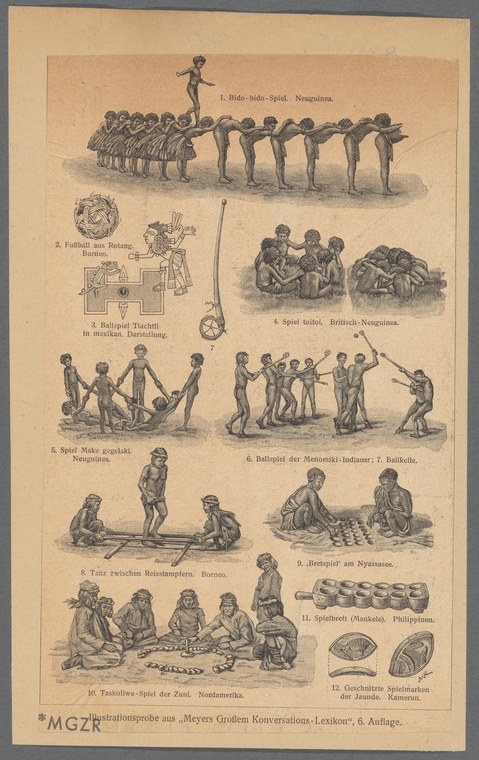
This is a composite anthropological print showing eleven numbered scenes of dance and movement practices from non-European cultures, arranged on a single page in a dense layout typical of 19th-century ethnographic publishing. The scenes depict practices from various regions: scene 1 shows a line of figures in a horizontal human chain or shoulder-hold formation labeled as Negapicos; scene 2 depicts Football am Bolang (football) with figures at play; scene 3 shows a swing or suspended equipment with seated figures; scene 4 presents what appears to be a British Negapicos spiel (game); scene 5 shows figures in a circle or group formation with what may be sticks or props; scene 6 depicts the Ballspiel der Monomini-Indianer (ball game of Monomini Indians); scene 7 shows figures in linear formation appearing to be in motion between two landmarks; scene 8 presents an Aboriginal and Tjurunga scene (likely Australian Aboriginal practice); scene 9 shows Spieldosen (musical boxes or similar devices) with figures; scene 10 depicts Taschenbau-Spiel des Zuni from New Mexico; scene 11 shows Spieloetsel (Mandala-like pattern) from Philippines; scene 12 presents Geschnittene Spielsteine from the Philippines. The entire composition is rendered as an engraving or lithograph on aged paper, with German labeling throughout.
The dancing
The figures throughout are rendered as simplified, schematic forms in profile or three-quarter view. In scene 1, the bodies are arranged horizontally in a line, leaning forward in apparent unison with arms at various angles. Scene 5 shows figures arranged in circular or semi-circular formations with limbs extended, suggesting rhythmic or synchronized movement. The rendering is reductive—bodies are shown without anatomical detail, reduced to essential postures and spatial relationships. The artist's interest is clearly ethnographic classification rather than capturing individual virtuosity or refined technique.
The dance depicted
This is an ethnographic reference plate designed to document and categorize movement practices across colonized and non-colonized populations. The labeling in German suggests it comes from a German-language ethnographic encyclopedia or educational series (the source attribution indicates 'Illustrationsprobe aus Meyers Grossem Konversations-Lexikon,' Meyer's Grand Conversation Lexicon). The image conflates dance, games, play, and ritual movement—categories that European ethnography of the period often treated interchangeably when documenting non-European practices. The emphasis on 'Spiel' (game/play) throughout suggests that European viewers were not expected to distinguish performance dance from children's games or ritual activity. The specific practices named—Australian Aboriginal Tjurunga, Zuni games, Philippine customs—indicate a global scope intended to present these practices as comparable phenomena rather than distinct cultural traditions.
How it was made
This is an engraving or steel-faced engraving, identifiable by the fine parallel hatching used to model form and shadow, the precision of line work, and the uniform gray tone. The technique allowed mass reproduction for encyclopedic circulation, and the condition of the paper (aged tan, showing foxing) suggests this is a late 19th-century or early 20th-century impression from a well-used plate. The density of information and the dense layout are characteristic of reference material designed for consultation rather than contemplative viewing.
About this work
This is an ethnographic reference plate from a late 19th or early 20th-century German encyclopedic source, documenting movement practices across multiple continents and cultures. It represents a moment in European visual culture when dance, games, and ritual were documented side by side as comparable data points in the study of human culture. The work sits at the intersection of dance history, colonial anthropology, and the history of visual reproduction—it is simultaneously a document of actual human practices and a record of how European institutions chose to present and organize those practices for metropolitan audiences. The print embodies the taxonomic impulse of the period: to collect, arrange, label, and render comprehensible.
How to look at it
Notice how the page flattens and equalizes radically different practices—Australian Aboriginal ritual, Philippine crafts, Zuni games, and European football—into a single visual taxonomy. Attend to the simplification of each scene: figures are reduced to posture and arrangement, stripped of costume detail, facial expression, and context. The German labels and numbering system impose order and comparability where none may have existed. This is less a window onto the dances themselves than an artifact of European epistemology—a record of what European systems of knowledge chose to see and how they chose to arrange it.
The period
This print comes from the era of high imperialism and intensive ethnographic collecting (late 1800s–early 1900s), when European museums and publishing houses were systematically documenting colonized peoples. Meyers Konversations-Lexikon was one of the most widely distributed reference works in German-speaking Europe, giving this image considerable reach and authority. At this moment, dance was understood by European ethnographers as a window into 'primitive' or 'savage' social organization—play, ritual, and physical culture were often conflated. Photography and cinematography were just beginning to offer alternatives to engraving for ethnographic documentation, but encyclopedic publishing still relied on these composite plates for their economy and legibility.
Where it lives
This print is held by the New York Public Library in the Prints collection and is identified as coming from Meyer's Grossem Konversations-Lexikon (Meyer's Grand Conversation Lexicon), a major German encyclopedic reference work. It represents the category of ethnographic reference material produced for mass distribution to educated metropolitan audiences.
Dance in this work
Questions about this work
Are these actual dances or inventions?
These likely reference real practices, but the engraver had no direct observation and worked from descriptions or earlier sources. The simplification and standardization tells us more about European categorization systems than about the actual practices. The page treats dance, games, ritual, and crafts as equivalent—a classification that reflects European intellectual frameworks rather than the cultures' own distinctions.
Why are so many cultures shown together on one page?
This compositional strategy was common in encyclopedic publishing: it allowed editors to present human cultural diversity as a comparable, classifiable system. Showing Australian Aboriginal practice beside Philippine crafts beside Zuni games suggests they are equivalent data points in a global survey of human behavior. This flattening is characteristic of 19th-century ethnographic logic.
What does this tell us about how dance was understood in this period?
To European observers of this era, non-European dance was primarily evidence of social organization, ritual function, or primitive entertainment rather than an art form with its own aesthetic traditions. The conflation of dance with games and play reflects an assumption that these practices were undifferentiated expressions of culture rather than distinct genres.
More dance artwork





