49 works in this view — arrow keys or swipe to move between them.
Dance in Art
Das Tanzen
Unknown artist
- Collection:
- Prints depicting dance
- Source:
- New York Public Library
- Rights:
- Public domain — free to use, share and adapt.
- Recorded as:
- Public Domain
The print provides rare visual evidence of how courtly dance was actually performed and valued in the 18th century—not as choreography to be analyzed in isolation, but as a social practice embedded in dress, interior design, and the regulation of aristocratic behavior. For historians of dance, fashion, and social history, it documents the material reality of the minuet and related forms at a moment when they dominated elite European culture.
What you are looking at
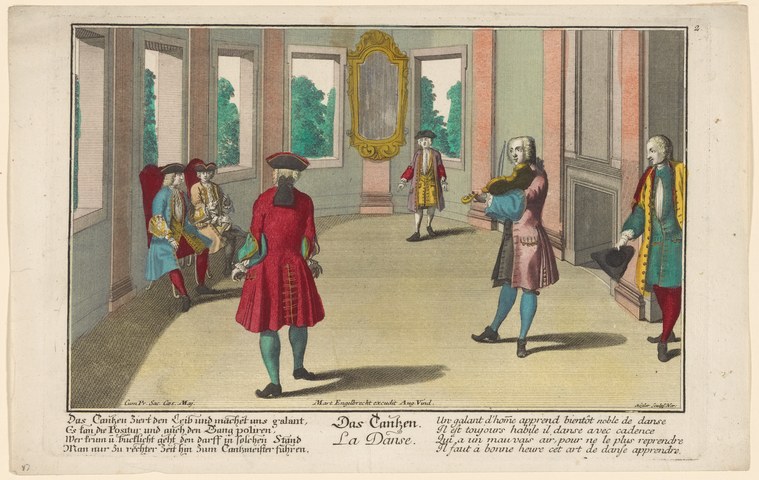
This is a colored engraving depicting an elegant interior dance scene, likely from the 18th century. A spacious hall with pale green and coral walls is lined with tall arched windows framed by dark pilasters; a gilt-framed mirror hangs between the windows. The floor is a pale polished wood. Six figures occupy the space: two couples are dancing in the center and foreground, while two additional figures stand at the sides observing. The dancers wear aristocratic dress—the men in colored coats (red, yellow, gold) with knee breeches, stockings, and formal shoes; the women in full skirts in pink and blue over panniers. A woman in the foreground wears a deep red dress. The light is even and clear, characteristic of a daytime social gathering in a grand house. The mood is formal and controlled, with careful attention to the deportment and spacing of all figures.
The dancing
The foreground shows a woman in deep red in an active turning or pivoting position, arms extended. Behind her, a man in a golden coat faces her, maintaining formal distance and posture. To the left, another couple stands in conversation or waiting positions. A man in a red coat is visible in the middle distance. All figures maintain the upright carriage and controlled arm positions typical of 18th-century courtly dance. The dancers show no partnering in closed holds; instead, they move in the open, face-to-face manner of French court dances, with considerable space between partners.
The dance depicted
This is almost certainly a depiction of French or German court dance of the early to mid-18th century, most likely a minuet or similar baroque courtly form. The engraving's title 'Das Tanzen' (The Dance) and the German text suggest a German context. The formal setting, dress, and the characteristic spacing and facing positions of the dancers—particularly the woman's turning movement and the upright posture of all participants—are consistent with the minuet or a related branle-derived form. The leisurely, processional quality and the emphasis on individual bearing over complex partnering techniques point toward baroque courtly practice.
How it was made
This is a hand-colored engraving, as evidenced by the fine line work defining forms and the careful tonal modeling visible in the architecture and figures. The coloring appears to have been applied after the engraving was printed, a common practice for popular prints of the period. The technique allowed for fine detail in costumes and architectural features, and the inclusion of German text beneath suggests this was created for a German-speaking audience, likely as an instructional or documentary print about courtly behavior and dress. The quality of the engraving indicates a professional workshop rather than a casual amateur effort.
About this work
This hand-colored engraving documents the social practice of aristocratic dance in the early-to-mid 18th century, capturing a moment in a grand drawing room where courtiers demonstrate the minuet or a similar baroque court form. The work is both a record of dance practice and a representation of courtly civility and decorum; the formal spacing, upright posture, and careful execution of movement were central to aristocratic identity. As a German print titled 'Das Tanzen' with accompanying text, it belongs to a tradition of educational and aspirational prints that circulated widely among the European gentry, teaching proper behavior and elegant movement.
The image is valuable not for identifying a specific named dance with certainty, but for showing how such dances were actually executed and valued: as measured, face-to-face interactions between partners in formal dress, performed in domestic or court interiors by people trained from childhood in precise deportment. The engraving's attention to spatial relationships, the restraint of movement, and the equality of male and female participants all reflect the aesthetic ideals of baroque courtly practice.
How to look at it
Notice the distance and formal facing positions maintained between the dancers—this is not the close partnering of later ballroom dance, but the open, reciprocal arrangement of baroque courtly practice. Observe the woman's body position in the foreground: the turn or pivot she executes, the extension of her arms, and the apparent lightness of her movement are all consistent with the minuet's characteristic style. The engraver has chosen to show the dance not as a moment of maximum visual display, but as a moment of ordinary, habitual execution—the dance as a social ritual rather than a theatrical performance. The calm, orderly interior and the formal dress emphasize that this is elite social practice, not entertainment.
The period
The early-to-mid 18th century saw the minuet at the height of its social and aesthetic prestige in France and the Germanic territories. The minuet had evolved from earlier branle forms into a highly refined, slow, and dignified dance that served as a marker of gentility and education. Printed instructional and documentary images of dance and courtly behavior circulated widely in this period, serving both as aspirational models for the rising bourgeoisie and as records of elite practice. German princes and their courts actively promoted French courtly practices, including dance, as a sign of cultural sophistication, making such prints particularly popular in German-speaking regions.
Where it lives
The print is held in the New York Public Library's collection of prints depicting dance. No publisher, engraver, or date is recorded in the catalogue, though the style, dress, and printing technique all suggest production in the German-speaking territories sometime in the first half of the 18th century.
Dance in this work
Questions about this work
What dance is being shown here?
The engraving is titled 'Das Tanzen' (The Dance) and most likely depicts a minuet or a closely related baroque courtly form such as a branle. The formal dress, the interior setting, the spacing between dancers, and their upright posture are all consistent with such dances. However, the engraving does not provide enough choreographic detail to identify a specific named dance with certainty.
Who would have danced like this?
This was the dance of the aristocracy and upper gentry of 18th-century Europe, particularly in France and the Germanic territories. Both men and women danced it, typically after instruction from professional dancing masters. The minuet was considered an essential accomplishment for anyone of rank or pretension.
Why is the spacing so large between the dancers?
Baroque courtly dances such as the minuet did not involve the close partnering of later ballroom forms. Partners faced one another and moved in parallel or reciprocal paths, often at a considerable distance. This open arrangement allowed for the display of individual bearing and execution and was itself a statement of formal propriety.
Is this a painting or a print?
This is a hand-colored engraving. The fine lines visible in the architecture and figures show the work of the engraver's burin, and the colors were applied by hand after printing, a common practice for popular prints of the period.
More dance artwork





