49 works in this view — arrow keys or swipe to move between them.
Dance in Art
Mazurier dans le ballet de Meuniers
Unknown artist
- Collection:
- Prints depicting dance
- Source:
- New York Public Library
- Rights:
- Public domain — free to use, share and adapt.
- Recorded as:
- Public Domain
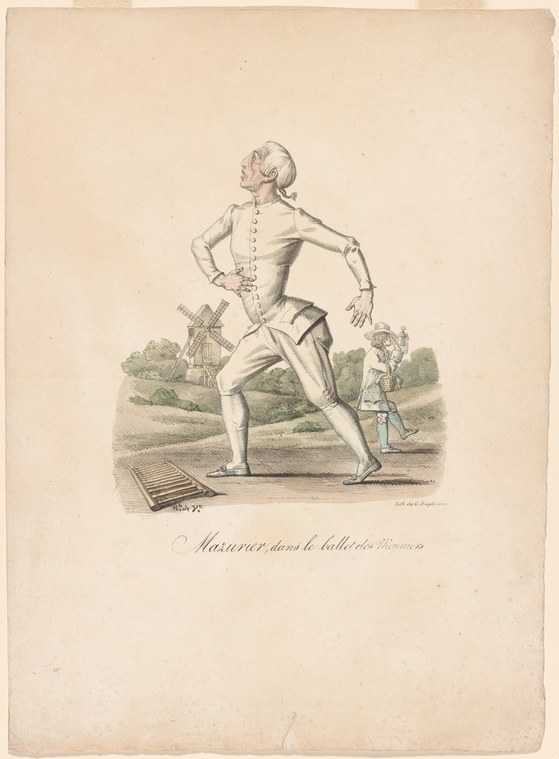
This print is a rare direct visual record of male ballet technique and performance practice in the late eighteenth century, a period when written descriptions of dance far outnumber surviving images. The work shows the technical demands placed on male dancers—the elevation, line, and control—and the formal costume and presentation that marked theatrical dance as distinct from social or popular movement. For dancers and historians, it provides evidence of how a celebrated performer was marketed, presented, and remembered.
What you are looking at
A male dancer in late-eighteenth-century dress performs a dynamic leap or jump in the center of the composition, his body angled in profile, one leg extended behind him and the other bent beneath. He wears a fitted jacket with buttons down the back, breeches, and stockings—the costume of a trained male dancer of the period. His posture is energetic and controlled, the body held upright despite the suspended motion. The setting is a simple landscape with a windmill visible in the middle distance and two smaller figures (one appears to be a woman in a long dress) standing to the right, suggesting a village or rural scene. The foreground includes what may be a bench or piece of stage furniture. The composition emphasizes the dancer's elevation and technical skill, freezing a moment of balletic movement against a naturalistic backdrop that contrasts with the artifice of the pose.
The dancing
The principal figure is a single male dancer captured mid-leap, with his weight clearly projected upward and forward. His torso is erect, his arms are positioned naturally but with control, and his legs show the stretched extension expected of trained ballet technique—the back leg fully extended, the front leg bent. The pose suggests a moment of sustained elevation rather than the peak of a jump; the artist has chosen to show the dancer at a point where control and line are maximally visible. The secondary figures in the landscape are too small and distant to read as dancers themselves; they function as scale reference and narrative context rather than as movement partners.
The dance depicted
The work depicts a male ballet dancer performing what appears to be a jump or allegro movement in the style of late-eighteenth-century theatrical dance. The term 'Mazurier' in the title refers to a celebrated French dancer of that era, and the costume and technique on display are consistent with the vocabulary of ballet de cour and early theatrical ballet. The controlled vertical elevation, the extended line, and the formal stage dress all point to a trained classical dancer executing a technical movement for public performance. The setting suggests either a scene from a ballet d'action or a portrait of the dancer in his performance character rather than a pure portrait.
How it was made
This is a hand-colored engraving or print, evident from the fine linear hatching visible in the background and drapery, the precision of the line work defining the figure, and the application of watercolor or gouache over the printed base. The print has been selectively colored—the landscape has subtle greens and earth tones, while the figure's clothing is left relatively pale to emphasize his form and movement. The technique allowed for relatively inexpensive mass production, making such images accessible to theater-goers and dance enthusiasts, and the presence of color indicates this was a premium or luxury version. The precise, controlled line work is typical of late-eighteenth-century French theatrical portraiture.
About this work
This is a portrait of a celebrated dancer in performance, executed as a hand-colored engraving in the late eighteenth century. It documents both the appearance of a famous performer—Mazurier—and the technical vocabulary of male ballet at a transitional moment in dance history, when the conventions of court dance were being absorbed into the emerging form of theatrical ballet. The work combines portraiture, dance notation in visual form, and theatrical promotion, capturing an instant of balletic technique for a wide audience.
The image belongs to a genre of dancer portraiture that flourished in the late 1700s and early 1800s, particularly in France, where prints of celebrated performers were collected and circulated among theater patrons. Such works served both as souvenirs and as documents of performance practice, allowing viewers who had seen the dancer to recall the exact posture and costume of a memorable moment, and allowing those who had not to experience a sense of the virtuosity on display.
How to look at it
Attend to the precise placement of the dancer's weight and the control implied by the pose. The extended back leg and the upright torso show a dancer at the apex of technique, not at the peak of a jump but at the moment of greatest extension and line. The artist has frozen a split-second that makes the dancer's training visible—the elongation, the turnout, the stability of the upper body. The contrast between the formally posed figure and the landscape setting invites two readings: this is both a portrait of an individual performer and a demonstration of a new physical discipline.
The period
This work dates to the height of the classical ballet tradition in France, during or shortly after the career of Jean-Louis Aumer and the later years of Jean-Georges Noverre's influence. The late eighteenth century saw the formalization of ballet technique, the rise of the professional ballet dancer as a public figure, and the increasing circulation of prints documenting famous performers. Male dancers held significant status in this period, and leading male performers were celebrated in portraiture and prints as celebrities. The work reflects the conventions of theatrical promotion and the appetite for dance images among urban audiences.
The costume shown here—the fitted jacket, breeches, and stockings—represents the male ballet dress of the period, distinct from the tunics and tights of later Romantic ballet. The rural or village setting in the background is unusual and may reference a specific ballet d'action, or may be a generic pastoral frame chosen for aesthetic contrast to the formality of the figure.
Where it lives
This print is held in the Library's collection of prints depicting dance, part of their broader holdings of dance history materials. The work is a commercial theatrical print, likely issued for sale to theater-goers and collected as a souvenir of performance.
Dance in this work
Questions about this work
Who was Mazurier and why is this print of him important?
Mazurier was a celebrated male dancer of the late eighteenth century, a period when France dominated European ballet. Male dancers held high professional status and were celebrated as virtuosi. This print documents not only the appearance of a famous performer but also the technical demands and formal presentation of theatrical dance in the period immediately before Romantic ballet. It is one of few visual records of how a leading dancer of the age was posed and presented to the public.
What dance is he performing?
The specific dance cannot be identified from the image alone. The title references 'ballet de Meuniers,' which may be the name of a specific work or role, but without additional documentation, we cannot say what choreography is being represented. The movement shown is a standard male ballet technique—an elevated jump or allegro movement—performed in the formal costume and style of late-eighteenth-century theatrical dance.
Why is he set in a landscape rather than on a stage?
The pastoral or village setting may reference the narrative of a specific ballet d'action, or it may be a generic romantic frame chosen to elevate the subject. It was common in theatrical portraiture of the period to place the figure in a landscape or architectural setting that suggested the character or context of their performance rather than showing them in a bare studio or stage space.
More dance artwork





