49 works in this view — arrow keys or swipe to move between them.
Dance in Art
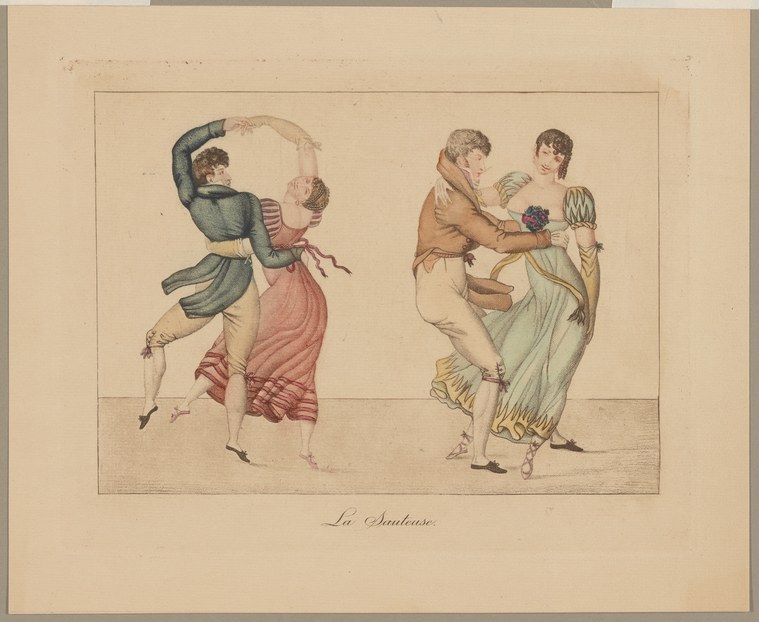
La Sauteuse
Unknown artist
- Collection:
- Prints depicting dance
- Source:
- New York Public Library
- Rights:
- Public domain — free to use, share and adapt.
- Recorded as:
- Public Domain
This image documents a specific, named ballroom figure at a moment when such dances were being systematized and published as fashionable entertainment for the elite. It shows that early 19th-century ballroom technique included supported lifts and dramatic body displays—a fact often overlooked in histories that separate ballroom from theatrical dance. The print's circulation as instruction material reveals how dance was transmitted visually and commercially during the Regency era.
What you are looking at
Two pairs of dancers occupy a shallow, neutral stage space rendered in soft washes of tan and gray. On the left, a man in a dark blue-green coat with red breeches lifts a woman in a pink gown; her body arches backward dynamically, one leg extended, her arms raised. On the right, a man in a tan coat and cream breeches similarly supports a woman in a pale yellow-green gown, her frame also arched and elevated. Both women wear their hair up in the Regency style, and both pairs are captured mid-lift, their bodies forming mirror-image curves. The composition is intimate and theatrical—the neutral background focuses all attention on the lifted bodies and the precise geometry of the poses. The hand-coloring in delicate washes of watercolor gives the print a refined, almost intimate quality despite its celebratory subject.
The dancing
Both dancers in each pair demonstrate a classical supported lift: the man's arms are positioned to bear the woman's weight across his torso, while each woman's body curves away from her partner in a dramatic arch or swoon. The women's arms are raised and extended; their legs are extended or bent expressively. The poses suggest control and partnership—this is not rough or comedic but elegant and choreographed. The symmetry of the two pairs suggests this is a demonstration of a named figure or technique rather than a snapshot of social dancing.
The dance depicted
The print depicts what is almost certainly a figure from Regency-era ballroom dance, most likely a moment from the cotillion or quadrille in which a male dancer supports and displays his partner in an elevated or arched position. The title "La Sauteuse" (The Jumper or The Leaper) suggests the emphasis is on the lifted, airborne quality of the movement. The style and precision of the pose—the woman's elongated body line, the formal support—aligns with theatrical ballroom display dances of the early 19th century. The pairing of two identical couples implies this is instruction or demonstration material, showing the correct execution of a fashionable figure.
How it was made
This is a hand-colored engraving or aquatint, likely French, from the early 19th century. The linear precision of the figures and the delicate watercolor washes suggest a professional print intended for circulation among the dancing public—such prints served both as fashion plates and as dance instruction. The refinement of the hand-coloring and the care taken with the figures' faces and dress indicate this was aimed at a genteel audience. The technique allowed for both the precise anatomical rendering needed for instruction and the artistic finish that made it a collectable commodity.
About this work
This hand-colored engraving depicts a Regency-era ballroom figure in which a male dancer lifts and displays his female partner in an arched, suspended pose. The title "La Sauteuse" suggests the figure emphasized elevation and the illusion of weightlessness. Two pairs demonstrate the movement symmetrically, a convention of dance instruction prints that allowed viewers to understand the position from multiple viewpoints. The work sits within the tradition of early 19th-century French dance prints, which functioned as both fashion illustration and technical documentation. It demonstrates how ballroom dance in this period was theatrical, formally choreographed, and sufficiently codified to merit publication and instruction.
How to look at it
Attend to the moment of suspension: both women are caught at the apex of their lift, their bodies fully extended and arched away from their partners. This is not a moment of active movement but of achieved form—the artist has frozen the position at which the figure is complete and visible. The symmetry of the two pairs is intentional; it allows the viewer to confirm the correctness of the position from multiple angles, as though reading a diagram. Notice the precision of the hand placement and the elongation of the women's bodies—these are markers of trained, fashionable movement, not improvised partnering.
The period
The print dates to the Regency or early Restoration period in France (roughly 1810–1830), when ballroom dancing was undergoing rapid codification and commercialization. Dance instruction prints, often with French titles and produced by Parisian engravers, flooded the European market; they served both as fashion documents and as technical manuals for the aspiring amateur dancer. The cotillion and quadrille were the dominant forms, often featuring elaborate figures with named steps and positions. Theatrical elements—lifts, arches, display—were increasingly absorbed into fashionable ballroom practice, blurring the boundary between social and staged dance.
Where it lives
The work is held in the New York Public Library's collection of prints depicting dance. It is an example of the commercial instruction-and-fashion print market that flourished in early 19th-century Europe, particularly in France.
Dance in this work
Questions about this work
What does 'La Sauteuse' mean?
Sauteuse means 'the female jumper' or 'the leaper'—it emphasizes the woman's elevation and the suspended, airborne quality of the pose. The title suggests the figure's appeal lay in creating the illusion of weightlessness and display.
Is this social dancing or performance?
It is ballroom dancing designed to be theatrical and display-oriented. Early 19th-century ballroom dance, especially among the elite, incorporated choreographed figures with dramatic elements like lifts and arches. This was fashionable social dance, but it was highly formalized and performative.
What is the purpose of showing two pairs?
Showing the figure twice allows the viewer—who may be learning from the print—to see it from different angles and confirm its correctness. This is a common convention in dance instruction material, offering clarity and reassurance.
How do we know this is French or Regency-era?
The French title, the style of dress (high-waisted gowns, Regency silhouette), the men's tailoring, the hair styles, and the technique of the hand-colored engraving all point to French production in the early 19th century. The aesthetic and subject matter align with known Parisian dance print production of this era.
More dance artwork





