49 works in this view — arrow keys or swipe to move between them.
Dance in Art
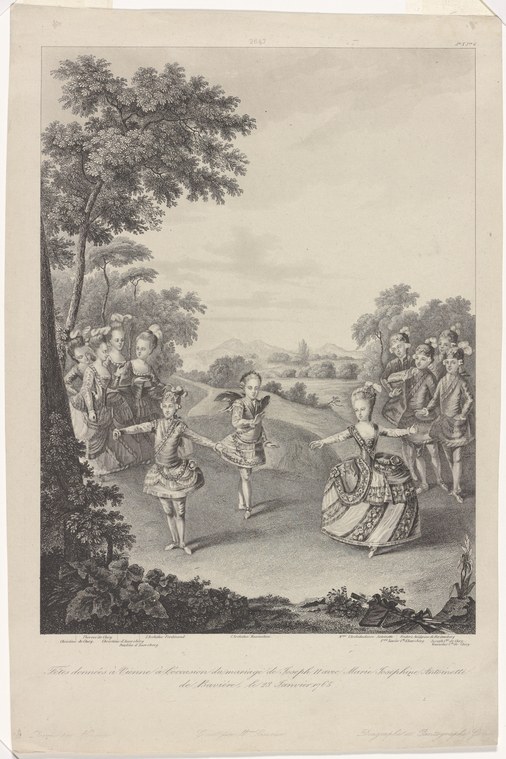
Fêtes données à Vienne à l'occasion du mariage de Joseph II avec Marie Josephine Antoinette de Baviére, le 23 Janvier 1765
Unknown artist
- Collection:
- Prints depicting dance
- Source:
- New York Public Library
- Rights:
- Public domain — free to use, share and adapt.
- Recorded as:
- Public Domain
This engraving is one of the few surviving visual records of actual imperial court dancing in the 18th century, documenting both the formal movements and the ceremonial context in which the minuet functioned. It shows the physical reality of courtly dance—the posture, the spatial relationships, the costume—rather than an idealized or theoretical account. For historians of dance, it is a rare opportunity to see how the prescribed minuet actually looked in performance, and to understand the scale and formality of the occasions on which it was danced.
What you are looking at
An engraved scene of aristocratic dancers performing outdoors in a formal garden setting, evidently celebrating an imperial marriage. The composition is divided into three spatial zones: a large tree dominates the left foreground, a cleared dancing ground occupies the center, and a group of courtiers stands watching on the right. In the middle distance, a landscape of fields and distant buildings (suggesting Vienna) stretches beneath a clouded sky. The dancers wear richly embroidered court dress—the women in wide panniers and corseted gowns, the men in knee breeches and decorated coats. At least two couples are visible in active movement: one pair in the center foreground appears to be executing a courtly step or turn, while others stand in formal positions. The engraving technique renders the foliage of the tree and distant architecture with fine parallel lines, creating atmosphere and depth. The scene captures a moment of ceremonial social dancing, the kind that would have concluded a formal court entertainment in the 18th century.
The dancing
The dancers maintain the upright, composed frame characteristic of Baroque courtly dance. Their posture is formal and constrained by their costume; the women's extreme width at the hip from their panniers affects the range of lateral movement, while their high waistlines and tight corseting enforce an elevated carriage. The visible dancers appear to be executing small, controlled steps rather than vigorous motion—weight held forward, feet in turned positions. There is no evidence of contact hold between couples; instead, dancers relate through spatial arrangement and mutual orientation. One male dancer in the center ground appears to be executing a gesture or révérence (formal salute). The overall effect is one of decorous restraint and geometric precision, entirely consistent with the courtly dance vocabulary of the 1760s.
The dance depicted
This almost certainly depicts a minuet or related courtly processional dance—the formal vocabulary of aristocratic festivity in 18th-century Vienna. The title identifies the occasion (Joseph II's marriage to Marie Josepha of Bavaria, 23 January 1765) and the location (Vienna), both consistent with court dance as the centerpiece of imperial celebration. The minuet was the dominant social and ceremonial dance form of the period; it would have been performed by the imperial couple themselves, by nobles in order of rank, and by invited guests. The garden setting, formal dress, and composed demeanor of the figures all align with documented practice: imperial marriages were celebrated with elaborate balls and garden fêtes that included choreographed minuets. The engraving likely documents (or commemorates) an actual event, though the degree of naturalism should not be overstated—court artists conventionalized such scenes. The small, measured steps and upright carriage visible here are exactly what contemporary dance masters prescribed.
How it was made
This is an engraving, identifiable by the fine parallel hatching used to suggest shadow, volume, and atmosphere—particularly visible in the tree foliage and distant landscape. The technique allowed for mass production and circulation; this print would have been issued as a commemorative document of the imperial wedding festivities, reaching a court audience and possibly a broader educated public across Europe. Engravings were the dominant medium for documenting court ceremonies and courtly pleasures in this period. The composition shows sophisticated spatial construction, with atmospheric perspective in the distant view and carefully balanced grouping of figures—likely the work of a professional court artist or a publishing house with court connections. The title appears in italic script at the bottom, identifying both the event and (implicitly) its cultural significance.
About this work
A formal engraved commemoration of dancers performing during the marriage celebrations of Joseph II of Austria, 23 January 1765. The work documents courtly social dance in its most regulated form—the minuet and its variants—as performed in an imperial garden in Vienna. The print captures not an instant of improvisation but a carefully orchestrated ceremonial moment, with aristocratic dancers in formal dress executing the measured, geometric vocabulary prescribed by contemporary dance masters. This is a historical document as much as a work of art: it records what counted as dancing at the highest levels of European court culture, and how such dancing was understood as a marker of imperial power and social order.
The engraving belongs to a large body of 18th-century print culture devoted to court spectacle and aristocratic life. It was likely issued by a Viennese print publisher to commemorate the wedding and to circulate the image of imperial magnificence to a broader audience. For dancers and historians, it is evidence of the minuet's centrality to court ceremony, the physical constraints imposed by formal dress, and the role of dancing in the performance of dynastic power.
How to look at it
Attend to the posture and arm positions of the dancers: notice how upright and constrained they are, how the women's extremely wide hips (from panniers) determine the angle at which they can turn, how the men maintain a formal, measured stance. Look at the spacing: dancers are not in contact hold but arranged in geometric patterns, relating to one another through sight lines and mirrored positions rather than physical connection. Observe the moment chosen—this is neither the moment of maximum extension nor of vigorous motion, but a moment of composed dignity, suggesting that courtly decorum mattered more than dynamic movement. The tree and garden setting, though prominent in the composition, are secondary to the human figures; the engraver has made the dancers the visual and ceremonial center, with landscape as supporting frame.
The period
The minuet dominated European court dancing from the late 17th century through the 1780s, and it remained the ceremonial centerpiece of imperial court life even as newer dances (the contredanse, the German) gained popularity in ballrooms. The year 1765 falls near the peak of the minuet's prestige: it was the dance performed first at any ball, the dance used to open imperial ceremonies, and the dance in which rank and status were most visibly encoded. Joseph II's marriage was a major dynastic event, linking the Austrian Habsburgs to the Bavarian line; the attendant festivities, including the court ball and garden fête, were opportunities to display imperial splendor and proper order through dance. The engraving belongs to a wider 18th-century culture of print documentation of court spectacles—weddings, coronations, state visits—in which dance featured prominently. The formal, linear engraving style was itself a marker of official significance and courtly audience.
Where it lives
The work is held in the Prints collection of the New York Public Library, catalogued under 'Prints depicting dance'. It is one of many 18th-century engravings documenting court ceremonies and courtly entertainments, likely issued by a Viennese printer in the months following the wedding to commemorate the event and to circulate an image of imperial magnificence.
Dance in this work
Questions about this work
Is this a real dance, or an imaginary scene?
It documents a real historical event—the wedding festivities of Joseph II in Vienna, January 1765. The dances depicted were actual court minuets and related courtly forms, performed on this occasion. However, as with all engraved commemorations, the artist has composed and idealized the scene; it is not a photographic record, but rather a formal, ceremonial representation of what such dancing looked like.
What dance are they doing?
Almost certainly a minuet or a closely related courtly processional dance. The formal dress, upright carriage, measured steps, and geometric spacing are all characteristic of the minuet vocabulary. The minuet was the opening dance at imperial balls and the dance used for the most ceremonial occasions, making it the natural choice for an imperial wedding celebration.
Why are the women's hips so wide?
They are wearing panniers—a framework of hoops or whalebone worn under the skirts to create a distinctive silhouette that was fashionable in the 1760s. Panniers were a defining feature of formal court dress for women and significantly restricted lateral movement, forcing dancers to move forward and back rather than side to side. This constraint shaped the physical vocabulary of courtly dance.
How do I know this is an engraving?
The technique is identifiable by the parallel hatching lines used to create shadow, volume, and atmospheric effect—visible especially in the foliage of the large tree and the distant landscape. This linear technique was characteristic of copper-plate engraving, the dominant print medium for commemorative and documentary works in the 18th century.
More dance artwork





