49 works in this view — arrow keys or swipe to move between them.
Dance in Art
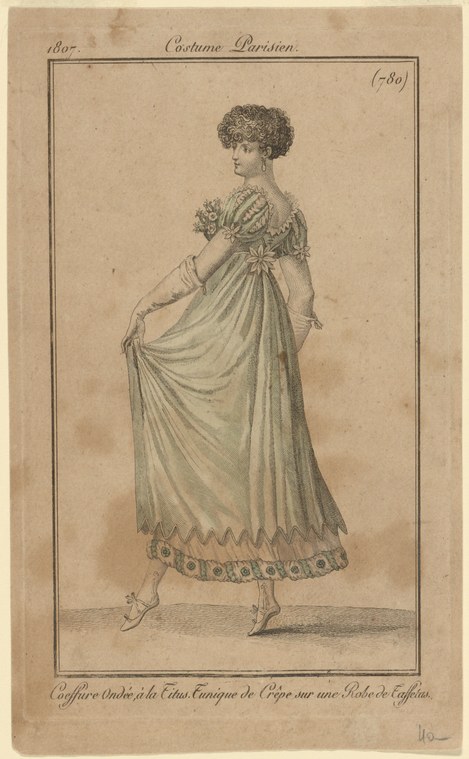
Costume Parisien.: Coeffure ondée, à la Titus. Tunique de crêpe sur une robe de taffetas
Unknown artist
- Collection:
- Prints depicting dance
- Source:
- New York Public Library
- Rights:
- Public domain — free to use, share and adapt.
- Recorded as:
- Public Domain
This image preserves how elite female bodies were dressed for dancing during the shift from Baroque to Regency fashion—a moment when neoclassical reference became the dominant aesthetic, and when women's bodies in dance were increasingly silhouetted in high-waisted, slim column gowns that allowed the lower body far greater mobility than the stiff corsetry of the previous century. For historians of both fashion and dance, it documents the material conditions of movement: this is what the body wore when the waltz arrived in Paris, and how contemporaries understood and circulated that costume as fashionable.
What you are looking at
A single female figure stands in three-quarter view against a plain ground, her body turned slightly to the left. She wears a high-waisted empire-line gown of the Regency period, rendered in fine line engraving with subtle cross-hatching to suggest the drape of lightweight fabric. The dress falls in vertical pleats from beneath the bust, creating a columnar silhouette that extends to her ankles. At the hem, an ornamental border of repeated geometric or foliate motifs (possibly Greek key or anthemion pattern) adds classical detail. Her short puffed sleeves sit low on the shoulders in the Grecian mode, leaving the upper arm bare. The figure's hair is arranged high on her head in the Titus crop—short, curled closely to the skull in the manner of classical Roman sculpture—and she holds a small cluster of flowers at her chest. The composition is frontal and still, presenting the garment as if for a fashion plate or costume documentation. The printing is clean and monochromatic, with the artist's mark visible at the bottom right.
The dancing
The dancer—if she is one—is in a standing pose of stillness rather than action, neither in motion nor engaged with a partner. Her weight appears evenly distributed on both feet. One arm hangs at her side, holding the drapery of the skirt; the other arm crosses her body at chest height, holding flowers. There is no visible turn-out or active positioning of the feet. The posture is upright and frontal, the bearing dignified rather than dynamic. The figure presents herself to view as a display of fashionable costume rather than as a moving body.
The dance depicted
This is a fashion plate rather than a depiction of dancing. The title identifies it as a Parisian costume—a muslin tunic worn over a taffeta slip—documented for the record as fashionable dress during the Regency era (c. 1805–1815). The Titus coiffure and high waistline are neoclassical references fashionable among progressive Parisian society during the Consulate and Empire periods. If this garment was worn for dancing—and Regency ladies' gowns were designed for ballroom wear—no evidence of the dance itself appears in this image. The figure is posed as a standing model, not in the act of moving, turning, or holding a partner.
How it was made
This is a hand-colored or partially colored engraving, likely aquatinted or stipple-engraved to achieve the soft gradations visible in the folds and the figure's face. The technique allows for the fine linear detail in the pleating and ornament at the hem, and for the subtle modeling of form through parallel lines and cross-hatching. The delicate line work and refined execution suggest this was produced for a fashion journal or a series of costume plates circulating among the Parisian elite—expensive enough to reach wealthy subscribers, yet reproducible in quantity. The date mark (1807) and the French inscription confirm this as a contemporary document of elite Parisian fashion during Napoleon's reign.
About this work
This is a fashion plate from a Parisian journal documenting the high-waisted, neoclassically-inspired dress that dominated elite female fashion during the Regency period. The figure wears a muslin tunic in the Grecian manner—the silhouette that defined early-19th-century ballroom dress in Paris, London, and across Europe. Although the costume was made for dancing, the image itself shows the garment as a static display of fashion rather than as a body in motion. It belongs in a gallery of dance imagery because the dress is inseparable from the dance practices of its era: this is what a Regency woman wore to waltz, to quadrille, to cotillion. The Titus crop and the neoclassical references were markers of fashionable modernity and revolutionary sentiment, worn by women who danced in circles that valued aesthetic innovation. The print is a document of how dance bodies were dressed and how that dress was recorded for circulation among those who followed fashion.
How to look at it
Look at the silhouette: the high, almost horizontal waistline directly under the bust, and the way the fabric falls in simple vertical pleats rather than the gathered, structured skirts of earlier decades. The Titus crop is deliberate—a classical reference that was read as politically progressive and aesthetically modern. The bare shoulder and short puffed sleeve are innovations that freed the arm for movement in the waltz hold. The small flowers held at the bodice are a period detail, often included in fashion plates as a marker of refined taste. The formal frontality of the pose—the costume display attitude—was the convention of fashion documentation; it allowed the viewer to read the cut and construction of the garment without the distraction of movement.
The period
This print was made during the Consulate and early Empire (1799–1815), when neoclassical aesthetics dominated elite European taste following the French Revolution. The turn toward Grecian dress—high waists, minimal corseting, lightweight fabrics—was a deliberate break from ancien régime fashion, reflecting both classical scholarship and revolutionary ideology. During this same period, the waltz arrived in Paris from Vienna and the Germanic territories, causing moral scandal and fascination in equal measure. The women who wore these dresses were dancing in transformed ballroom spaces: the cotillion, minuet, and quadrille remained dominant, but the waltz's closed hold and spinning motion were beginning to reshape how bodies moved together. Fashion plates served as the primary medium for circulating knowledge of dress before photography; they were read by seamstresses, wealthy clients, and fashionable aspirants across Europe. This print's presence in the New York Public Library collection suggests it was valued as a historical document of costume from the moment of its making.
Where it lives
This print is held in the New York Public Library's collection of prints depicting dance. It bears a date mark of 1807 and a record number visible on the image. The inscription is in French and identifies it as a Paris fashion plate from the journal Costume Parisien.
Dance in this work
Questions about this work
Why is this in a dance gallery if nobody is dancing?
This dress was made for dancing—for the ballroom of the Regency period. Fashion plates document how dance bodies were dressed and how that costume was understood by the elite women who wore it. The high waist, short sleeves, and lightweight fabric are all innovations that made the waltz and the cotillion possible. To understand how people danced, historians need to know what they wore.
What does the Titus crop tell us?
It was a radical choice in 1807, a classical reference that marked the wearer as educated, modern, and aware of revolutionary aesthetics. In court dance, an elegant head was as important as an elegant body, and coiffure was documented in fashion plates as carefully as dress. The Titus crop implied that the woman wearing it valued classical learning and contemporary fashion over the elaborate, heavily powdered hairstyles of the previous generation.
Could you actually dance in a dress like this?
Yes—far more easily than in 18th-century fashion. The high waist freed the hip and leg from the rigid structures of stays and panniers. The lightweight muslin and simple draping allowed the fabric to follow the body's movement rather than constrain it. This is precisely why wealthy women were willing to abandon the elaborate dress of their mothers: the new silhouette enabled the new dances, particularly the waltz's spinning motion.
More dance artwork





