49 works in this view — arrow keys or swipe to move between them.
Dance in Art
La jolie fille de Gand: quadrille, facile et brillant
Unknown artist
- Collection:
- Prints depicting dance
- Source:
- New York Public Library
- Rights:
- Public domain — free to use, share and adapt.
- Recorded as:
- Public Domain
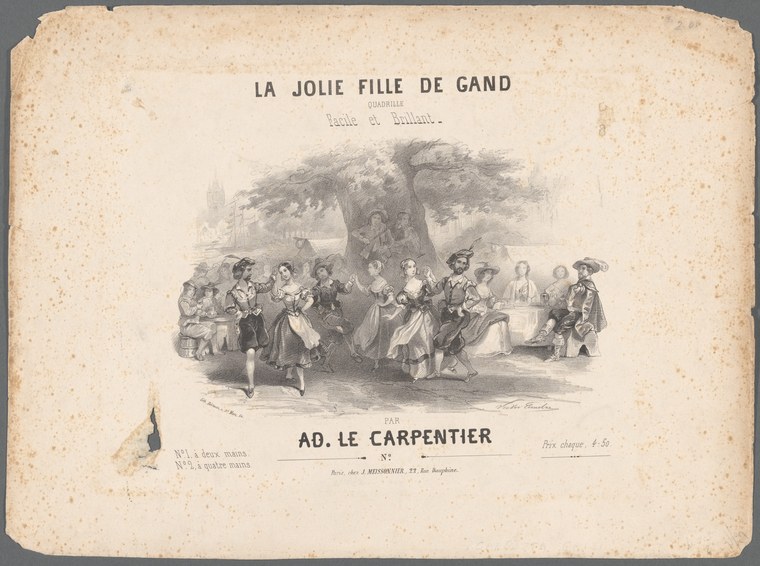
The quadrille was central to 19th-century social life and to the emergence of standardised ballroom dancing; images like this are rare visual evidence of how the dance was actually performed and who danced it. The engraving documents both the physical form—the holds, the spatial arrangement, the dress—and the social context, showing dance as a public leisure activity rather than a theatrical spectacle.
What you are looking at
A lively outdoor gathering beneath a massive, gnarled tree that dominates the composition. A group of roughly a dozen fashionably dressed figures in 19th-century clothing are arranged in a social dance formation, some standing, others in motion. The women wear long full skirts and bonnets or hats; the men are in tailcoats and hats. The scene captures a moment of coordinated social movement rather than a staged performance—this is ballroom dance transplanted to nature. The tree's trunk is rendered with dramatic shadow, creating depth and framing the dancers within its protective canopy. In the background, a small building or pavilion is visible, suggesting this may be taking place at a fashionable resort or garden venue. The engraving technique creates a delicate play of light and shadow across the figures and foliage.
The dancing
The dancers are distributed across the foreground in the closed and open holds characteristic of quadrille formation. Several couples face each other or stand side-by-side in the squared-off arrangement the dance requires, with arms extended to partners or held at the sides. The postures are upright and formal, the women's full skirts suggesting considerable fabric in motion. A few figures appear to be executing the characteristic side-stepping or turning movements of the quadrille. The composition is intentionally balanced rather than naturalistic—the artist has arranged the group to show multiple couples simultaneously, allowing the viewer to understand the dance's geometric structure.
The dance depicted
This is unmistakably a quadrille, a figure dance that was the dominant social ballroom form of the 19th century and remained extremely popular throughout the Gilded Age. The title *La jolie fille de Gand* (The Pretty Girl of Ghent) is a known quadrille air or tune, indicating this illustrates a specific, named dance rather than a generic scene. Quadrilles were performed by four couples arranged in a square, executing a precise sequence of figures to lively instrumental music. The image captures the social context in which this dance thrived: outdoors at a resort or garden party, among fashionably dressed members of the leisure class. The woman at or near the center of the composition may represent the "jolie fille" of the title.
How it was made
This is an engraving, likely a wood engraving or steel engraving given the fine parallel hatching and crisp line work. The technique was ideal for reproducing dance images in the sheet music market and popular prints of the era, allowing multiple impressions to be distributed widely. The delicate cross-hatching creates volume and shadow on the tree trunk and foliage while keeping the dancers' figures relatively light and clear. This was a standard commercial technique for dance instruction and social documentation in the mid-19th century, suggesting the image had practical currency: it could accompany the published music or serve as a visual guide to the formation.
About this work
This is a commercial dance engraving from the mid-19th century, illustrating a quadrille set to the tune 'La jolie fille de Gand.' It belongs to a large body of published sheet music covers, dance instruction prints, and popular engravings that documented the social dances of the Victorian era. The image is valuable not primarily as a work of fine art but as a historical record of how quadrilles were experienced in fashionable society—outdoors, in mixed company, as a choreographed but still social form of entertainment. The outdoor garden setting, the careful rendering of contemporary dress, and the legible dance formation all serve documentary purposes alongside aesthetic ones.
The work sits at the intersection of commercial publishing, dance pedagogy, and social history. It records a moment when the quadrille was a marker of respectability and social standing, danced by amateurs in public spaces. The artist (unknown) was one of many commercial engravers working in the mid-century music and print trade, producing instructional and aspirational images for a middle-class audience.
How to look at it
Look first at the spatial arrangement: the dancers are not randomly placed but occupy the four corners and sides of an invisible square, the fundamental geometry of the quadrille. Notice how the artist has rendered several couples in different phases of the dance—some facing each other, some in profile—to communicate the sequential nature of the figures. The women's skirts, though still rendered in outline rather than with the photographic literalism later engravers achieved, show the volume and weight of mid-century fashion. The tree serves both as framing device and as a sign of the social occasion—this is leisure, not labour. The formal dress and composed postures signal that this is respectable society at play.
The period
The quadrille emerged in France in the 1780s and became the dominant social dance form across Europe and North America for nearly a century. By the time this print was made in the mid-19th century, the quadrille was at the height of its popularity and respectability—it was taught in dance schools, performed at balls and garden parties, and accompanied by published music and instruction prints. The Gilded Age saw a proliferation of such commercial dance prints, both as sheet music covers and as standalone instructional or souvenir images. The outdoor garden setting reflects the mid-century rise of leisure culture and the public dance venue. Simultaneously, Romantic ballet was establishing itself as the dominant theatrical dance form, but social dancing remained the experience of the vast majority of people.
Where it lives
The work is held in the New York Public Library's collection of prints depicting dance. It appears to be a commercial engraving from sheet music or a dance instruction context, rather than a fine art print, and would likely have been produced and distributed in multiple copies.
Dance in this work
Questions about this work
What is a quadrille?
A quadrille is a figure dance for four couples arranged in a square, popular from the 1780s through the 19th century. Each couple performs a sequence of choreographed movements—forward, back, side-steps, turns, and promenades—in time with instrumental music. It was a social dance, not a theatrical one, and was performed at balls, assemblies, and private parties by amateurs.
What does the title 'La jolie fille de Gand' mean?
It translates as 'The Pretty Girl of Ghent.' This was a specific, named quadrille tune and choreography, published and performed throughout the 19th century. Named quadrilles were very common; composers and dance masters would publish new ones regularly, and they often had romantic or local titles.
Why is this engraved rather than painted?
Engraving was the standard technique for reproducing dance images in commercial sheet music and popular prints during the 19th century. It allowed multiple copies to be printed inexpensively, making dance instruction and documentation available to a wide middle-class audience. Fine art paintings of dance existed, but commercial prints like this reached far more people.
Who would have danced the quadrille?
Primarily the urban and rural middle and upper classes—people with leisure time and access to balls, assemblies, and dancing schools. The quadrille was a marker of respectability and social standing. Working people and the poor were largely excluded from these spaces, though some adapted quadrille steps for their own social dancing.
More dance artwork





