49 works in this view — arrow keys or swipe to move between them.
Dance in Art
Carro d'Amore
Unknown artist
- Collection:
- Prints depicting dance
- Source:
- New York Public Library
- Rights:
- Public domain — free to use, share and adapt.
- Recorded as:
- Public Domain
For dance historians, this print offers evidence of how dance and spectacle were imagined and circulated in early modern courtly culture, where theatrical entertainments integrated movement, music, costume, and allegory into unified performances. The work demonstrates that dance in this period was rarely autonomous but rather embedded within larger pageants and court ceremonies that had deep roots in humanist learning and classical revival.
What you are looking at
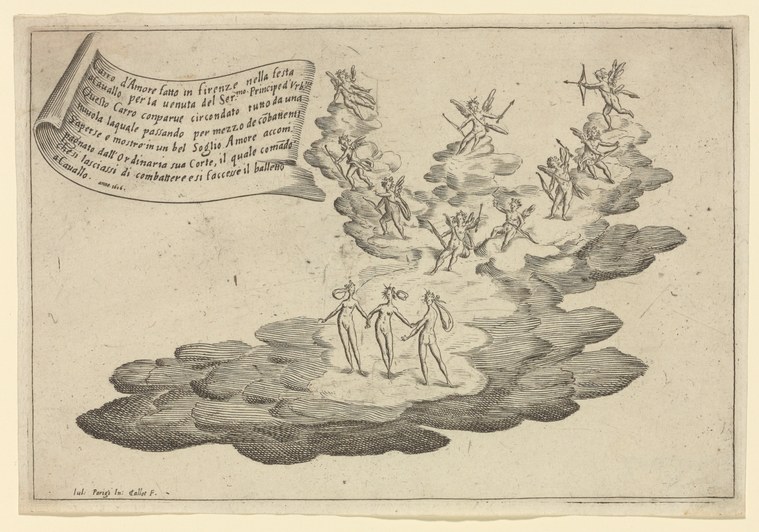
A celestial or allegorical scene depicting the Chariot of Love (Carro d'Amore), rendered in the mode of a spiritual or mythological vision. In the lower portion of the composition, three figures in long robes stand on an undulating cloud formation rendered with dense cross-hatching. Above them rises a dramatic landscape of ethereal clouds populated with numerous winged figures—putti or cherubs—some bearing torches or other attributes. The clouds accumulate vertically, creating a sense of ascension or divine space. A substantial cartouche unfurls from the upper left, containing Latin text in italic script. The entire scene is rendered in line engraving with careful attention to atmospheric perspective through gradations of tone; the lower clouds are darker and more densely marked, while the upper reaches of the composition become lighter. The style and subject matter suggest Renaissance or early modern allegorical art, possibly derived from a theatrical spectacle, court entertainment, or emblem tradition.
The dancing
The three central figures on the cloud stand in relatively static poses, their bodies oriented toward the viewer or in profile, wearing long flowing garments consistent with early modern dress or theatrical costume. Their posture and proximity suggest formal arrangement rather than active choreography. The putti above are rendered in varied attitudes—some appear to be floating or dancing, with limbs extended in playful gestures, though the engraving's detail at that distance and scale makes specific footwork or holds difficult to discern. The composition suggests spectation or processional movement rather than partnered social dance.
The dance depicted
This work likely documents or illustrates a court spectacle, pageant wagon, or emblem related to Renaissance or early modern themes of love and divine allegory. The title *Carro d'Amore* (Chariot of Love) connects it to a tradition of theatrical triumphs and allegorical processions common in Italian court culture, particularly of the 15th–16th centuries. If a dance was performed in such a spectacle, it would have been embedded within a broader narrative or processional framework rather than constituting an autonomous dance form. The presence of winged figures and the vertical composition suggest this depicts either a moment from a staged performance or an emblematic print celebrating such a spectacle. No recognizable ballroom hold, Renaissance couple dance frame, or specific courtly dance vocabulary is evident in the static arrangement of the central trio.
How it was made
This is an engraving, identifiable from the fine linear hatching, the controlled tonal modeling through parallel and cross-hatched lines, and the characteristic clarity and precision of line work typical of Renaissance and early modern printmaking. Engraving allowed wide circulation of designs for court spectacles, pageants, and allegorical imagery; such prints served as records of elaborate entertainments and as sources of inspiration for similar productions elsewhere. The cartouche and Latin inscription indicate this was a learned, elite object addressed to a humanist and courtly audience. The technique's capacity for fine detail—visible in the rendering of the putti's forms and the drapery of the central figures—and its repeatability made it the preferred medium for documenting and disseminating expensive court performances.
About this work
This engraving documents or celebrates a court spectacle centered on allegorical and mythological themes of love, rendered as a heavenly procession or triumph. The work sits within a rich tradition of emblem prints and theatrical spectacle documentation from Renaissance Italy, where dance, pageantry, and visual art merged in elaborate entertainments staged for aristocratic audiences. The three earthbound figures and the ascending realm of putti above suggest a narrative in which mortal and divine realms interact—a common trope in court spectacles where dance, music, and procession enacted humanist philosophical ideals.
How to look at it
Attend to the vertical composition: the three mortals below are rendered in a moment of stillness or processional formality, while above them swirls a celestial throng of animated putti. The artist has chosen to freeze a moment of transition or ascent, not an instant of partnered movement. The careful cross-hatching of the lower clouds and the lighter rendering of the upper realm create a visual metaphor for the ascent of the spirit or the transcendence of earthly love into divine love. The Latin text in the cartouche is integral to the work's meaning and would have been essential for courtly viewers to understand the allegory and its connection to a specific performance or emblem tradition.
The artist
The artist is not recorded. The cartouche and refined technique suggest a trained printmaker working within a court or humanist circle in Italy or northern Europe in the 16th century or possibly later. The engraving may derive from a theatrical design or a description of an actual spectacle, or it may be an independent allegorical composition in the emblem tradition. Without attribution, dating, or provenance detail, the maker's identity and specific context remain open.
The period
The *Carro d'Amore* belongs to the tradition of Renaissance court spectacles and pageant wagons, which flourished especially in Italy from the 15th century onward. Such spectacles combined music, dance, costuming, and architectural design to enact classical allegories and humanist philosophy before elite audiences. Dance in this context was not categorized as a separate art but as one element within a multimedia performance. The tradition of the triumphal procession and the chariot—drawn from Petrarchan and classical sources—was revived and elaborated throughout the Renaissance as a vehicle (literally and figuratively) for courtly display and political ceremony. Printmaking, particularly engraving, became a crucial medium for recording and circulating images of these ephemeral spectacles.
Where it lives
Held in the New York Public Library's collection of prints depicting dance. The work is catalogued minimally, with date and medium unknown to the holding institution. It survives as a single engraving, likely one of many impressions that would have circulated in early modern courtly and humanist circles.
Dance in this work
Questions about this work
Is this actually a dance depiction, or just an allegory?
It is both. The *Carro d'Amore* almost certainly documents or was inspired by an actual court spectacle in which dance played a key role. Renaissance pageant wagons and triumphal processions combined movement, costume, music, and narrative. This print preserves the iconography and narrative of such a spectacle, even if the dance itself is subsumed within the larger allegorical framework. For the period, this is how dance was often preserved visually—not as autonomous choreography but as part of a multimedia performance event.
What would the dancers actually have been doing?
Court spectacles of this type typically included formal processions, stately group movements, and possibly some solo or paired dancing within the narrative framework. The three central figures suggest a formal arrangement, possibly the principals of the pageant or the virtues being allegorized. Dance in such spectacles was often slow, geometric, and aligned with classical ideals of order and harmony. Without the text or archival records of the specific performance, the exact choreography cannot be reconstructed, but it would have been courtly, decorous, and integrated with music and costuming.
Why does the text matter so much?
The cartouche contains the full description or moral interpretation of the allegory. For Renaissance learned audiences, the visual spectacle and the textual commentary together created meaning. The dance, music, and costume would have enacted or illustrated the concepts laid out in the Latin text. Reading the text is essential to understanding what the spectacle represented and what role dance and movement played in conveying its meaning.
More dance artwork





