49 works in this view — arrow keys or swipe to move between them.
Dance in Art
Les dames de Seville: waltz by Camille Schubert
Unknown artist
- Collection:
- Prints depicting dance
- Source:
- New York Public Library
- Rights:
- Public domain — free to use, share and adapt.
- Recorded as:
- Public Domain
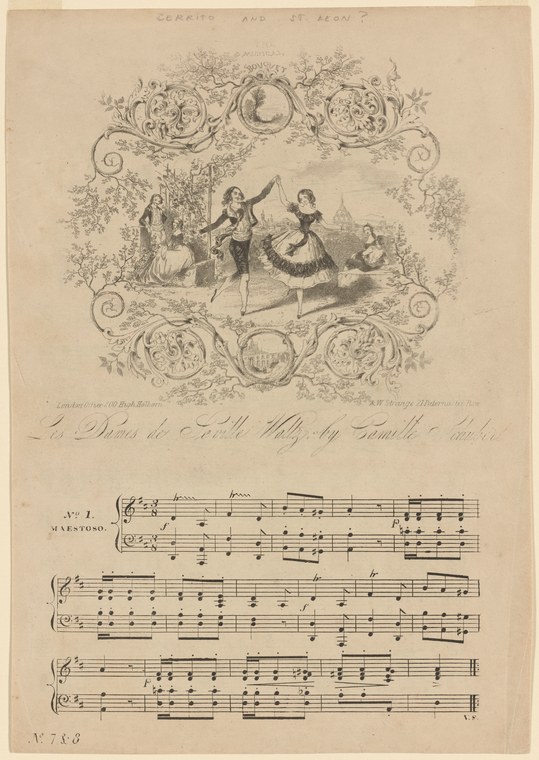
This image documents the waltz at the precise moment it was reshaping European social dance and ballroom culture. It is evidence of the commercial infrastructure around dance in the early 19th century—the publication, distribution, and pedagogy of dance steps through musical scores and engravings. Dancers and historians can read from this a clear picture of the hold, the arm carriage, the moment of the turn that made the waltz distinctive.
What you are looking at
This is a theatrical dance scene rendered as an engraving, framed within an ornamental Rococo border of scrollwork and floral garlands. Within the central vignette, five dancers in early 19th-century dress occupy a shallow stage space. Three women in long, full skirts dominate the composition: the foreground figure on the right executes a turning movement with one arm raised and extended, her body caught mid-rotation; beside her, a second woman in a similar pose leans into the turn; a third woman stands to the left. Two male figures in dark coats and breeches frame the scene. The lighting is even and clear, typical of engraving technique, with no atmospheric effect. The entire composition conveys controlled, refined movement within the bounds of ballroom propriety—this is not a wild or passionate scene, but a social dance frozen at the moment of greatest visual extension.
The dancing
The dancers are in closed or near-closed ballroom position, characteristic of early 19th-century European social dance. The women's arms are extended upward and outward in a graceful arc; their upper bodies are upright despite the spinning motion suggested by their stance. The men stand more solidly, their frames supporting the women's movement. The artist has captured the women at the peak of a turn, with skirts beginning to lift and swirl, the fabric spreading outward under centrifugal force. This is a moment of maximum visual drama—not the foot-work itself, which is invisible beneath the skirts, but the overall body carriage and extension of the limbs.
The dance depicted
This is a waltz as performed in the early 19th century, the dance that was defining European ballroom culture in the 1820s–1840s. The title specifies it as 'Les dames de Seville: waltz by Camille Schubert'—likely a published dance piece with musical accompaniment. The image shows the three-beat rotational movement of the waltz at the moment of maximum turn, with the characteristic upright posture and arm extension that distinguishes it from earlier minuet-based dances. The fact that this is a musical publication—the engraving includes musical notation at the base—confirms that what we see is a promotional image for a commercial dance composition intended for ballrooms across Europe.
How it was made
This is an engraving with hand-applied colour or watercolour wash, a common and economical method of producing sheet music covers and dance instruction materials in the early 19th century. The ornamental frame suggests it is a title page or cover illustration for a published waltz composition. The decorative Rococo border indicates production probably between 1820 and 1850—after neoclassicism had declined but before photographic reproduction made engraved dance images largely obsolete. The technique allowed for relatively inexpensive mass production and wide distribution to middle-class households with pianos and dancing masters.
About this work
This is a commercial engraving and musical score cover for a waltz choreography published in the early 19th century. It documents not only the steps of the waltz—a dance that revolutionized European ballroom culture by introducing close partner contact and continuous rotation—but also the aesthetic ideals of the period: grace, upright posture, and controlled extension within a formal social setting. The engraving medium itself tells us this was a work of commercial circulation, meant to reach dancing masters and aspiring dancers across Europe. It represents the waltz at its moment of greatest cultural dominance, before other dances and musical styles would reshape the ballroom.
Waltz imagery appears frequently in 19th-century prints and paintings, but most focus on the frivolity or moral danger of the dance; this image instead captures the technical and aesthetic content—the actual bodies in motion—making it valuable evidence for how the waltz was understood as a structured, skillful practice rather than merely as a social scandal.
How to look at it
Attend to the position of the women's arms and torsos: they are neither slack nor rigid, but extended in a sustained arc that shows the dancer's command over her own body even as she turns at speed. The artist has chosen the moment at the top of the turn, when the spinning movement is most visually apparent and the skirts are most fully extended—the moment of maximum grace. The formal frame and orderly composition (balanced grouping of figures, clear foreground and background) reflect the ballroom's own social order. This is not a moment of improvisation or expressive freedom, but of mastery within a strict formal convention.
The artist
The composer or choreographer is named as Camille Schubert, but nothing in the image itself identifies the engraver or artist. This was standard practice: dance music and instruction prints of this period often credited the composer but not the illustrator. The work appears to be a professional commercial production, likely from a Paris or London music publisher, but without further research on Schubert's publishing history, more cannot be said.
The period
The waltz emerged as a respectable ballroom dance in the 1810s–1820s, though it had been controversial for its close partner hold and continuous rotation. By the 1830s, it had become the dominant social dance across Europe, spawning an enormous industry of published waltzes, polkas, and quadrilles in musical notation. Publishing houses produced thousands of dance compositions, many with decorative covers and instructional images. This engraving dates to that moment of commercial ascendancy. In the visual arts, Romantic-era painters and printmakers were simultaneously exploring dance as a subject—sometimes as frivolous spectacle (as in Hogarth's tradition), sometimes as graceful and refined sociability, which is closer to what we see here.
Where it lives
This work is held in the New York Public Library's Prints depicting dance collection. It is a commercial engraving and musical score cover, characteristic of the output of European music publishers in the early 19th century. The record does not specify the publisher or date of publication.
Dance in this work
Questions about this work
What is the waltz and why did it cause such a fuss?
The waltz was a closed-partner dance that emerged in the late 18th century and became the dominant ballroom dance by the 1830s. Unlike earlier dances (minuets, cotillions) that were often performed in lines or formal geometric patterns, the waltz required continuous close contact between partners and rapid rotation. This physical intimacy shocked many in conservative society and was condemned by moralists and church figures. By the 1820s–1830s, however, it had become respectable and fashionable across Europe, driving an enormous publishing industry.
How do I know this is a waltz and not another dance?
The title explicitly identifies it as a waltz. Visually, the continuous rotating position of the couples, the upright frame, and the arm carriage shown here are all characteristic of the waltz. The three figures in motion suggest the three-beat time signature of waltz music. Earlier dances (minuets, country dances) would show very different body positions and movement patterns.
What was Camille Schubert's role in this?
Schubert is credited as the composer/choreographer of this waltz composition. In the early 19th century, a published waltz typically included both choreographic notation (or at least description) and musical score. Whether Schubert composed the music, choreographed the steps, or did both cannot be determined from this image alone.
Why is there an engraving with musical notation at the bottom?
This is a title page or cover for a published waltz composition—a complete package for sale to middle-class households with pianos and dancing masters. The engraving sold the romance and elegance of the dance; the music notation allowed performers to practice it. This was a major commercial category in the 19th century.
More dance artwork





