49 works in this view — arrow keys or swipe to move between them.
Dance in Art
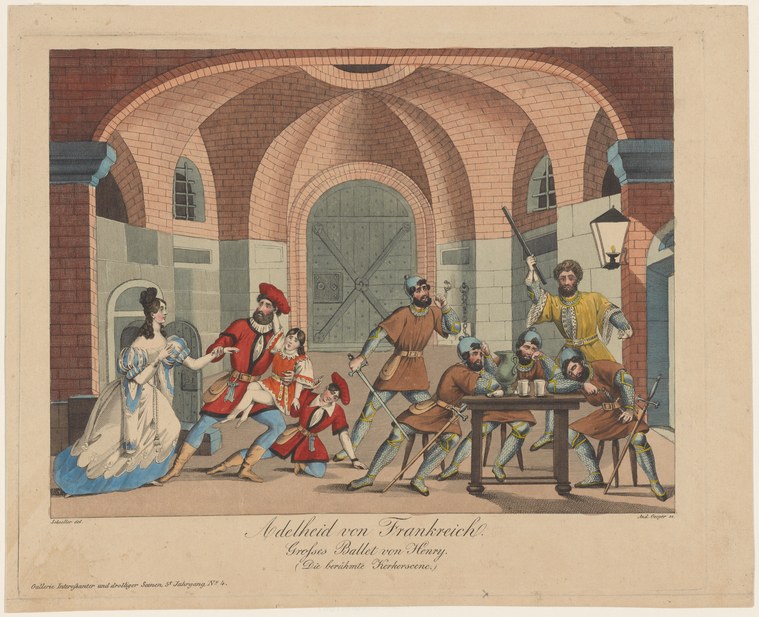
Adelheid von Frankreich: grosses Ballet von Henry, (die berühmte Kerkerscene)
Unknown artist
- Collection:
- Prints depicting dance
- Source:
- New York Public Library
- Rights:
- Public domain — free to use, share and adapt.
- Recorded as:
- Public Domain
The work documents the vocabulary of performance in the German 18th century, where 'ballet' encompassed heroic narrative spectacle and pantomime as well as formal dance. For historians of theatrical dance and gesture, it illustrates how emotional and political content was staged through the body and spatial arrangement at a time when the boundaries between dance, pantomime, and dramatic theater were not yet fixed.
What you are looking at
A grand interior with brick vaulting and arched ceiling, lit by warm tones of ochre and cream. A theatrical prison scene unfolds: in the left foreground, a woman in a long white gown with blue train kneels pleading before a military commander in scarlet and gold. Several pages or attendants in red surround them. At right, a group of men in period dress sit at a wooden table, some armed, watching the scene unfold. A tall lantern hangs from the wall. The composition stages a moment of dramatic supplication—the woman's gesture is one of desperate appeal, her body angled toward the seated men who hold her fate. The architectural grandeur and the careful distribution of witnesses suggest this is a pivotal narrative moment, likely from a heroic historical drama.
The dancing
The kneeling woman is the focal point, her body in a low, pleading posture with one hand raised in supplication, her skirt spread wide on the ground. The scarlet-clad officer beside her stands with commanding posture and upheld sword, creating a stark contrast of power and vulnerability. The seated men at the table are static, their stillness emphasizing their role as judges or decision-makers. There is no evident balletic hold or frame among any figures; the bodies express narrative emotion and social hierarchy rather than dance technique.
The dance depicted
While the title invokes 'Ballet'—*Adelheid von Frankreich: grosses Ballet von Henry*—this does not appear to depict social or theatrical dance in the modern sense. In 18th-century German print culture, 'Ballet' often referred to elaborate narrative spectacles or pantomime scenes performed on stage, particularly court dramas with music and movement. This scene appears to be from such a theatrical work, likely a heroic or tragic drama ('die berühmte Kerkerscene'—the famous prison scene), rather than a dance in the balletic or ballroom sense. The figural arrangement and frozen moment suggest pantomime or dramatic tableau rather than choreographed dance steps.
How it was made
This is a hand-colored engraving or possibly a colored print from the 18th century, as evidenced by the fine cross-hatching in the architectural elements, the careful stippling for shading, and the distinct register marks where color was applied. The technique allowed for mass circulation of theatrical imagery to a broad public; such prints were used to advertise and record popular stage productions, particularly German-language dramas. The warm palette and delicate line work are typical of theater documentation in this period and region.
About this work
This is a scene from a German-language historical drama or pantomime known as *Adelheid von Frankreich*, depicting a critical narrative moment in which a woman appeals to powerful men in a prison setting. Though titled as a 'Ballet,' it represents the 18th-century theatrical use of that term to encompass elaborate historical spectacles with music, movement, and dramatic action rather than dance as an autonomous art form. It belongs in a dance gallery as evidence of how 'ballet' was understood in German-speaking regions—not primarily as a technique, but as a mode of theatrical storytelling that incorporated music, gesture, and movement.
How to look at it
Attend to the spatial and bodily hierarchy in the composition: the kneeling woman occupies the foreground and the lowest physical position, her gesture one of vulnerability and appeal, while the armed men sit elevated and command the scene through stillness and authority. The artist has frozen the moment of petition—the instant of maximum dramatic tension before a judgment is rendered. The architectural setting and the presence of witnesses frame this as a formal, ritualized moment rather than an intimate one, emphasizing the public nature of the drama.
The period
In the 18th century, particularly in German and Austrian territories, the term 'Ballet' referred broadly to court spectacles and theatrical productions that combined music, dance, and narrative drama. The 'great ballets' of the German stage were often historical or heroic in subject and were disseminated through engravings and colored prints. This period saw the rise of pantomimic dance as a serious dramatic form, particularly through the work of figures like John Weaver and, later, Jean-Georges Noverre, who argued that gesture and movement could convey narrative without words. The formal ballet technique as codified in France coexisted with this broader German conception of 'ballet' as spectacle.
Where it lives
This hand-colored engraving is held in the New York Public Library's collection of prints depicting dance, catalogued as an illustration of the theatrical spectacle known as *Adelheid von Frankreich*. It is a documentary artifact: a printed record of a stage production, likely from the late 18th century, distributed to a literate public curious about popular theatrical works.
Dance in this work
Questions about this work
Why is this called a 'Ballet' if nobody is dancing?
In 18th-century German theatrical vocabulary, 'Ballet' did not refer solely to formal dance technique. It encompassed spectacular theatrical productions that combined music, movement, narrative, and pantomime—what we might now call 'opera' or 'musical theater.' This print documents that now-archaic use of the term, which is why it appears here alongside works of dance proper.
What is the story of Adelheid von Frankreich?
The catalogue record does not provide the narrative. The print shows 'the famous prison scene,' but the full plot is not recorded here. The work was known enough to be printed and circulated, but we cannot recover the complete story from the image alone.
Is this a real historical event or a fictional drama?
Almost certainly fictional or heavily dramatized. Adelheid (Adela, Adelaide) was a historical figure—the name belongs to several medieval and early medieval women—but this theatrical version is a 18th-century invention or adaptation, shaped by the aesthetics and interests of that period.
More dance artwork





