49 works in this view — arrow keys or swipe to move between them.
Dance in Art
Carlotta Grisi
Unknown artist
- Collection:
- Prints depicting dance
- Source:
- New York Public Library
- Rights:
- Public domain — free to use, share and adapt.
- Recorded as:
- Public Domain
Carlotta Grisi was not only a virtuoso technician but also one of the first women to achieve the status of international dance celebrity and to have a significant say in the roles she created and danced. This portrait is part of the visual archive of her celebrity and serves as evidence of how women dancers were imaged and marketed in the 19th century. For anyone studying Romantic ballet, Grisi's roles, or the visual culture of 19th-century theatre, this engraving is a primary document.
What you are looking at
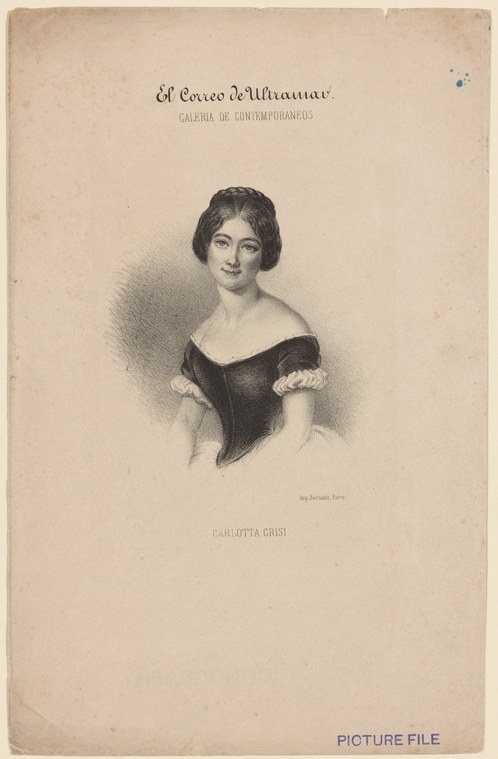
This is a bust-length portrait of a young woman in early 19th-century dress, rendered as an engraving or lithograph on cream paper. She is shown from the shoulders up, her body angled slightly to the viewer's right, her face turned toward the viewer with a serene, direct gaze. She wears a black off-shoulder dress or bodice with short puffed sleeves that expose her upper arms and shoulders—a style characteristic of the 1830s–1840s. Her dark hair is parted in the center and swept back smoothly in the fashion of the period. The background is plain and unmarked, rendered only with light shading to suggest volume and depth around the figure. The title beneath reads "CARLOTTA GRISI" in capital letters. The work is executed in a soft, tonal technique with careful modeling of light and shadow across the face and bare shoulders, creating an intimate, contemplative portrait.
The dancing
The subject is a single seated or standing figure, shown in three-quarter view from the waist up. Her posture is upright and composed, with the axis of her shoulders aligned slightly forward of her hips, suggesting a natural, unstudied ease. Her face is calm and her gaze direct, meeting the viewer without affected expression. The bare shoulders and exposed upper arms emphasize the dancer's form—the controlled musculature and carriage that mark a trained body. No active gesture or pose is shown; this is a moment of repose, not movement.
The dance depicted
The subject is identified by the inscription as Carlotta Grisi, the Italian–French dancer who became one of the most celebrated ballerinas of the Romantic era. She was known for her technical brilliance and dramatic presence in roles such as Giselle (1841), and she was also a notable mime and actress. The portrait tells us nothing directly about her technique or the choreography of her roles, but the off-shoulder dress conforms to the fashion of the 1830s–1840s and places this image within her working years. The soft, flattering style of the portrait—with its emphasis on her face and the graceful line of her neck and shoulders—was conventional for circulating images of celebrated dancers of the period, meant to convey both their beauty and their status.
How it was made
Based on the tonal qualities, paper texture, and handling visible in the image, this is almost certainly an engraving, lithograph, or possibly a steel engraving—reproductive media designed for mass circulation in the form of prints sold to the public or included in theatrical publications and periodicals. The soft, atmospheric rendering of light and shadow across the face and the smooth gradations of tone are characteristic of lithography or the heavier tonal work of later steel engraving, techniques that allowed for wider distribution and a broader audience than oil painting. Such prints were sold individually as mementos of celebrated performers and served as both publicity and documentation of the dancer's appearance and era.
About this work
This is a portrait engraving or lithograph of Carlotta Grisi, one of the greatest ballerinas of the Romantic period, dating to the 1830s or 1840s when she was at the height of her fame. The work is a document of both the dancer and the era: it records her face and bearing, the fashion of early 19th-century stage dress, and the conventions of how celebrated performers were presented to the public. The portrait belongs in a gallery of dance imagery both as evidence of how dancers were represented and remembered, and as a window into the celebrity and visual culture of Romantic ballet.
The work circulated as a print, likely sold to admirers and patrons of the theatre, and would have appeared in theatrical periodicals and collections of celebrity portraits. It represents the machinery by which a dancer's image and reputation were disseminated during an era before photography dominated such representation. For historians, the image offers insight into the self-presentation of dancers and the aesthetics of Romantic femininity as applied to the ballet stage.
How to look at it
This is a portrait of composure and stillness, not of dance itself. Pay attention to the carriage of the shoulders and the line of the neck—these are markers of training and discipline in a body meant to move with control and grace. The off-shoulder dress is both a fashion statement and a convention of theatrical portraiture: it exposes the form the dancer has trained, making visible the body as an instrument. The direct gaze and serene expression are part of a coded language of Romantic femininity—a sense of inwardness, refinement, and an almost melancholy dignity that was central to the appeal of Romantic ballerinas. The artist has chosen a moment of repose, not action, and this stillness is itself part of how a dancer's status and artistry were communicated through portraiture.
The artist
The artist is not recorded in the catalogue. The work is unsigned or the signature is not legible in the reproduction. The style and execution suggest a skilled professional lithographer or engraver working in the 1830s–1840s for a publisher of theatrical prints or periodicals, but without further research the individual identity cannot be established. Such portraits were often produced by studios or collaborative workshops rather than sole individuals, and attribution is frequently uncertain.
The period
This portrait dates to the height of the Romantic era in ballet, when the art form shifted from the technical display and aristocratic courtship rituals of classical ballet toward an emphasis on narrative, emotion, and the supernatural. Carlotta Grisi was central to this transformation: she created the role of Giselle in 1841, one of the cornerstones of the Romantic repertoire, and her interpretations of sylphs and ghostly heroines set the aesthetic standard for generations. In visual culture, the 1830s and 1840s saw an explosion of printed portraits of celebrated dancers and other theatrical celebrities, circulated through journals, print shops, and private collections. The soft, flattering style of this engraving—with its emphasis on the sitter's face and the graceful line of her shoulders—exemplifies the aesthetics of Romantic portraiture, in which beauty, refinement, and an appearance of effortless grace were paramount.
Where it lives
The work is held in the New York Public Library's collection of prints depicting dance, catalogued as source material for the study of dance history and performance culture. It is a historical document circulated in the 19th century as a commercial print, likely sold to patrons and collectors of theatrical imagery.
Dance in this work
Questions about this work
Who was Carlotta Grisi?
Carlotta Grisi (1819–1899) was an Italian-French ballerina who became one of the most celebrated dancers of the 19th century. She premiered the role of Giselle in 1841 and was known for her technical brilliance, dramatic presence, and influence on the development of Romantic ballet. She also worked as a mime and actress, and had a significant career in both Europe and the United States.
What era of ballet does this portrait represent?
This portrait dates to the Romantic era of ballet, approximately 1830s–1840s, when the art form shifted from purely technical display toward narrative, emotion, and the exploration of supernatural themes. Grisi was a central figure in this transformation, and her interpretations of sylphs and ghostly heroines became iconic.
Why are her shoulders bare?
The off-shoulder dress was both a fashion of the 1830s–1840s and a convention of theatrical portraiture. It served to display the trained form of the dancer's body—the neck, shoulders, and upper arms—making visible the discipline and control that were central to her art. This style became standard in portraits of celebrated female performers of the era.
Is this an original painting or a print?
This is a reproductive print—most likely an engraving or lithograph—designed for mass circulation. Such prints were sold individually to admirers, appeared in theatrical journals and periodicals, and formed part of the visual culture through which dancers' images and reputations were disseminated before the advent of photography.
More dance artwork





