49 works in this view — arrow keys or swipe to move between them.
Dance in Art
Couple in a landscape, woman with castanets, man with guitar
Unknown artist
- Collection:
- Prints depicting dance
- Source:
- New York Public Library
- Rights:
- Public domain — free to use, share and adapt.
- Recorded as:
- Public Domain
This print is evidence of how Spanish dance, and flamenco in particular, were staged and marketed to 19th-century European audiences through the visual media of theatrical prints. It shows the standardized costume, instruments, and body positions that defined the tradition in performance, making it a valuable document for understanding both the dance itself and the international circulation of Spanish cultural forms.
What you are looking at
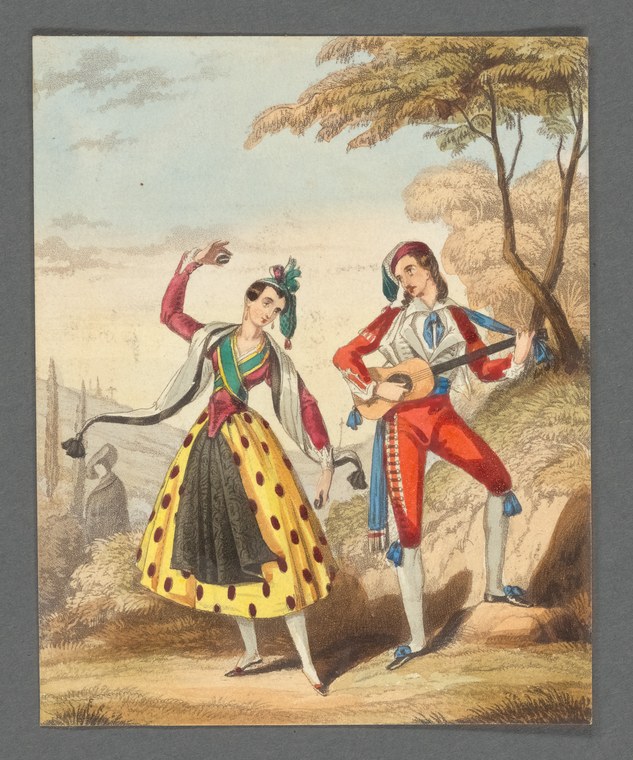
A man and woman perform together in an outdoor landscape beneath spreading trees. The woman, at left, wears a richly decorated dress with a yellow skirt spotted with red dots, a dark bodice trimmed in gold braid, and a red cape draped across her shoulders. She holds castanets in both raised hands and her body curves in a dynamic pose, weight shifted, suggesting active movement. The man at right, dressed in a red coat with blue collar facings and white breeches, plays a guitar. His posture is relaxed but engaged, angled toward his partner. Behind them, architecture visible in the distant left suggests an urban setting, while the foreground is dominated by natural landscape—grasses, shrubs, and large trees with feathery foliage overhead creating dappled light. The color palette is warm and muted, typical of hand-colored theatrical prints of the 19th century. The composition is deliberately staged and theatrical rather than documentary.
The dancing
The woman's frame is open and expressive, her arms raised high with castanets, her torso in a gentle S-curve suggesting rhythmic movement rather than static pose. Her weight appears shifted to one leg, her skirts flaring to suggest a turn or swaying motion. The man's guitar posture is upright and controlled; he does not hold her or dance with her in the formal hold sense, but rather accompanies her performance. The two figures are spatially coordinated but not in physical contact, which is characteristic of flamenco or Spanish folk performance where the guitar player and dancer are separates participants in the same act.
The dance depicted
This depicts Spanish or Spanish-influenced folk dance, most likely flamenco or a related regional style such as Sevillanas or Bolero. The castanets, the decorative dress with its yellow-spotted skirt and gold-trimmed bodice, and the guitar accompaniment are all hallmarks of Spanish dance performance in the 19th century. The woman's raised-arm position, open frame, and apparent weight shift are consistent with flamenco arm work and the rhythmic swaying of the upper body characteristic of that tradition. The theatrical context—the posed setting, the coordinated costume and instrument, the print format—suggests this represents a stage or public performance rather than a social dance.
How it was made
This is a hand-colored lithograph or engraving, characteristic of theatrical print production in the 19th century. The technique allowed for rapid circulation of images of popular performers and dances to a wide audience of theatergoers and print collectors. The hand-coloring—evident in the delicate washes of yellow, red, and blue—indicates this was produced for the popular market rather than as a fine art print. The fine line work in the figures and background landscape shows skilled draftsmanship, while the overall composition and style suggest production for a commercial print publisher, likely European.
About this work
This is a 19th-century theatrical print documenting a moment of Spanish folk or flamenco dance performance. The image captures the essential visual elements of the tradition: the castanets, the decorative dress, the guitar accompaniment, and the characteristic arm and body positions of the female dancer. As a hand-colored print, it circulated among theater audiences and print collectors of the era, preserving a record of how Spanish dance was performed and understood in European popular culture. The work belongs in a dance gallery because it documents both the technical vocabulary of a specific dance tradition and the theatrical context in which it was presented and consumed.
How to look at it
Attend to the moment of the woman's movement: the artist has chosen to freeze her mid-gesture, with her arms raised and her body in a dynamic curve that suggests the continuous swaying and rhythmic motion of the dance. The raised castanets are the focus, positioned at the apex of her reach. Notice how the man, though present and essential to the performance, remains secondary in compositional terms—his role is to accompany, not to lead. The theatrical setting—the carefully composed landscape, the rich costume detail, the coordinated pose—tells you this is not naturalistic observation but rather a stylized representation of a stage performance.
The period
The 19th century saw intense European interest in Spanish and other 'exotic' folk traditions, driven by Romanticism and the growth of popular theater and mass-produced prints. Spanish dance, with its perceived passion and sensuality, became a favorite subject for theatrical performance and visual documentation. This print likely dates from the mid-to-late 19th century, when such theatrical images were produced in large quantities and sold to a broad audience of theatergoers, collectors, and the simply curious. The technical sophistication of the print and its hand-coloring suggest it was a relatively high-quality commercial product, aimed at an audience that could afford to purchase theatrical memorabilia.
Where it lives
The work is held in the New York Public Library's prints collection documenting dance imagery. As a mass-produced theatrical print, it would have been one of many similar images distributed to the public in the 19th century, making it a representative example of popular visual culture around dance and theater rather than a unique or high-status object.
Dance in this work
Questions about this work
Is this flamenco?
It is most likely Spanish folk dance of the flamenco family, though the style could also be a related form such as Bolero or Sevillanas. The castanets, guitar, costume, and the woman's arm positions and body movement are all consistent with flamenco as performed on European stages in the 19th century. Without further documentation, the exact regional or stylistic variant cannot be determined.
Why is the man not dancing?
In Spanish flamenco and related traditions, the guitarist is a performing musician, not a dancer. The roles are distinct: the woman dances to the accompaniment of the man's guitar playing. They are partners in the performance but participate in different ways. This reflects the actual structure of flamenco performance, in which the cante (song), guitarra (guitar), and baile (dance) are separate elements that work together.
What are those yellow spots on her skirt?
They are decorative spots or polka dots, part of the costume design. The patterned skirt with contrasting colors was typical of Spanish folk costume as represented in 19th-century theatrical dress, whether or not it reflected actual regional garments. The spots add visual interest and texture to the print.
More dance artwork





