49 works in this view — arrow keys or swipe to move between them.
Dance in Art
Les polonaises. Mazurkas
Unknown artist
- Collection:
- Prints depicting dance
- Source:
- New York Public Library
- Rights:
- Public domain — free to use, share and adapt.
- Recorded as:
- Public Domain
This work documents a crucial moment in dance history: the mainstreaming of a folk dance (the Polish mazurka) into elite European and American society. The raised-arm pose shown here became the visual signature of the mazurka in nineteenth-century art and culture, so much so that a contemporary viewer would have recognized the gesture instantly. For dance historians, the print is evidence of how choreography, dress, and military identity were fused in the performance and promotion of the dance during the romantic era.
What you are looking at
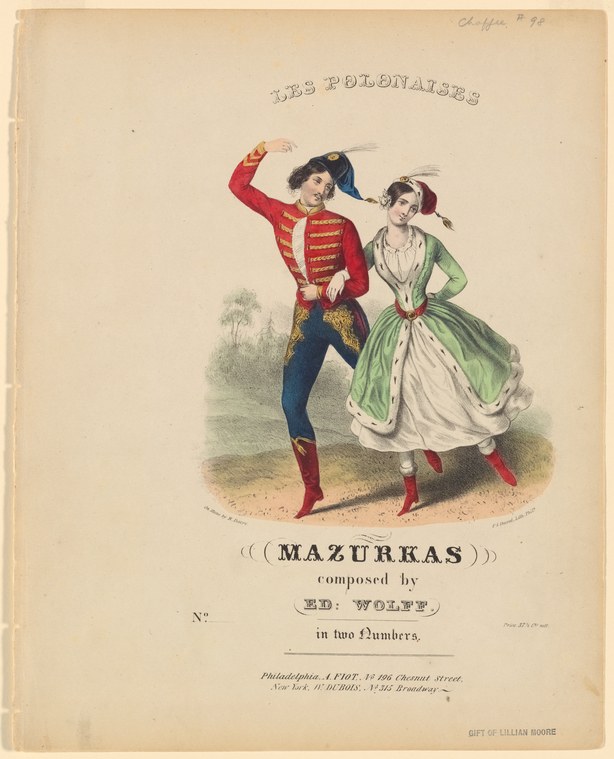
A hand-colored engraving showing two figures in a moment of social dance, likely from the 1830s–1840s. On the left stands a military officer in a brilliant red coat with gold braiding, his left arm raised high in a characteristic gesture, his right hand positioned as if grasping a partner's hand. To the right is a young woman in a pale green dress with a white chemisette, her posture upright and animated. Both wear feathered caps or bonnets. The setting is spare—a suggestion of landscape in the background—keeping focus on the dancers and their dress. The composition captures a moment of courtship and display, with the officer's bold red uniform dominating the scene and the woman's graceful stance creating a visual counterpoint. The title and composer credit are printed below.
The dancing
The officer's pose is key: his left arm raised sharply upward and backward in a distinctive gesture strongly associated with the mazurka, a Polish dance gaining fashionable currency across Europe. His right hand reaches toward the woman, suggesting a hand-hold or the moment of engagement between partners. The woman stands with her weight on one foot, her body angled toward the officer, her arms at her sides with a natural ease. The energy is upright and elevated rather than smooth and sustained, consistent with a folk-derived dance. The raised arm and active posture suggest the stylized swagger characteristic of the mazurka's deportment.
The dance depicted
This is almost certainly a mazurka, announced in the title and confirmed by the officer's signature raised-arm gesture, which became the emblematic pose of the dance in nineteenth-century visual culture. The mazurka originated in Poland and was rapidly adopted by European ballrooms and concert halls from the 1820s onward. The print shows the dance as a couple-based social or theatrical interpretation, with the military officer's uniform suggesting that the mazurka had acquired aristocratic and cosmopolitan prestige by the time this work was made. The composer Ed. Wolff was a Paris-based pianist and composer (c. 1816–1880) known for fashionable salon music and dances, confirming this as a commercial music-and-dance print for an educated urban audience.
How it was made
This is a hand-colored engraving or lithograph (the catalogue does not specify, but the style and finish are consistent with lithography or hand-colored engraving). The fine linear details of the figures' dress, the feathering on the caps, and the braiding of the uniform are rendered with precision; the hand-coloring in watercolor or gouache adds luminosity, especially to the woman's dress and the officer's brilliant red coat. This technique allowed for rapid, affordable reproduction and wide circulation in the parlor-music and fashion markets of the 1830s–1840s. The title, composer credit, and publisher information (Philadelphia and New York addresses) printed at the bottom confirm this was commercial sheet music or album cover art, distributed internationally to middle-class households.
About this work
This is a hand-colored engraving or lithograph advertising the mazurka as a fashionable dance and music genre in early nineteenth-century urban society. The image captures the moment when the Polish mazurka, with its characteristic raised-arm gesture and energetic deportment, had become a prestige dance of European ballrooms and concert halls. The military officer's uniform and the woman's elegant dress signal that the mazurka was understood as a sophisticated, cosmopolitan form, associated with European nobility and military life. The print exemplifies how dance imagery circulated through commercial music publishing, reaching a broad educated audience through the parlor and the salon.
How to look at it
Attend to the officer's left arm: raised and curved backward in a distinctive arc. This pose is not accidental or merely decorative; it is the mazurka's most recognizable gesture in nineteenth-century visual culture, and it signals the dance's identity instantly. The weight and energy of his body, the forward lean, and the woman's responsive stance show the dance as a moment of flirtation and display, not a close embrace. The precision of the dress—the feathered cap, the braiding, the pale green silk—tells you that this is a fashionable, urban interpretation of the dance, refined for ballroom and concert consumption. Compare this with visual sources of the waltz or the quadrille to see how differently each dance was posed and promoted.
The artist
The work is attributed to composer Ed. Wolff (c. 1816–1880), a German-Polish pianist and composer who settled in Paris and became known for fashionable salon music, fantasias on popular opera themes, and dances for the drawing room. Wolff published prolifically in both Paris and London, and his works were marketed as sheet music for amateur pianists and performers. The engraving itself is uncredited, typical of commercial music publishing of the era, where the composer's name appeared prominently but the engraver remained anonymous.
The period
The mazurka arrived in Western Europe around 1820–1830 and became a sensation among the Romantic-era urban elite. The dance was promoted both as a ballroom form and as a concert piece, with composers from Chopin to Liszt writing virtuosic mazurka variations. In the 1830s–1840s, the mazurka was associated with cosmopolitan taste, European travel, and the prestige of Polish and military culture. The fashion for the dance coincided with the popularity of other European folk dances adapted for ballroom and stage (the polka, the waltz, the tarantella), reflecting a Romantic fascination with the "authentic" and the national. Visual imagery promoting the mazurka—including prints like this—helped cement the dance's place in fashionable society and ensured its survival in the concert and ballroom repertory.
Where it lives
This is a commercial music-and-dance print from the New York Public Library's collection of prints depicting dance. It was published by a Philadelphia and New York music house (addresses visible at the foot of the print), making it part of the transatlantic trade in fashionable music and entertainment. The print's survival in a major research collection reflects its value as a document of popular taste and commercial culture.
Dance in this work
Questions about this work
What is the raised-arm gesture the officer is making?
This is the characteristic pose of the mazurka, a Polish dance that became fashionable in European ballrooms in the 1830s–1840s. The raised arm, often curved backward and sometimes striking a quasi-military stance, became the visual signature of the dance in paintings, prints, and photographs. It signaled the dance's identity to a contemporary viewer as clearly as pointe shoes signal ballet today.
Was the mazurka danced by all social classes, or just the elite?
In its Polish origins, the mazurka was a folk dance; in Western European ballrooms, it became an elite fashion. This print, aimed at a middle-class audience with access to sheet music and drawing rooms, shows the mazurka as a refined ballroom and concert form. Professional dancers and military officers would have been prominent in public demonstrations, contributing to the dance's association with sophistication and national prestige.
Who was Ed. Wolff, and why did he compose mazurkas?
Ed. Wolff (c. 1816–1880) was a Paris-based pianist and composer who made his living writing fashionable salon music, dances, and variations on popular themes. Composing mazurkas was part of a broader commercial strategy to meet demand from amateur musicians and dancers. The mazurka craze of the 1830s–1840s made such pieces highly marketable, and Wolff's prolific output helped ensure that the dance reached a wide audience through sheet music.
What does the military uniform tell us about the mazurka?
The officer's dress signals that the mazurka had acquired prestige and was associated with European nobility, military life, and cosmopolitan travel. In the Romantic era, military dress in dance imagery suggested sophistication, national pride, and courtship ritual. The uniform was part of the dance's appeal: the mazurka became fashionable partly because it was performed and promoted by officers and aristocrats.
More dance artwork





