49 works in this view — arrow keys or swipe to move between them.
Dance in Art
Carlotta Grisi
Unknown artist
- Collection:
- Prints depicting dance
- Source:
- New York Public Library
- Rights:
- Public domain — free to use, share and adapt.
- Recorded as:
- Public Domain
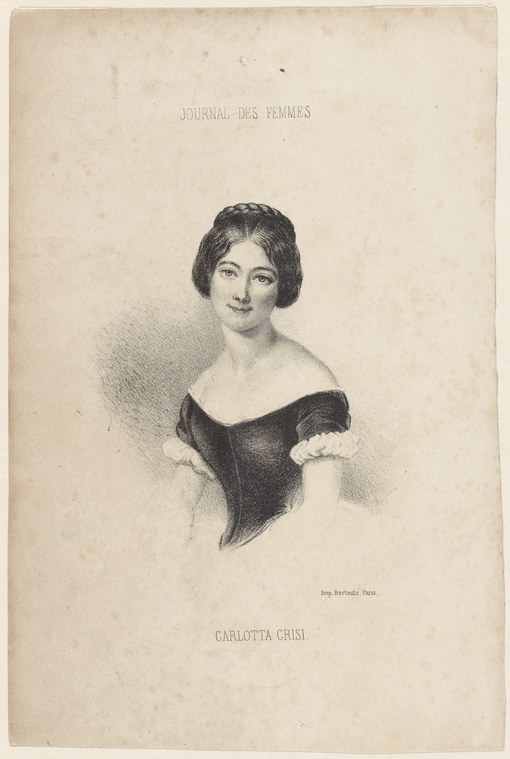
Grisi was a transformative figure in ballet history, and this image preserves her likeness as she would have been known to her contemporaries. It shows how dance performers, particularly women, were promoted and consumed as celebrities in the nineteenth century, through prints and periodicals that framed them as objects of public fascination and admiration. The work is evidence of the professionalization and celebrity status of dance in the Romantic era.
What you are looking at
A half-length portrait of a woman set against a plain, slightly textured background. She is shown from roughly the waist up, her body angled three-quarters to the right but her face turned almost directly toward the viewer. Her dark hair is parted in the center and swept back smoothly from her face in the fashion of the mid-nineteenth century. She wears an off-the-shoulder dress in dark fabric—likely black or very dark brown—with short, puffy sleeves that expose her shoulders and upper arms. The neckline is a shallow horizontal sweep across her chest. Her skin is rendered in fine halftone or stippled tones that create a sense of three-dimensionality; her gaze is direct and contemplative. The technique employs fine lines in the background to suggest depth, while her shoulders and chest are modeled through careful shading. The overall effect is one of elegant restraint—this is a portrait of a professional performer at the height of her fame, composed with the gravity usually reserved for portraits of nobility or statesman.
The dancing
The figure is stationary and posed rather than caught in movement. Her posture is upright and composed, her shoulders relaxed. Her arms are not visible below the elbow, cropped by the frame. The slight turn of her body and the direction of her gaze create a sense of quiet authority and self-possession. There is no indication of active dance or physical exertion; this is a portrait meant to convey personality and status rather than choreographic skill.
The dance depicted
This is not a depiction of dance in action, but rather a portrait of Carlotta Grisi, the renowned Italian-French Romantic ballet dancer. Grisi was one of the most celebrated dancers of the mid-nineteenth century, known for originating the role of Giselle in the 1841 ballet of that name. The portrait records her as a public figure and star of the Romantic ballet era, during which she would have performed in the pointe work, ethereal costuming, and narrative pantomime characteristic of the period. The image serves as a record of her as a personality and performer rather than as documentation of a specific choreographic style or technique.
How it was made
This is a line engraving or steel engraving, a reproductive printmaking technique widely used in the nineteenth century to create portraits for publication and distribution. The fine parallel lines (hatching) and careful stippling create tonal gradation and the illusion of volume. The technique allowed high-quality reproduction at scale and relatively low cost, making such portraits accessible to a wide audience—essential for celebrity circulation in the age before photographic reproduction dominated the market. The masthead reads 'JOURNAL DES FEMMES' (Journal of Women), indicating this was published as part of a periodical, likely a fashion, society, or arts journal aimed at educated readers, mostly women.
About this work
This is a portrait engraving of Carlotta Grisi, published in the Journal des Femmes, a mid-nineteenth-century French periodical. It records not a moment of dance but the public image of one of Romantic ballet's greatest stars at the height of her fame. Grisi was the original Giselle and a dancer of international renown; this portrait served to circulate her likeness among the educated public who attended ballet and read about its performers. It belongs in a gallery of dance in art because it documents how dancers were represented in the cultural imagination of their time—not primarily as bodies in motion but as celebrities and public figures whose image carried cultural capital.
How to look at it
Attend to the artist's choice to present Grisi as a dignified, composed figure rather than in an active dance pose. Her gaze and posture convey authority and self-possession—she is not a decorative figure but a commanding presence. The off-the-shoulder dress acknowledges her profession as a performer (such exposure would be scandalous in street dress) while maintaining decorum in the portrait format. The fine technique and careful modeling of light and shadow signal that this is a work of serious artistic attention, not a quick sketch or gossip-column illustration.
The artist
The artist is not recorded in the catalogue. The engraving is signed 'Imp. Bertaudi, Paris' at lower right, indicating it was printed (rather than engraved) by a Paris printer named Bertaudi. The actual engraver is unknown. This was likely created for circulation as a celebrity portrait in French periodicals aimed at middle- and upper-class readers interested in the arts, fashion, and society gossip of the day.
The period
This engraving was made during the height of Romantic ballet in the 1840s–1850s, when dancers—particularly female dancers—became celebrities on an international scale. The Journal des Femmes was a periodical that catered to educated women and combined art criticism, fashion advice, serialized fiction, and society news. The inclusion of Grisi's portrait in such a journal reflects both her enormous fame and the growing attention to dance as a subject worthy of serious artistic and cultural attention. Lithography and steel engraving were the primary means of circulating images of performers before photography became dominant in the 1860s.
Where it lives
This is part of the New York Public Library's collection of prints depicting dance. It appears in the Library's holdings as an example of nineteenth-century performance documentation and celebrity portraiture.
Dance in this work
Questions about this work
Who was Carlotta Grisi?
Carlotta Grisi (1819–1899) was an Italian-French Romantic ballet dancer, one of the most celebrated performers of her era. She created the title role in Adolphe Adam's Giselle (1841) and danced throughout Europe and America. She was known for her technical skill, dramatic presence, and beauty, and was a favorite of critics and audiences alike.
Why does the portrait show her without dancing?
This is a celebrity portrait rather than a dance documentation. Its purpose was to circulate Grisi's likeness among readers of the Journal des Femmes—to promote her public image and reinforce her status as a celebrated performer. Such portraits were meant to be kept, displayed, and discussed, creating a visual record of the star as a person, not just an artist.
What is an engraving and how was it used?
Steel engraving was a printmaking technique that used a metal plate incised with fine lines to produce high-quality, durable prints. Engravings could be printed many times, making them ideal for mass circulation in periodicals. They were more expensive than lithographs but finer in detail, and were preferred for important portraits and art reproductions.
More dance artwork





