49 works in this view — arrow keys or swipe to move between them.
Dance in Art
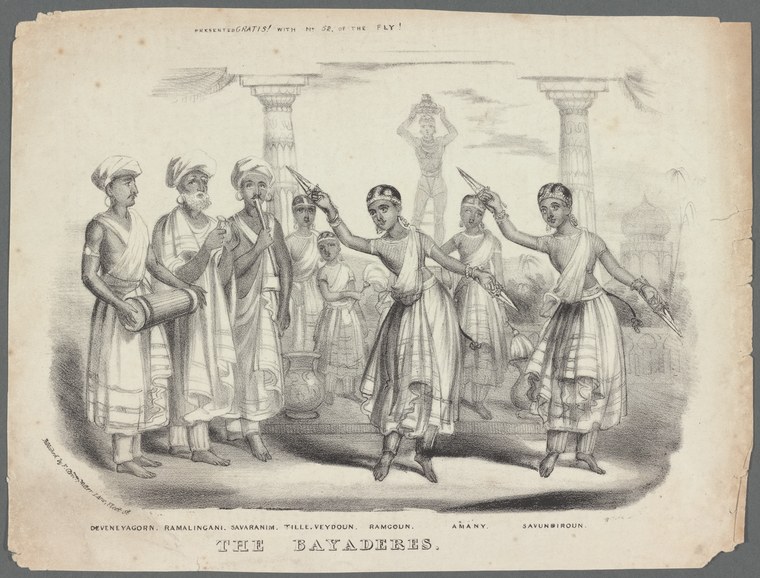
The Bayaderes: Deveneyagorn, Ramalingani, Savaranim, Tille, Veydoun, Ramgoun, Amany, Savundiroun
Unknown artist
- Collection:
- Prints depicting dance
- Source:
- New York Public Library
- Rights:
- Public domain — free to use, share and adapt.
- Recorded as:
- Public Domain
This engraving is rare documentation of South Indian Bayadère dance during a period when the form was actively practiced and celebrated, capturing the specific elements—the weapons, dress, architectural setting, and ensemble formation—that characterized the style. For historians of Indian classical dance and global performance history, it provides visual evidence of how this tradition was understood and represented in European print culture, and thus offers insight into both the dance itself and the cultural exchange that shaped its documentation.
What you are looking at
Seven female dancers stand in a theatrical setting marked by classical architectural elements—fluted columns and ornamental capitals visible in the background. The women wear ankle-length white muslin dresses with short sleeves and fitted bodices, each topped with a large turban or elaborate headdress wrapped in striped fabric. They hold curved swords or scimitars in both hands, positioned at various heights—some raised high, others held across the body or lowered. The composition forms a loose semi-circle, with the figures arranged at different depths to create spatial interest. The engraving's light falls evenly across the scene, with fine parallel hatching used to model the fabric folds and create shadow. The architectural setting suggests a palace or temple interior, and the overall effect is of a choreographed moment frozen mid-performance.
The dancing
The dancers display varied arm positions and stances, each holding curved blades in ways that suggest simultaneous but non-synchronized movement. Some raise their weapons overhead with extended arms, others hold them diagonally across their bodies, and at least one extends a sword to the side. The poses suggest weight distributed on both feet with slight variations in stance from figure to figure—no dancer appears to be in motion through space, but rather each occupies a distinct position within a larger formation. The consistent dress and repeated gesture of weapon-holding indicates these are ensemble dancers executing a coordinated, if varied, sequence.
The dance depicted
This engraving depicts Bayadères (or bayaderes), the female temple dancers of South India, most likely performing a form of armed dance or martial display. The title lists seven dancer names: Deveneyagorn, Ramalingani, Savaranim, Tille, Veydoun, Ramgoun, Amany, and Savundiroun—suggesting either the names of celebrated performers or character roles. The curved swords (likely scimitars or Indian talwars) indicate a martial or processional context that was part of South Indian dance practice, especially in temple and court settings. The Bayadère tradition, already well-established by the 18th century when this print likely dates, combined temple dance with courtly performance and often incorporated weapons, acrobatic elements, and display of technical skill.
How it was made
This is an engraving, identifiable by the fine parallel hatching lines used for shading, the precision of the line work, and the consistent surface tone. The technique allowed for mass reproduction and wide circulation, particularly among European audiences with growing interest in representations of 'oriental' performance. Engravings of this type were typically made from drawings or paintings and sold as individual prints or in collections of ethnographic or theatrical subjects. The formal composition and careful anatomy suggest the engraver worked from a reliable source or from patterns established in European artistic practice for depicting non-European performers.
About this work
This engraving documents the Bayadères, the celebrated temple dancers of South India, in a formal performance context. Seven named performers, identified only by the artist as Bayadères, hold curved swords in a classical architectural setting, executing a choreographed sequence that combines aspects of sacred temple dance, courtly performance, and martial display. The print belongs to a long European tradition of theatrical and ethnographic engravings that circulated knowledge of non-European performance practices, particularly during the 18th and 19th centuries when interest in 'oriental' spectacle was at its height. It documents both a historical dance form and the European fascination with its visual presentation.
How to look at it
Note the careful variation in pose and weapon position: the artist has avoided simple symmetry, giving each dancer a distinct gesture while maintaining the unity of the ensemble. The curved swords are the key visual element that marks this as martial display rather than pure dance. Look at how the turbans and wrapped headdresses create vertical emphasis and how the muslin dresses, with their fine linear rendering, ground the figures in textile specificity rather than idealized nudity. The architectural frame signals a palace or temple context, elevating the scene beyond street performance and anchoring it in institutional dance practice.
The period
Bayadère dance was an established temple and court tradition in South India by the 18th century, combining ritual function with courtly entertainment and erotic appeal. By the time this engraving was made, European interest in Indian performance had intensified through colonial contact, travel literature, and theatrical spectacle. The formal naming of individual dancers suggests either genuine accounts of celebrated performers or the European practice of assigning 'exotic' names to generic figures of oriental fantasy. The Bayadère would later become a standard character in European Romantic ballet (La Bayadère, 1877), creating a lasting European imaginary around the form that mixed ethnographic curiosity with fantasy.
Where it lives
The print is held in the NYPL's collection of prints depicting dance. It is catalogued under the generic era label 'unknown' and without attribution to an artist, suggesting it may be from a bound collection of ethnographic or theatrical engravings, or a later assemblage of prints on the subject of non-European dance.
Dance in this work
Questions about this work
What is a Bayadère?
Bayadère (from the French/Portuguese corruption of the Tamil devadasi) refers to a female dancer attached to Hindu temples in South India, who performed ritual dances, courtly entertainments, and public performances. The role combined sacred function with courtly and sensual dimensions, and was documented extensively in European travel accounts and prints from the 18th century onward. By the 19th century, the term had entered European theatrical vocabulary as a marker of exotic oriental femininity, notably in the 1877 ballet La Bayadère.
Why are the dancers holding swords?
Curved swords or scimitars were part of the Bayadère performance tradition, used in martial displays and processions that mixed weapon dance with expressive movement. This reflects South Indian dance's historical connection to both temple ritual and courtly martial traditions. The swords emphasize skill, power, and technical virtuosity alongside the sensual or devotional dimensions of the dance.
Are these real dancers or generic figures?
The title lists seven specific names, suggesting these may represent actual celebrated performers of the time, though without further documentation it is impossible to verify. Alternatively, the names may be European assignments of 'exotic' identity to generic representations of Bayadères. Either way, the specificity of naming indicates this was intended to document real or credible performance practice, not pure fantasy.
When was this print made?
The catalogue record does not provide a date. Based on the style of engraving, the costume, and the European aesthetic conventions visible in the composition, this likely dates to the late 18th or early 19th century, a period of intense European interest in Indian performance. A more precise date would require further research into the collection's holdings and provenance.
More dance artwork





