49 works in this view — arrow keys or swipe to move between them.
Dance in Art
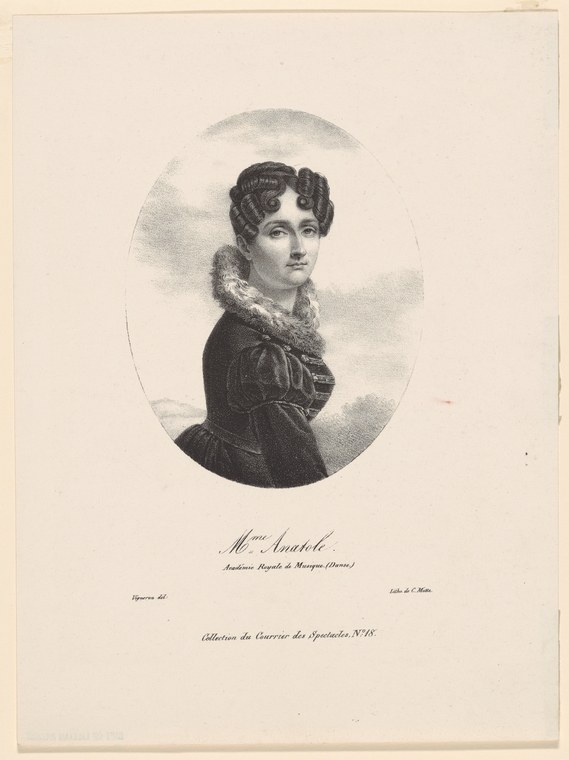
Mme Anatole. Académie Royale de Musique (danse)
Unknown artist
- Collection:
- Prints depicting dance
- Source:
- New York Public Library
- Rights:
- Public domain — free to use, share and adapt.
- Recorded as:
- Public Domain
This portrait documents the material culture of Romantic ballet and the celebrity status of professional female dancers in the 1820s–1830s. For historians, it offers direct visual evidence of how a working dancer presented herself publicly and how she was represented to the theater-going public—her dress, styling, and the formal conventions of her portraiture all speak to her position as a respectable, accomplished performer.
What you are looking at
A half-length portrait of a woman in three-quarter view, turned slightly to the left. She wears a dark velvet or wool dress with elaborate details: a high collar trimmed with fur or feathers, and what appears to be draped fabric or a decorative brooch at the shoulder. Her dark hair is arranged in fashionable ringlets pulled back from her face, in the style of the 1820s–1830s. The image is rendered as an engraving, with careful stippling and line work to suggest volume and fabric texture. The background is neutral and softly modeled, drawing all attention to the figure. The portrait is set within an oval frame, a common convention for theatrical portraiture of the period. The subtitle identifies her as "Mme Anatole" and notes her affiliation with the Académie Royale de Musique (danse)—the Paris Opera.
The dancing
The woman stands in a quiet, composed pose with her body angled and her gaze directed toward the viewer with a slight, knowing expression. Her head is held with the poise expected of a trained performer. Her arms are not prominently featured, being mostly out of frame or held close to her body in a naturalistic manner. There is no indication of active movement or dance gesture; this is a portrait of repose, not a scene of performance.
The dance depicted
This is a portrait of a professional dancer from the Paris Opera's ballet company in the early 19th century. The inscription confirms her status as a member of the Académie Royale de Musique, the institutional home of Romantic ballet in France. The image does not depict dance in action but rather the dancer as a public figure—a celebrity of the stage captured in a moment of stillness. The formal, dignified presentation and the fashionable dress suggest she was a soloist or principal dancer of sufficient standing to merit an engraved portrait for public circulation.
How it was made
This is an engraving, rendered in the stippled and line-based technique typical of reproductive prints from the 1820s–1830s. The fine detail and tonal modeling suggest a skilled hand, likely a professional portrait engraver working from a drawing or painting original. Such engravings were mass-produced and distributed as prints to theaters, collectors, and the public, serving as the primary visual currency of theatrical celebrity before photography. The oval framing was conventional for theatrical portraiture and helped identify the sitter as a performer of note.
About this work
This is a commemorative portrait engraving of a Paris Opera ballet dancer, a work in the tradition of theatrical celebrity prints that circulated in early 19th-century Europe. The inscription identifies her only as "Mme Anatole," and the image preserves no record of her first name or career details. It belongs to the vernacular visual culture of Romantic ballet, documenting the public face and fashionable dress of the professional dancer at a crucial moment in ballet history—the era of Marie Taglioni, *La Sylphide*, and the full flowering of pointe work and the ethereal aesthetic. Such prints were displayed in theaters, sold in music shops, and collected by ballet enthusiasts; they are now primary evidence of how dancers looked, dressed, and were valued in their time.
How to look at it
The image freezes the dancer in a moment of composed stillness rather than active movement—a conventional choice for theatrical portraiture, which aimed to capture the performer as a known and recognizable public figure rather than in the transient spectacle of performance. The careful attention to her costume—the fur collar, the draped fabric, the fashionable hairstyle—tells you that her body and its adornment were themselves part of the spectacle. Notice the fineness of the engraving technique and the skill required to suggest the texture of velvet, fur, and skin through line and stipple alone. This level of detail and finish was expensive and suggests a dancer of sufficient rank and public interest to justify the cost of an engraved portrait for distribution.
The period
This engraving dates to the height of European Romanticism and the golden age of ballet at the Paris Opera. The early 1820s–1830s saw the emergence of Romantic ballet proper, with the triumph of works like *La Sylphide* (1832) and the rise of the female dancer as the central figure of theatrical spectacle. The Paris Opera was the preeminent ballet institution in Europe, and its dancers—including both famous soloists and ensemble members—became celebrity figures. Theatrical prints and engravings were the mass media of the era, the equivalent of modern photograph and film stills; they were cheaper and more widely distributed than painted portraits and reached a broad public audience. The formal conventions of the portrait print—the oval frame, the three-quarter view, the fashionable dress—established the dancer as a respectable, cultured figure suitable for a bourgeois drawing room.
Where it lives
The work is held at the New York Public Library as part of its collection of prints depicting dance. It belongs to a larger tradition of theatrical portraiture from the 19th century and serves as documentary evidence of the ballet world of its time.
Dance in this work
Questions about this work
Who was Mme Anatole?
The inscription identifies her only as a dancer ("danseuse") of the Académie Royale de Musique (the Paris Opera ballet company). Her full name and biographical details are not recorded in the available sources. The respectful engraving of her portrait suggests she was a professional performer of some standing, likely a soloist or principal dancer, but she is not among the most famous names of the Romantic era.
What does the inscription mean?
"Académie Royale de Musique (danse)" refers to the ballet company of the Paris Opera, the premier ballet institution in Europe during this period. It was literally a royal academy, funded and sanctioned by the French monarchy, and the label on her portrait signals her professional status and institutional affiliation.
Why is she in a portrait rather than dancing?
Theatrical portrait engravings typically showed the performer in a composed, recognizable pose rather than in the moment of performance. The goal was to create a lasting image of the dancer as a public figure and celebrity—something that could be sold, collected, and displayed. Active dance poses were less common and harder to engrave with clarity.
What does her dress tell us?
Her fashionable velvet dress with fur collar and elaborate trim reflects the early 19th-century taste for rich materials and refined detail. It is not a stage costume but rather the kind of dress a respectable woman of some means would wear in public. This signals that ballet dancers were cultured professionals, not disreputable performers, and were part of genteel society.
More dance artwork





