49 works in this view — arrow keys or swipe to move between them.
Dance in Art
La danse champêtre
Unknown artist
- Collection:
- Prints depicting dance
- Source:
- New York Public Library
- Rights:
- Public domain — free to use, share and adapt.
- Recorded as:
- Public Domain
The work shows dance moving from ballroom into landscape, and demonstrates how 18th-century prints commodified and sentimentalized rural social practice for urban consumption. It is rare visual evidence of how courtly dance forms were adapted and performed in village contexts, and of the way dance became a picturesque subject fit for the domestic print collection.
What you are looking at
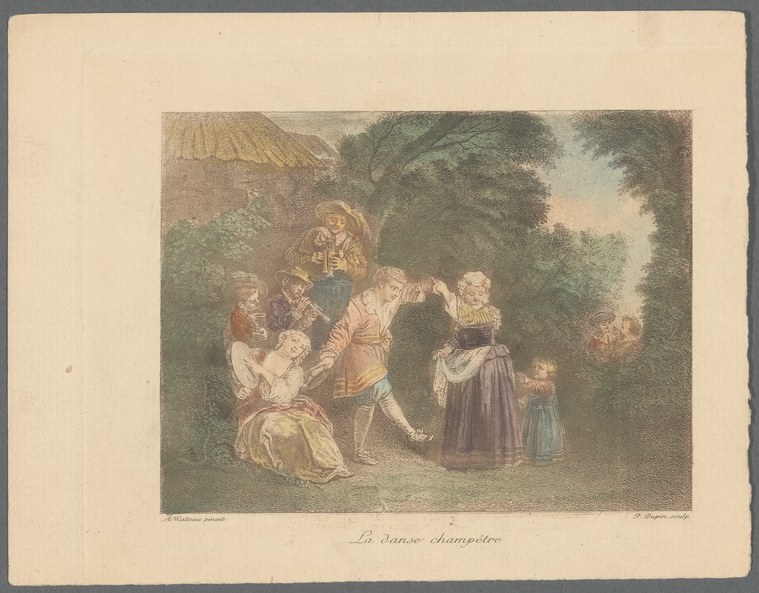
A rustic outdoor gathering in a wooded setting, with a thatched-roof cottage visible in the middle distance. A young couple dances at the center while onlookers—men and women in modest period dress—watch from around them. The woman wears a pale yellow or cream skirt with a dark bodice; the man is dressed in light breeches and a jacket. The setting suggests an informal country celebration, lit by warm afternoon light filtering through the trees. The composition is ordered but animated, with clear spatial recession from the foreground figures toward the cottage and landscape beyond.
The dancing
The central couple holds a closed ballroom position, standing face-to-face with the man's arm around the woman's waist and their outer hands joined. The woman's weight appears to be on her right leg with her left extending into a step; the man faces her squarely. Their posture is upright and formal despite the rural setting. The surrounding spectators stand at a respectful distance, their attention focused on the dancers, with the nearest observers—including an older woman and a young girl—positioned immediately to the right of the couple.
The dance depicted
This depicts a country or rustic dance of the 18th century, most likely a minuet, cotillion, or contredanse adapted to outdoor village celebration—a "danse champêtre" or peasant dance. The closed hold and face-to-face position, combined with the upright carriage and formal gesture of the dancers, suggests a country version of courtly dance forms that had diffused into rural practice. The presence of spectators rather than active participants reflects how these dances were often performed for an audience in community gatherings. The title emphasizes the rural context, positioning this as a picturesque moment of folk recreation rather than a formal court or ballroom affair.
How it was made
This is a hand-colored engraving or aquatint, identifiable by the linear hatching visible in the foliage and the even tone of the hand-coloring in greens, creams, and warm ochres. The technique allowed wide circulation as a print; the subject's sentimental rural theme suggests it was aimed at an educated urban audience purchasing prints for albums or mounting. The hand-coloring indicates either a deluxe edition or later colorist work, increasing its value and aesthetic appeal beyond simple black-and-white impressions.
About this work
This is an 18th-century engraved print depicting a country dance in a woodland setting, titled *La Danse Champêtre* (The Rustic Dance). It captures a moment when courtly dance forms—particularly the minuet and its variants—had become internalized in village celebration, performed both for participant pleasure and for the assembled gaze of community. The image sits at the intersection of folk dance documentation and picturesque aesthetics, romanticizing rural life for a print-buying urban audience. It is evidence of how dance, by the 18th century, had become a subject worthy of artistic circulation and collection, and how the boundary between elite and popular dance practice had become permeable.
How to look at it
Look at the closed hold and the formal upright carriage of the dancers: despite the cottage and trees, this is ballroom posture translated to countryside. Notice how the artist has frozen a moment of lift and forward momentum, the woman's extended leg suggesting the small, controlled steps of the minuet. Observe the careful arrangement of spectators: they frame and dignify the dance, treating it as a performative moment worth witnessing. The warm light and pastoral setting transform what might be an ordinary ballroom figure into something timeless and natural-seeming—a key aesthetic move of 18th-century picturesque culture.
The period
The 18th century saw an explosion of interest in prints depicting social dance, fed by both the increasing availability of engraving technology and the Enlightenment fascination with 'natural' rural life. Dance manuals circulated widely, and prints of dancers—from formal ballroom scenes to picturesque rustic ones—became standard items in middle-class homes. The Romantic movement's idealization of peasant life meant that rural dances were increasingly depicted not as crude folk practice but as innocent, emotionally authentic alternatives to court artifice. At the same time, the minuet and contredanse were spreading from aristocratic ballrooms into village greens and harvest celebrations, a process these prints both documented and promoted.
Where it lives
The work is held in the NYPL Prints collection, catalogued as depicting dance but lacking further attribution or technical specification. It survives as a hand-colored engraving, likely from the late 18th century, though the exact date and printer remain unrecorded in the catalogue.
Dance in this work
Questions about this work
What dance is being shown here?
Most likely a minuet or contredanse in a rural adaptation. The closed hold, upright posture, and small controlled steps are consistent with these courtly forms. The title *La Danse Champêtre* identifies it as a country dance specifically, suggesting a simplified or adapted version performed at village celebrations rather than in a ballroom.
Why is this a picturesque or sentimental image?
The 18th-century urban audience that bought these prints was fascinated by 'natural' rural life. By placing ballroom dancers in a landscape with a cottage and woodland, the artist presented rural dance as innocent and emotionally authentic—a counterpoint to the formality of court dance. This was a commercial aesthetic: prints like this sold well to middle-class homes.
What does the formal posture tell us about village dance?
It shows that by the 18th century, courtly dance forms had become so widespread that even village celebrations adopted them. The dancers here use the same closed hold and upright carriage as ballroom dancers, indicating how deeply minuet style had penetrated social practice beyond the court.
Who are the spectators, and why are they important?
They appear to be fellow villagers—adults and children watching the dance. Their presence suggests that rural dances were often performative events, watched and appreciated by the community. This is documentary evidence that dance was a social occasion where some performed and others observed.
More dance artwork





