49 works in this view — arrow keys or swipe to move between them.
Dance in Art
Une chambrée de rats
Unknown artist
- Collection:
- Prints depicting dance
- Source:
- New York Public Library
- Rights:
- Public domain — free to use, share and adapt.
- Recorded as:
- Public Domain
This work captures the subordination of dance technique to social protocol in the domestic sphere. Unlike theatrical dance prints, which celebrate physical prowess, this image shows dance as a system of consent, hesitation, and regulated flirtation—revealing how dance functioned as a language for negotiating courtship and class in the 19th century.
What you are looking at
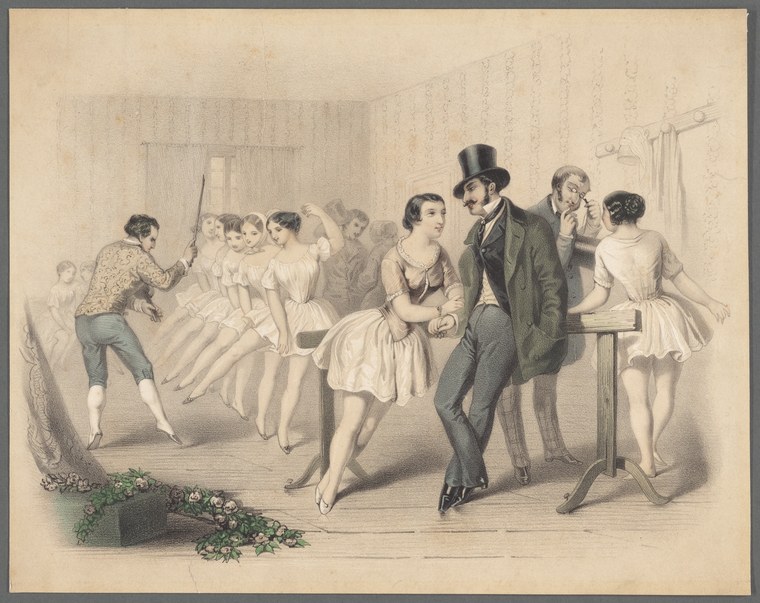
A lively indoor social dance scene set in an elegant parlor, depicted in hand-colored lithograph or engraving. The composition centers on a couple in the middle ground—a woman in a pale, high-waisted Empire silhouette dress and a man in formal dark coat and top hat—who appear to be dancing or about to dance. Around them, other figures in similar period dress mill about in various attitudes: some watching, some conversing, at least one figure on the left wielding what appears to be a sword or stick. The setting includes tall windows with curtains in the background, and foliage (roses or similar flowers) in a planter at the bottom left corner. The color palette is soft and muted—pale flesh tones, white and cream dresses, dark coats—with careful cross-hatching giving the print subtle modeling and depth. The overall mood is one of refined social interaction and anticipation rather than vigorous movement.
The dancing
The central couple stands in close proximity but do not appear to be in contact; the woman faces the viewer with a demure expression while the man leans slightly toward her, suggesting a formal introduction or the moment before beginning a dance. Several onlookers surround them in attitudes of observation. The figure on the left holding a stick or sword creates visual tension and suggests some form of play or ceremony—possibly a traditional game accompanying the dance, such as a forfeit or parlor entertainment involving mock combat or initiation. The women wear the high-waisted, high-necked dresses and short sleeves characteristic of the 1800s-1810s; the men wear tailcoats and top hats. No obvious ballroom frame or closed hold is visible; the postures suggest social mingling rather than active partnered dance technique.
The dance depicted
This appears to document a 19th-century European social dance in a domestic or parlor setting, most likely a quadrille, cotillion, or formal country dance of the early 1800s. The title *Une chambrée de rats* ('A roomful of rats') suggests a satirical or humorous view of social pretension—a common theme in 19th-century social caricature. The presence of the stick-wielding figure and the sense of ceremonial play around the couple suggests this may depict a specific parlor game or forfeit ritual that accompanied social dancing, in which the 'rats' (young men and women of fashionable society) participated in structured flirtation and mock-gallantry under prescribed rules. The work does not show virtuoso technique or theatrical staging, but rather the social protocol and anxious anticipation of formal courtship dance in polite society.
How it was made
This is a hand-colored lithograph or color engraving, a technique that allowed satirical and social commentary prints to be produced and sold widely in early 19th-century Europe. The soft coloring, careful cross-hatching, and refined line work are consistent with commercial lithography of the 1810s–1830s, a period when such prints were distributed as popular entertainment and social observation. The hand-coloring—done after printing—accounts for the subtle and somewhat uneven application of pigment. This medium and format suggest the work was intended for a middle-class or educated audience familiar with ballroom society and fashionable life, circulated as single sheets, in albums, or as illustrations in periodicals.
About this work
This hand-colored print documents a moment in early 19th-century European parlor dance and social ritual, capturing not the virtuosity of professional dancers but the hesitation, observation, and coded social play that governed courtship and courtliness in drawing rooms. The satirical title and the presence of the stick-wielding figure suggest the print is a commentary on the artificial manners and hierarchies of fashionable society, using dance as its lens. The work belongs in a gallery of dance imagery because it records not what the body could do, but what society required it to perform: restraint, deference, and ritualized attraction. It is a document of dance as social grammar rather than physical art.
How to look at it
Notice the central couple's distance and formal bearing: they are not yet dancing, but posed in the moment of social recognition that precedes the dance. The formal dress and parlor setting tell you this is not entertainment for professionals, but a record of amateur social ritual. Attend to the stick-wielder on the left—a detail that transforms the scene from simple flirtation into a game with rules and potentially comic consequences. This is satirical observation: the artist is not celebrating the grace of the dancers, but rather exposing the mechanical courtesy and underlying anxiety of fashionable courtship.
The period
The early 19th century (c. 1810–1830) was the height of the quadrille and cotillion in European ballrooms, forms that codified social interaction through prescribed steps and figures. These dances were taught as part of genteel education and were central to the courting rituals of the middle and upper classes. Simultaneously, satirical and social-commentary prints flourished in France and England, often mocking the pretensions and anxieties of fashionable society. The work sits in this tradition of social satire: using dance and dress to expose the artifice of polite manners. Romanticism was also beginning to reshape theatrical dance (the era of Romantic ballet, c. 1830–1850), but social dancing remained strictly governed by etiquette.
Where it lives
This work is held in the New York Public Library's collection of prints depicting dance. It is catalogued by title only, without recorded artist, date, or medium, which is typical of 19th-century commercial prints that circulated widely and whose makers were often uncredited.
Dance in this work
Questions about this work
What is a 'chambrée of rats'?
The French title is satirical: *rats* was slang for fashionable young men and women of society, often with the implication of superficiality or pretense. A 'roomful of rats' thus mocks the affectations and social posturing of ballroom society. The stick or sword wielded by the figure on the left may reference a forfeit game or other parlor entertainment that added spectacle to social dancing.
Is this a real dance or an imagined one?
This depicts a real social context: formal parlor dancing of the early 1800s, almost certainly a quadrille or cotillion. However, the print is satirical commentary on that context, not a technical guide. The artist is documenting the social ritual and the psychology of courtship dance—hesitation, observation, hierarchy—rather than steps or technique.
Why are the figures so stiffly posed?
The formal, upright postures reflect the actual etiquette of early 19th-century ballroom dance. These dances were not about loose, natural movement; they required an erect frame, controlled arms, and measured steps. The stiffness is not artistic convention but a record of actual social requirement.
What does the stick mean?
It likely references a parlor game, forfeit ritual, or ceremonial element accompanying the dance—possibly a mock 'duel' or initiation game that was part of fashionable entertainment. Such games often governed who could dance with whom and added comic performance to the evening.
More dance artwork





