49 works in this view — arrow keys or swipe to move between them.
Dance in Art
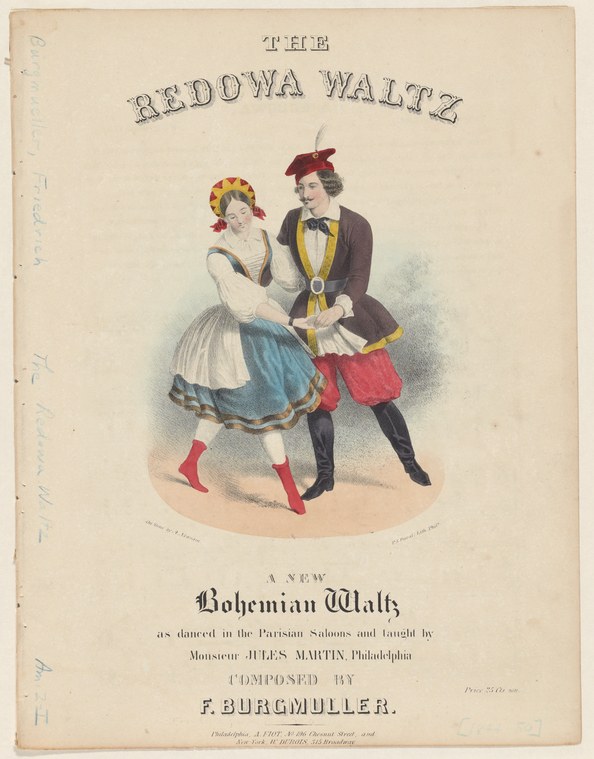
The Redowa waltz. A new Bohemian waltz as danced in the Parisian saloons and taught by Monsieur Jules Martin.=
Unknown artist
- Collection:
- Prints depicting dance
- Source:
- New York Public Library
- Rights:
- Public domain — free to use, share and adapt.
- Recorded as:
- Public Domain
The Redowa waltz represents a specific moment in dance history when Bohemian and Central European folk forms were being romanticized and absorbed into elite ballroom culture. The combination of precise figure work, named instruction source, and explicit dating (implied by the fashions and printing details) makes this image a rare document of mid-nineteenth-century ballroom practice: what steps looked like, how bodies were positioned, and how popular dances moved from saloon to home.
What you are looking at
A colored lithograph shows a couple mid-dance against a plain background. The woman wears a full white skirt with blue underlay and trim, a fitted bodice with gold trim, a red bonnet with gold decoration, and red stockings. The man wears a dark coat with gold buttons and trim, a red waistcoat, breeches, and a burgundy cap. Both figures are caught in the turning motion characteristic of waltz, the woman's skirt swung out by centrifugal force, her body leaning slightly back into the turn. The man's frame is upright and controlling, his right arm supporting her at the waist, his left hand holding hers at shoulder height. The composition is intimate and close—the figures fill most of the frame—and the pale background throws the vivid costumes into sharp relief. The moment chosen is one of active rotation, not a posed position.
The dancing
The couple dances in closed ballroom hold: his right hand at her waist, hers on his shoulder, their opposite hands joined at face height. Both bodies are inclined into the turn, with the woman's torso leaning back in the characteristic sway of waltz. Her arms form a soft frame; his lead is evident in the angle of his body and the direction of their travel. The distribution of weight and the tilt suggest this is the middle of a turn, not a static moment. The positioning is consistent with early-nineteenth-century waltz technique—upright, contained, with the rotational energy expressed through the legs while the upper body remains relatively still.
The dance depicted
This is a Redowa waltz, a Bohemian variant of the waltz that became fashionable in Paris in the 1830s–1840s and remained popular through the mid-nineteenth century. The Redowa was faster and more energetic than the standard Viennese waltz, with a distinctive three-step and hop pattern that gave it a bouncing quality. The title tells us this version was 'as danced in the Parisian saloons and taught by Monsieur Jules Martin,' a real dancing master based in Philadelphia. The couple's posture—the woman's relaxed back lean, the man's upright control—reflects the Redowa's character: more playful and less constrained than its Austrian cousin, yet still ballroom-respectable. The vivid ethnic costume (the woman's Bohemian or Central European dress) is theatrical rather than documentary, part of the Romantic era's fascination with exotic 'folk' sources.
How it was made
This is a hand-colored lithograph—a print medium that allowed for rapid and affordable distribution of dance instruction and popular entertainment. The base image was drawn on stone, printed in black or brown, and then colored by hand, which explains the slight irregularities in the color work (visible particularly in the skirt and jacket). Lithography was the dominant medium for sheet music covers, dance instruction manuals, and popular prints in the nineteenth century. It allowed a single design to be reproduced in hundreds of copies, each one individually finished, making it ideal for marketing new dances to middle-class ballroom dancers in cities across America and Europe. The printing information on the sheet—'Philadelphia: J. Fiot, 10 So. 9th Street' and 'New York: E Schuberth 285 Broadway'—indicates this was a commercial music publication, the kind that would have been purchased by families who danced at home or in assembly rooms.
About this work
This is a teaching image and advertisement combined: a visual record of a specific dance style taught by a named instructor in a named city, designed to be reproduced cheaply and circulated widely. The Redowa waltz was part of the explosion of ballroom dancing in the nineteenth century, when new dances spread rapidly from Europe to America through prints, traveling masters, and sheet music. What makes this image valuable is not artistic ambition but cultural witness—it shows how a dance was performed, what dancers wore, and how the dance was merchandised to the middle class. The figure work is precise and convincing: the artist (or the master who posed for it) understood the mechanics of the waltz and could render it clearly. The colored lithograph format itself is part of the story: this was the Instagram of its era, a way of capturing and spreading a momentary fashion.
How to look at it
Notice the position of the woman's back and the angle of her lean—this is the moment of maximum rotation, when her body weight is fully transferred and the skirt flies out. The artist has chosen the most visually dynamic moment, not a static frame. Look at the man's posture: his spine is nearly vertical, his gaze is forward and composed, his lead is expressed entirely through his frame and arms, not through visible footwork. This is ballroom dancing in the nineteenth-century style—the technical complexity happens below the waist and in the core; the upper body remains controlled and composed. The costumes are key to understanding the dance's appeal: the Redowa was marketed as fun, slightly rustic, and 'foreign,' a welcome break from the formality of the stately ballroom.
The artist
The artist is not identified on the print. The composition and figure work are competent but not distinctive—this is commercial illustration, made to convey information clearly rather than to achieve artistic effect. The hand coloring suggests the work of a print shop apprentice or assistant, a common career path in nineteenth-century commercial publishing. Jules Martin, named as the choreographer and instructor, was a real figure in Philadelphia's dancing-master community; the print was his advertisement as much as hers.
The period
The Redowa waltz emerged in Prague around 1835 and reached Paris by the early 1840s, where it was adopted into fashionable ballroom practice. It arrived in America in the 1840s and remained popular for decades. This was the height of the European Romantic era, when artists and audiences were fascinated by rural, 'national,' and 'exotic' cultures—a fascination that affected dance as much as painting or music. The woman's costume in this print, while stylized, references actual Bohemian dress, though simplified and romanticized for ballroom eyes. The waltz itself, which had scandalized society just thirty years earlier with its closed hold and intimate proximity, was now established as respectable, and instruction books and prints proliferated. Lithography was still the cutting edge of image reproduction, superior to older woodcut and engraving methods because it allowed finer detail and cheaper color application.
Where it lives
The print is held in the New York Public Library's collection of prints depicting dance. It is a commercial music-publication cover or independent dance instruction print, one of hundreds issued by publishers in major American cities during the 1840s–1870s. The NYPL collection of such materials represents the visual culture of nineteenth-century American domestic dancing.
Dance in this work
Questions about this work
What is a Redowa waltz and how is it different from a normal waltz?
The Redowa was a Bohemian variant of the waltz, faster and with a more springing action than the Viennese waltz. It has a three-step-and-hop pattern that gives it a bouncing, playful character. It became fashionable in Paris in the 1840s and was marketed as more modern and exciting than the older waltz, yet still respectable for ballroom use. This print shows Jules Martin's version as taught in Philadelphia.
Who was Jules Martin and why is he named on the cover?
Jules Martin was a dancing master based in Philadelphia who taught ballroom dances to the middle class. Being named on a printed dance cover was a form of advertisement and professional credential—it guaranteed that you were learning the steps as taught by an established instructor, not from some amateur's interpretation. It's similar to how modern fitness DVDs tout a celebrity trainer's name.
Why is the woman wearing Bohemian costume?
The Redowa waltz came from Bohemia (now part of the Czech Republic), and European and American audiences of the 1840s were fascinated by 'folk' and 'national' dances. The costume connects the dance to its source while also romanticizing it—this is theatrical costume, simplified and made fashionable, not an accurate historical recreation. The exoticism was part of the dance's appeal.
What does this print tell us about how dance was taught in the nineteenth century?
Dances were taught by local masters (like Jules Martin) who learned from traveling instructors or from published instruction manuals. New dances spread rapidly through a combination of live teaching, printed manuals, sheet music covers, and word-of-mouth. This print is both advertisement and instruction aid—prospective students could see what the dance looked like and who taught it.
More dance artwork





