49 works in this view — arrow keys or swipe to move between them.
Dance in Art
Japanese masked dancers
Unknown artist
- Collection:
- Prints depicting dance
- Source:
- New York Public Library
- Rights:
- Public domain — free to use, share and adapt.
- Recorded as:
- Public Domain
Theatrical prints of this kind are the primary visual documentation of how Japanese masked performance looked to contemporary audiences, preserving evidence of costume, headdress design, and the formal spatial arrangements that structured Noh and related forms. For historians and dancers studying Japanese classical theatre, such prints are irreplaceable records of visual practice before photography.
What you are looking at
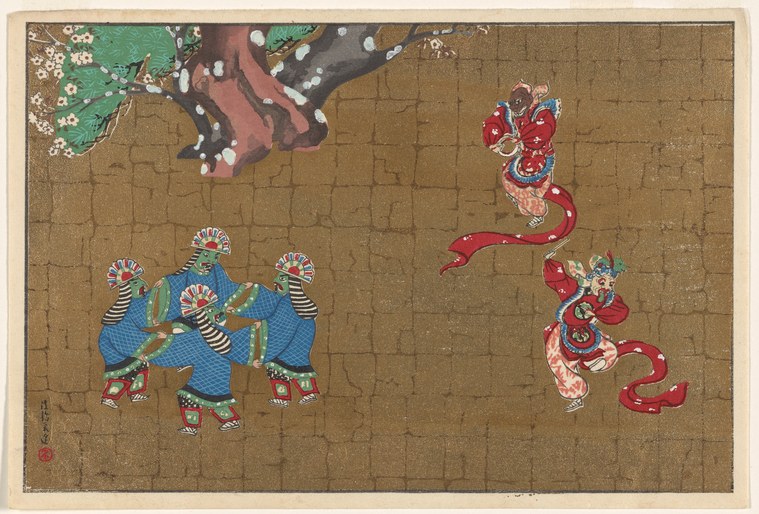
A print on a gold or tan ground depicting four masked figures in elaborate costumes arranged in two groups. On the left, three figures wearing blue robes with white striped sleeves and large elaborate headdresses topped with white fan-like crests stand in close formation, their bodies angled toward the center. To their right, two red-robed figures with similar crested headdresses are positioned vertically, one above the other, their forms more elongated and sinuous. A flowering branch with blossoms and dark foliage appears in the upper left corner. The composition is divided by a subtle grid pattern suggesting a textile or painted surface. All figures wear decorative robes with intricate patterning, and their movements are stylized and formal rather than naturalistic.
The dancing
The three left-hand figures stand with weight evenly distributed, bodies close and frontal, their posture upright and formal. Their arms are positioned at their sides with hands visible and decorated. The two right-hand figures display a vertical, stacked composition with more expressive arm gestures and curved, sinuous body lines. All four wear elaborate ceremonial masks and headdresses of identical or near-identical design. The grouping suggests a processional or formal ceremonial arrangement rather than partner dancing or social movement.
The dance depicted
These appear to be figures from Japanese Noh theatre or a related masked performance tradition, most likely depicting characters from a formal dance-drama rather than social or recreational dance. The elaborate masks, stacked headdresses with white crests (possibly representing supernatural or divine figures), formal robing, and rigid frontality are consistent with Noh Mai or another formal Japanese theatrical dance form. The vertical stacking of the right-hand figures is particularly characteristic of certain Noh compositions. The print documents costume and character type rather than capturing motion or specific footwork, which is typical of documentation of Japanese classical theatre.
How it was made
This is a woodblock print or related relief print technique on paper, most likely Japanese, as evidenced by the composition, color palette, and treatment of the figures. The gold or tan ground appears to be the paper itself or a applied wash. The stylized linear treatment of the robes, the precise patterning, and the formal spatial arrangement are all characteristic of Japanese theatrical prints from the Edo or later period. The technique allowed for multiple impressions and wide circulation among audiences interested in theatre and performance.
About this work
This print documents Japanese masked theatrical dance, most likely from the Noh tradition, showing four elaborately costumed performers with ceremonial masks and formal headdresses against a gold-toned ground. Rather than capturing a moment of action, the composition presents character types in a formal, processional arrangement. The work is a record of costume, mask design, and theatrical convention rather than a study of movement or choreography, and exemplifies how printmaking was used to disseminate knowledge of performance traditions to a wider audience.
How to look at it
Attend to the headdresses: the white fan-like crests are likely symbolic, possibly indicating rank, character type, or supernatural status within the narrative. The contrast between the compact, frontal group on the left and the elongated, vertical arrangement on the right suggests different character types or moments in the performance. The grid pattern underlying the composition implies a formal spatial order characteristic of Noh choreography. The print preserves not the ephemeral moment of dance but the stable, repeated elements—mask, costume, and placement—that constitute the theatrical form.
The period
Japanese theatrical prints proliferated from the 17th century onward, serving as both souvenirs for theatre-goers and promotional materials for troupes and performances. Noh and related masked theatrical forms had been central to Japanese elite culture for centuries by the time this print was made, and theatre prints became a major publishing genre. The gold-ground treatment and careful attention to costume detail suggest this work was aimed at an educated audience with knowledge of theatrical conventions.
Where it lives
The work is held as part of the New York Public Library's Prints collection documenting dance. The catalogue record provides minimal information, suggesting it may be catalogued primarily by collection rather than by specific attribution or provenance.
Dance in this work
Questions about this work
What kind of mask is this?
The masks appear to be from Japanese Noh theatre, a form of classical masked drama that dates back to the 14th century. Noh masks are carved wooden masks that represent specific character types—gods, demons, women, old men—and are fixed in expression. Each mask type has a name and symbolic meaning within the tradition.
Are these dancers or actors?
In Noh, the distinction between dancer and actor is not meaningful in the Western sense. Noh performers are trained in elaborate movement vocabularies that are simultaneously dance and dramatic action. The formal, stylized postures and gestures visible here blend both qualities.
Why are some figures stacked vertically?
The vertical stacking is a compositional convention of the print, not necessarily reflecting how the figures appeared on stage. Theatrical prints often compressed or rearranged figures for visual impact and to fit them within the format of the paper.
What do the white crests on the headdresses mean?
The fan-like white crests are part of the formal costume associated with specific character types in Noh. They may indicate rank, supernatural status, or a particular role within the narrative of the performance.
More dance artwork





