49 works in this view — arrow keys or swipe to move between them.
Dance in Art
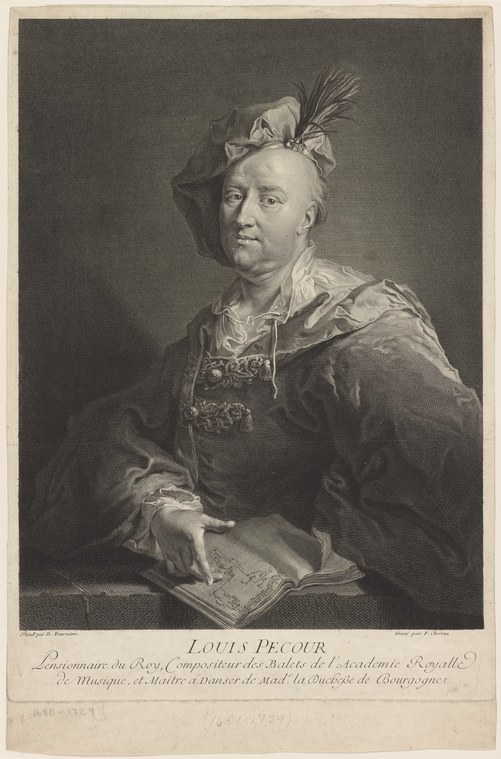
Louis Pecour: pensionnaire du Roy, compositeur des balets de l'Academie Royalle de Musique et maitre à danser de Mad. la Duchesse de Bourgogne
Unknown artist
- Collection:
- Prints depicting dance
- Source:
- New York Public Library
- Rights:
- Public domain — free to use, share and adapt.
- Recorded as:
- Public Domain
Pecour's choreographic notation system and surviving scores are among the most complete records we have of how baroque dance was actually performed in the late seventeenth century. This portrait offers visual evidence of how a master of dance and composition was represented in his own time—not as a performer, but as an intellectual authority and court official, suggesting the high status dance had achieved in French aristocratic culture.
What you are looking at
This is a bust-length portrait engraving of a man in aristocratic dress, shown three-quarter turn to the viewer's right. He wears a rich brocaded coat with ornate embroidery across the chest, a white linen shirt with deep lace cuffs, and a dark velvet cloak or cape draped across his shoulders. A white silk scarf or cravat is tied at his neck. Most distinctively, he wears an elaborate headdress: a tall white cloth wrapped turban-fashion with a large dark plume rising from the top, suggesting either theatrical costume or the fashionable dress of a high-ranking court figure. His left hand rests on an open book or document that sits in his lap, and his gaze is directed toward the viewer with a composed, dignified expression. The background is plain and dark, throwing the figure into sharp relief. The engraving technique creates fine linear detail in the fabric textures, lace, and the modeling of the face.
The dancing
A single seated figure, formally posed in a three-quarter view that was conventional for engraved portraits of distinction. The body is upright and frontal despite the head turn, conveying authority and stillness rather than movement. The left hand rests upon a document, a gesture signifying intellectual or administrative authority. There is no suggestion of active dancing or physical exertion; the pose is that of portraiture, not choreography.
The dance depicted
This is not an image of dance in progress. It is a portrait engraving of Louis Pecour, a historical figure of considerable importance in late-seventeenth and early-eighteenth-century French dance. The catalogue identifies him as 'pensionnaire du Roy, compositeur des balets de l'Academie Royalle de Musique et maitre à danser de Mad. la Duchesse de Bourgogne'—a royal pensioner, ballet composer at the Royal Academy of Music, and dancing master to the Duchess of Burgundy. The image documents him as a person and authority rather than as a dancer in action. His importance lies in his role as a choreographer and codifier of baroque dance technique during the period when French court ballet was the dominant form in Europe.
How it was made
This is an engraving, recognizable from the fine parallel line work (hatching and cross-hatching) used to model form, shadow, and texture throughout the composition. The technique allows precise detail and was the standard method for circulating portraits of notable figures in the seventeenth and eighteenth centuries. The quality and finish of the engraving suggest it was a formal, probably published portrait intended for a wide educated audience—the kind of image that would accompany a written biography or appear in a collection of notable persons. The linear precision is particularly evident in the rendering of lace and embroidery, areas where the engraver's skill was most visible.
About this work
This is a formal portrait engraving of Louis Pecour, one of the most significant choreographers and dance theorists of the French Baroque era. Though the image itself shows no dancing, it documents a historical figure whose work—particularly his choreographic notation system and his compositions for the royal court—shaped the practice and transmission of baroque dance throughout Europe. Pecour's role as both a dancing master and a ballet composer made him a bridge between the physical practice of dance and its theoretical documentation, at a moment when French court culture set the standard for aristocratic movement across the continent.
How to look at it
Attend to the symbolic elements of the portrait: the document in his hand, the formal dress, and especially the elaborate headdress, which may reference both court fashion and theatrical costume—a blend that reflects Pecour's dual role as courtier and choreographer. The engraver has chosen to represent him not in action but in stillness and authority, as a figure of learning and rank rather than physical skill. The precision of the engraving technique itself—the fine hatching that renders every detail of lace and embroidery—reflects the kind of precise notation that Pecour himself pioneered in recording dance on paper.
The artist
The engraver is not recorded in the catalogue. The inscription at the bottom of the print would typically name both the artist represented and the engraver, but this information is not deciphered in the current record. The style and quality suggest a professional engraver working in Paris in the late seventeenth or early eighteenth century, probably executing the portrait from a painting or drawing by another hand.
The period
This portrait dates to the era of Louis XIV's reign or shortly after, when the French court at Versailles had become the arbiter of European taste in dance, music, and visual culture. The establishment of the Académie Royale de Danse in 1661 had formalized the study and documentation of dance technique, and figures like Pecour represented the new status of dance as a discipline worthy of intellectual rigor and written codification. The baroque style of dress and the theatrical nature of the headdress reflect the courtly context in which both dance and portraiture were practiced as arts of display and authority.
Where it lives
The work is held in the New York Public Library's collection of prints depicting dance. It is a historical engraving, likely printed from a copper plate and distributed in the eighteenth century or later. The exact date of engraving and the circumstances of its creation are not recorded in the available documentation.
Dance in this work
Questions about this work
Who was Louis Pecour?
Pecour (c. 1651–1729) was a French choreographer, dancing master, and theorist who worked at the court of Louis XIV and afterwards. He is best known for developing a system of dance notation that allowed baroque choreography to be recorded and transmitted on paper. He created ballets for the Académie Royale de Musique and served as dancing master to high-ranking members of the royal family.
Why is he wearing a turban?
The elaborate headdress was fashionable in aristocratic portraiture of the period and may also reference theatrical costume, reflecting Pecour's position at the intersection of court culture and stage performance. It signals both his social rank and his association with the theater and spectacle.
What does the book represent?
The open document or book in his hand is a conventional attribute of learned authority in portraiture, suggesting that Pecour should be understood not merely as a performer but as an intellectual figure whose contributions were theoretical and literary as well as physical.
Is this the only portrait of Pecour?
Other portraits and images of Pecour exist, but this engraving is one of the most widely circulated and is a key historical document of how he was publicly represented in his own era.
More dance artwork





