49 works in this view — arrow keys or swipe to move between them.
Dance in Art
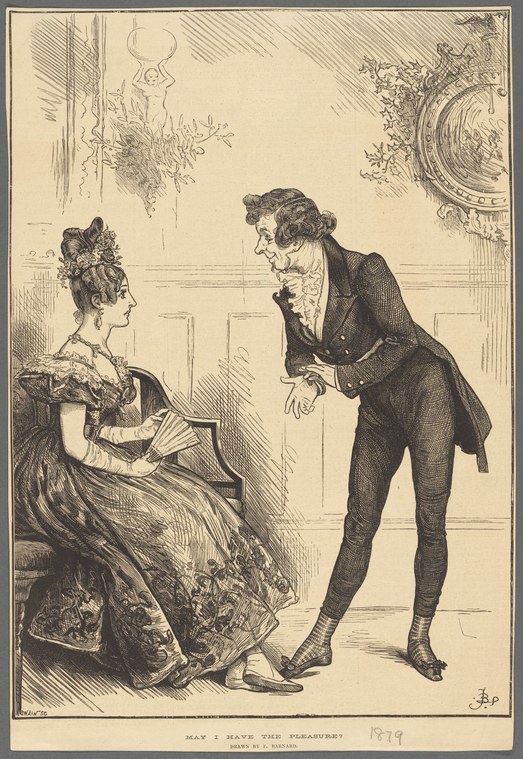
May I have the pleasure?
Unknown artist
- Collection:
- Prints depicting dance
- Source:
- New York Public Library
- Rights:
- Public domain — free to use, share and adapt.
- Recorded as:
- Public Domain
This engraving reveals that the history of dance includes the social grammar of invitation and refusal—the choreography of courtship itself. For anyone studying how dance functioned in Regency or Gilded Age society, this image is primary evidence: it shows what the moment before dancing looked like, how bodies communicated status and intention, and how the ritual was narrated in popular culture through humorous prints.
What you are looking at
A man in dark formal dress—tailcoat, white shirt front, and tight breeches—leans forward with one knee bent in an exaggerated posture of solicitation or entreaty, addressing a seated woman in an elaborate gown. She sits in profile to the left, her dress richly decorated with patterned fabric at the hem, her hair elaborately dressed with ornaments. The setting is an interior with decorative wall paneling, a mirror or framed artwork visible on the right wall, and hanging plants or garlands above. The engraving captures a moment of social ritual: the man's body language—deferential, eager, almost pleading—suggests he is asking the woman to dance. The woman's seated posture conveys a moment of consideration or mild amusement at his approach. The composition is intimate and theatrical, the moment frozen at a point of delicate social negotiation.
The dancing
The man's weight is thrown forward onto his left leg, his right knee raised and bent, his torso inclined toward the woman in a posture that combines deference with performative appeal. His arms are open, one hand gesturing expressively. The woman is seated, her body upright but relaxed, her gaze directed downward or away, creating a moment of studied indifference or courtly hesitation. There is no closed hold or active dancing: this is the prelude, the ask itself, captured with the gestural vocabulary of social dance rather than its execution.
The dance depicted
This image documents the social ritual of the dance invitation in polite society, most likely in the Regency or Gilded Age period based on the dress and interior. The 'pleasure' being requested in the title is the honour of a dance partner. Such invitations were governed by strict etiquette: a gentleman would approach a seated lady with a formal request, and her acceptance or refusal carried social weight. The image captures the moment of transaction—neither the negotiation nor the dance itself, but the threshold between them. This was a central motif in social satire and courtship narrative of the period.
How it was made
This is a line engraving, executed with fine parallel hatching to model form and suggest tone. The technique allows precise rendering of fabric texture, facial expression, and interior detail; the steady, controlled line conveys both the formality of the occasion and the wit of the satirical moment. Engravings of this type were mass-produced and widely circulated as prints, reaching middle-class parlours and print shops. The inscription at the foot—"MAY I HAVE THE PLEASURE?"—suggests this was a captioned social commentary, likely published as a single print or in a series.
About this work
This is a satirical social engraving documenting the formal ritual of requesting a dance in polite Regency or Gilded Age society. The work freezes the moment of invitation—a gentleman's deferential approach to a seated lady—rather than the dance itself, capturing the tension between male eagerness and female gatekeeping of social participation. The technical precision of the engraving and the wit of the title place it within a tradition of social satire that used the dance floor as a stage for observing courtship, gender relations, and the codes of behaviour that governed polite society. The work survives in the New York Public Library's collection of prints depicting dance, where it serves as evidence of how dance functioned not merely as movement but as a social transaction whose rules, hesitations, and negotiations were themselves a subject worthy of artistic attention.
How to look at it
Attend first to the man's posture: the exaggerated forward lean, the raised knee, the open gesture—these convey not confidence but a kind of performative supplication. Observe the woman's stillness and downward gaze in response; she holds the power of refusal. The engraver has chosen the moment before acceptance or rejection, the suspended instant when the outcome is unknown. The precision of the interior detail—the mirror, the panelling, the hanging plants—anchors this in a specific social world. The title is essential: read as text, not as a transcription of speech, it names the transaction as one of pleasure-granting, placing the power in the woman's hands.
The artist
The artist is not recorded in the catalogue, but the style, technique, and caption suggest a professional engraver working in the tradition of social satire popular in Britain in the late 18th and 19th centuries. The assured draughtsmanship and the knowing humour of the composition indicate a skilled practitioner accustomed to rendering both the detail of fashionable dress and the nuance of social interaction. The work likely appeared in a publication or was sold as a broadsheet print.
The period
In the Regency and Gilded Age periods, the dance floor was a primary theatre of courtship and social negotiation. Dances like the cotillion, quadrille, and later the waltz were governed by strict protocols: women sat until invited, men approached with formal requests, and acceptance or refusal carried real social consequences. Satirical prints were a major medium for observing and commenting on these rituals, often highlighting the awkwardness, vanity, or absurdity lurking beneath polite convention. Artists and publishers found endless material in the mismatch between the formal rules of etiquette and the messy human reality of desire, hesitation, and social ambition.
Where it lives
The work is held in the New York Public Library's collection of prints depicting dance, catalogued under prints and drawings. It is a line engraving, a commercial print form designed for circulation and collecting. The collection itself documents the historical intersection of dance and visual culture.
Dance in this work
Questions about this work
Was this a real moment or a satire?
Both. The ritual depicted—a gentleman requesting a dance from a seated lady—was absolutely real and governed by strict social protocol. But the exaggerated posture and the captioned title indicate that the engraver was satirizing or gently mocking the earnestness and awkwardness of the moment. Satire works by depicting something real and letting the viewer see its absurdity.
What dance would follow if she said yes?
That depends on the period of the print, which is not precisely known. If Regency-era, it could be a cotillion or quadrille; if later Gilded Age, it might be a waltz or quadrille. The print documents the invitation, not the dance that follows.
Why is this in a dance collection?
Because dance was never just movement. The social rituals surrounding dance—invitation, refusal, partnership, hierarchy—were part of the dance itself. This print is evidence of how dance functioned as a system of social interaction, not just a set of steps.
More dance artwork





