49 works in this view — arrow keys or swipe to move between them.
Dance in Art
Folk and ethnic dancing in wood engravings
Unknown artist
- Collection:
- Prints depicting dance
- Source:
- New York Public Library
- Rights:
- Public domain — free to use, share and adapt.
- Recorded as:
- Public Domain
For dance historians and performers, this engraving is significant as evidence of how South Asian dance was framed, distorted, and consumed by Western audiences in the 19th century—a context essential to understanding both the history of Indian classical dance and the ongoing legacies of Orientalism in how non-Western dance forms are presented. For students of print culture and visual studies, it exemplifies how wood-engraved illustrations in popular periodicals functioned as ideological instruments, naturalizing colonial power structures through the arrangement and representation of bodies.
What you are looking at
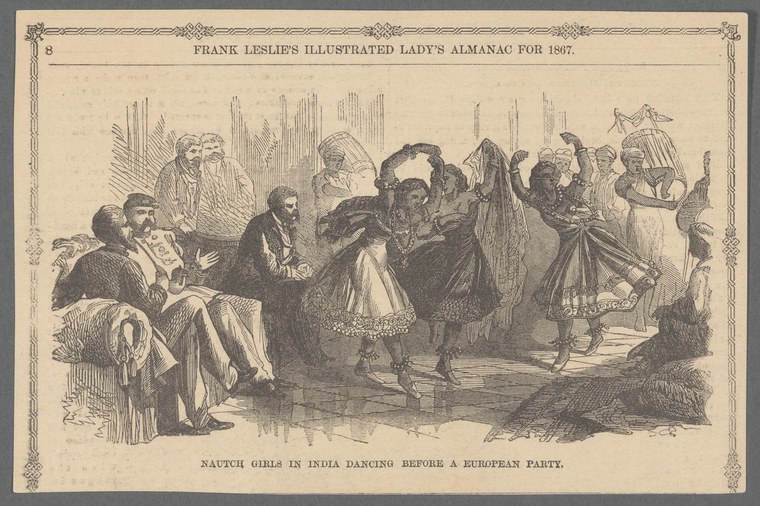
A wood engraving depicts a scene of colonial encounter, with European figures seated and standing in the foreground observing Indian dancers performing in an interior space. The composition shows a theatrical moment of spectatorship: on the left, well-dressed European men and women sit on chairs, watching intently; in the center and right, multiple figures in draped clothing perform what appears to be a coordinated dance, with raised arms and flowing garments creating a sense of movement and spectacle. The setting suggests an indoor European venue—perhaps a drawing room or performance hall—and the arrangement emphasizes the distance and formal observation between the European audience and the performing dancers. The engraving employs strong contrasts of light and shadow typical of the medium, with the dancers' flowing drapery rendered through careful hatching and line work.
The dancing
The dancing figures display upraised arms, some with extended limbs suggesting rhythmic or celebratory movement; the poses appear varied rather than synchronized, suggesting individual rather than strictly choreographed gestures. The performers wear light, draped garments—possibly saris or similar South Asian dress—that billow and move with the action. The European observers maintain formal, seated postures, creating a stark visual contrast between the active, gestural performance and the passive, controlled spectatorship. The spatial separation between dancers and audience is marked and deliberate, emphasizing the nature of this as a display or exhibition rather than participatory social dance.
The dance depicted
The work depicts what the caption identifies as 'Nautch Girls in India Dancing Before a European Party'—a reference to the nautch (or nach), a form of Indian dance performance traditionally associated with professional dancers, particularly women, in colonial-era India. The image reflects a 19th-century European fascination with 'exotic' performance, presenting the dance as a spectacle for Western consumption. The loose, gestural quality of the poses and the theatrical framing suggest entertainment performance rather than classical Indian dance forms, though the draped garments and arm positions echo South Asian movement vocabularies. This is not documentation of authentic practice but rather a European artist's interpretation of a colonial encounter, filtered through contemporary attitudes toward race, gender, and performance.
How it was made
This is a wood engraving, a relief printing technique in which an image is carved into the end grain of a wooden block. The fine line work, precise hatching, and capacity for detail visible here are characteristic of wood engraving at its height in the 19th century. The technique allowed for mass reproduction and wide circulation in printed publications—this work appears to be from Frank Leslie's Illustrated Lady's Almanac for 1867, suggesting it reached a middle-class domestic audience. Wood engraving at this period was the dominant technology for newspaper and magazine illustration, making it the vehicle for widely disseminated images of colonial life and 'exotic' peoples.
About this work
This wood engraving from Frank Leslie's Illustrated Lady's Almanac presents a scene of colonial spectacle: Indian dancers performing for a European audience in what appears to be a formal drawing-room setting. The work documents not the dance itself but the social performance of colonialism—the arrangement of bodies, gazes, and hierarchies that structured 19th-century encounters between European and South Asian cultures. As a mass-produced engraving circulated to middle-class American and European households, it shaped popular understanding of Indian dance as exotic entertainment rather than cultural practice, and of Indian women as objects of Western visual consumption.
The image belongs to a vast archive of colonial imagery produced during the height of European imperial power. It reveals the role of printmaking and illustrated periodicals in constructing and naturalizing colonial hierarchies, making this not simply a representation of dance but a representation of power relations—who watches, who performs, who is positioned as subject and who as spectator.
How to look at it
Attend to the formal composition: the stark separation between audience and performers, the framing that emphasizes spectatorship as the primary event, the minute attention paid to European dress and posture against the more generalized rendering of the dancers. Notice how the engraver has rendered movement through the billowing of drapery and the position of limbs, suggesting animation without precision—this is consistent with how Western artists typically portrayed non-Western dance when unfamiliar with its actual forms and vocabularies. The engraving's technical precision and quality of line work—traits that would convey authority and 'truth' to contemporary viewers—are applied here to an image that is fundamentally a colonial fantasy, not documentation.
The artist
The engraving is reproduced from Frank Leslie's Illustrated Lady's Almanac for 1867, but the original artist is not recorded in the catalogue. Frank Leslie's Illustrated Newspaper and associated publications were among the most widely circulated illustrated periodicals of the 19th century in America, employing teams of artists, engravers, and wood-block cutters to produce thousands of images annually. The visual culture of Leslie's publications was instrumental in shaping American attitudes toward colonialism, race, gender, and global cultures, presenting carefully curated scenes of distant places and peoples designed for middle-class domestic consumption.
The period
This image dates to 1867, in the midst of high Victorian imperialism and during the period when illustrated periodicals had become the primary medium of visual information for literate populations. Nautch performances had long been documented in colonial writing, often with disapproval or prurience; by the mid-19th century, they had become stock subjects in illustrated publications aimed at European and American audiences. The Indian Rebellion of 1857 and the subsequent formal establishment of British direct rule over India (1858) coincided with an explosion of illustrated colonial imagery in Western print media. Images of 'exotic' dance, dress, and rituals served both to educate (or claim to educate) Western viewers and to reinforce narratives of cultural superiority and the 'civilizing mission' of imperialism.
Where it lives
The work comes from Frank Leslie's Illustrated Lady's Almanac for 1867, held in the New York Public Library's collection of dance-related prints. Frank Leslie's was a major American illustrated periodical, and almanacs were popular domestic publications, suggesting this image reached a broad middle-class audience.
Dance in this work
Questions about this work
What is a nautch, and is this a realistic depiction?
Nautch (nach) refers to performances by professional dancers, traditionally women, in South Asia. This engraving is not a realistic ethnographic document but rather a European artist's interpretation filtered through colonial attitudes and theatrical conventions of the period. The loose, gestural poses and theatrical staging reflect what Western audiences expected 'exotic' dance to look like, not documented actual practice of classical Indian dance forms or authentic nautch performance.
Why is this in a 'Lady's Almanac'?
Almanacs were popular domestic publications aimed at middle-class households, particularly women. Including scenes of 'exotic' and often sexualized performances of women from colonized regions served multiple purposes: entertainment, titillation, and reinforcement of ideas about Western cultural superiority. The framing of Indian women dancers as spectacle for European female viewers was part of broader colonial visual culture.
What does the composition tell us about colonial power dynamics?
The spatial and visual hierarchy is explicit: Europeans sit passively, formally dressed, and are positioned as the primary focus; Indian dancers stand or gesture, their bodies available for visual consumption, positioned as entertainment. This arrangement—who watches and who is watched—encodes fundamental colonial hierarchies of power, race, and gender.
More dance artwork





