49 works in this view — arrow keys or swipe to move between them.
Dance in Art
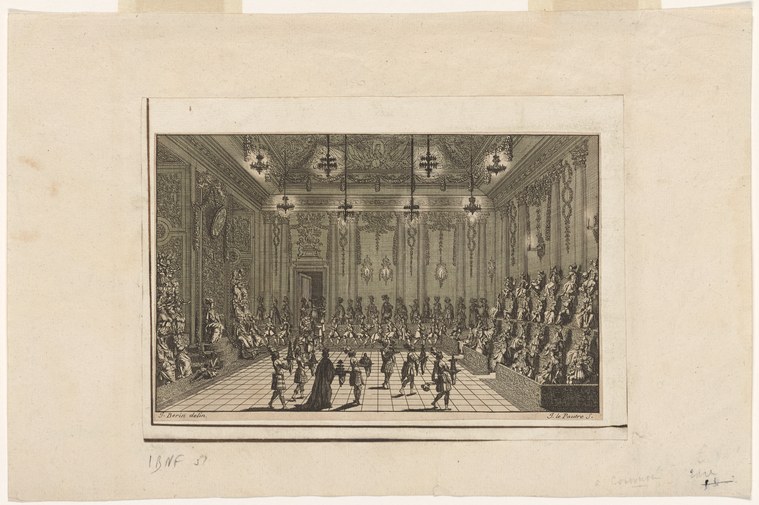
Collation servie au cours d'un bal donné à Versailles en 1683
Unknown artist
- Collection:
- Prints depicting dance
- Source:
- New York Public Library
- Rights:
- Public domain — free to use, share and adapt.
- Recorded as:
- Public Domain
This is documentary evidence of court dance as lived practice, not as technique or ideology. It shows the ratio of dancers to observers, the distance between partners, the posture and restraint required, and the integration of dance into a larger ceremonial event. For historians of dance and manners, it is a primary source; for artists, it demonstrates how engravers of the period translated three-dimensional courtly movement into a two-dimensional architectural and social document.
What you are looking at
A formal court ball in a grand palace hall, seen from an elevated vantage point that captures the entire ornate interior. The space is defined by soaring columns and an elaborate coffered ceiling from which hang multiple chandeliers providing light. The walls are richly decorated with pilasters and ornamental relief work typical of 17th-century aristocratic architecture. The floor is a geometric pattern of light stone. Hundreds of courtiers fill the hall in small clusters and pairs; many stand along the walls in observation, while couples occupy the floor itself. The dress is uniformly formal: men in long coats and breeches, women in full-skirted gowns of the period. In the immediate foreground, several groups converse or stand at ease; toward the center and middle distance, couples are engaged in the measured movements of formal social dance. The scene captures not a climax of energy but a moment of composed courtly ritual—this is how aristocratic bodies moved together in the late 17th century.
The dancing
The dancers visible on the floor are arranged in scattered pairs and small groups rather than in a unified line or formation. The couples maintain upright posture with considerable space between partners—no close frame visible. Men's arms appear extended in the period manner, guiding rather than holding; women's bodies are erect within the constraint of their skirts. The movement implied is restrained and processional rather than dynamic. Many figures on the periphery stand in conversation or observation, emphasizing that dance was one element of a broader social performance. The dancers themselves move with deliberate formality, their bodies expressing rank and courtship protocol rather than athleticism.
The dance depicted
This depicts court dance of the late 17th-century French baroque—almost certainly a minuet or contredanse, the dominant social dances of Versailles during the reign of Louis XIV. The 1683 date places this at the height of the court's formality and ceremony. The dance as shown here is a social interaction governed by strict rules of etiquette: couples take turns in prescribed patterns on the floor while the court observes and waits. What we see is not the dance itself in the modern sense but the dance as an element of courtly behavior—a performance of rank, restraint, and dynastic power. The actual footwork, if it involved the complex sequences of the minuet, would not be fully visible at this scale and distance, and the artist has chosen not to emphasize it.
How it was made
This is an engraving, identifiable by the parallel hatching lines used to create tone and shadow, the sharp crisp lines defining architectural detail, and the tonal gradations achieved through varying line density. The technique allowed wide circulation as multiple impressions could be pulled from a single plate, making images of court ceremony available to the broader aristocratic and bourgeois classes across Europe. The precision of the line work and the scale of the composition—the artist has rendered architectural perspective and hundreds of distinct figures—indicates a skilled professional engraver working from a drawing or painting. The print medium speaks to the documentary function of this image: to record and distribute a visual account of royal ceremony.
About this work
This engraving documents a collation—a formal supper or reception—held at Versailles in 1683, with dance as one component of the ceremonial proceedings. The work is both a historical record and a visual argument about power: the immensity and order of the space, the uniformity of dress and behavior, the precise hierarchy of positions from center to periphery, all communicate the absolute control the crown exercised over courtly life. For anyone studying 17th-century dance in its actual social context—not as an isolated art form but as protocol, courtship, rank negotiation—this engraving is invaluable. It shows what bodies were meant to do and where, and how dance functioned as one language among many in the grammar of absolute monarchy.
How to look at it
Attend first to the architecture and its message: the scale and ornament express power. Then track the distribution of bodies—the clusters of dancers on the floor are small and scattered, while the walls are lined with observers, conveying the ritual nature of the event and the importance of being seen. Look at the posture and spacing of the dancing couples: they are composed and distant, not intimate. The artist has chosen a moment not of motion but of ceremony, capturing the pause and formality of courtly dance rather than any instant of virtuosity. The perspective draws the eye toward the far end of the hall, creating depth and emphasizing the vastness of the space; this is a deliberate choice to make the event appear grander and more imposing than a close view would.
The artist
The artist is not recorded in the catalogue. The style and subject matter suggest a professional court engraver or a workshop associated with documenting royal ceremonies, likely French or Flemish. The precision of the perspective and the ambitious scale indicate someone trained in architectural and narrative engraving and practiced in rendering large crowds and palatial settings. The work may have been commissioned to commemorate the event or published as part of a larger series documenting royal festivities.
The period
In 1683, Louis XIV's court at Versailles was at its zenith of formality and ceremonial elaboration. Dance was a mandatory social practice for the aristocracy—a test of breeding, grace, and obedience to courtly law. The minuet and contredanse were the principal forms, performed in highly codified sequences. This was also the period when dance manuals were proliferating (Beauchamp and others were publishing descriptions of the five positions and basic steps), yet court dance remained fundamentally a social and political performance rather than a technical art. The engraving belongs to a tradition of court documentation that served both to celebrate royal power and to circulate models of courtly behavior to provincial nobility and aspiring bourgeoisie.
Where it lives
The work is held in the New York Public Library's prints collection focusing on dance imagery. It is an impression of an engraving; the plate and edition information are not recorded in the catalogue. The object's presence in a dedicated dance collection suggests later recognition of its value as dance documentation, though it was originally conceived and circulated as a record of court ceremony.
Dance in this work
Questions about this work
Is this actually depicting a dance, or just a formal gathering?
It is both. The event was a collation—a formal meal or reception—at which dance was one of several courtly performances. Several couples are visibly engaged in movement on the floor; the rest of the court stands in prescribed positions, watching and waiting. Dance here is not separate from courtly life but woven into it.
Why does no one look like they are moving?
The minuet and contredanse were slow, measured dances governed by strict rules of deportment. A dancer was supposed to look composed and graceful, not energetic or wild. The engraver has captured the aesthetic of restraint and control that courtly dance demanded. The movement existed, but it was calibrated and serene.
What was a collation at Versailles?
A collation was a formal reception or light supper, usually part of a day's ceremonial activities at court. It provided an occasion for the assembled nobility to perform courtship, alliance-building, and deference to the king through prescribed social behaviors, of which dance was a central element.
Could everyone at court dance, or was it only for professionals?
Court dance was mandatory for the aristocracy—all nobles were expected to dance well as a marker of breeding and obedience. There were no professionals in the modern sense; dance was simply part of what it meant to be a courtier. Poor execution could damage one's standing.
More dance artwork





