49 works in this view — arrow keys or swipe to move between them.
Dance in Art
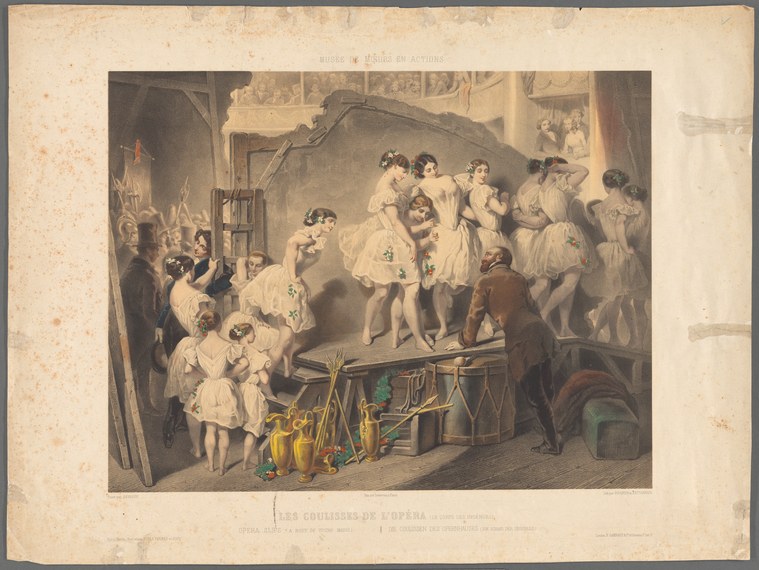
Les coulisses de l'Opéra (le corps de ingénues)
Unknown artist
- Collection:
- Prints depicting dance
- Source:
- New York Public Library
- Rights:
- Public domain — free to use, share and adapt.
- Recorded as:
- Public Domain
This work is essential evidence of how ballet was actually made and who made it. The Romantic ballet as depicted in idealized prints and paintings presents only the public spectacle; this image reveals the institutional structure, labor, and bodies of the ensemble that sustained it. It challenges the myth of the ballerina as ethereal muse by showing the material conditions of her work—the crowding, the casual physicality, the lack of ceremony in preparation. For historians of dance, labor, and nineteenth-century theater, it is invaluable.
What you are looking at
A bustling backstage scene at a grand opera house, rendered in hand-colored engraving. The composition is crowded with female dancers in various states of undress and preparation, wearing light gauze tunics and wraps. The foreground shows young dancers, some seated on a bench and examining costumes or props—bright yellow fabric and other stage materials are scattered about. The middle ground is dominated by a group of standing dancers, many bare-shouldered or partially dressed, arranged in loose clusters. The background recedes into shadow, with more figures barely visible in the wings. The lighting is warm and theatrical, casting the scene in golden tones with deep shadows that emphasize the theatrical space. A door or archway frames the left side, suggesting the transition between dressing room and stage. The mood is intimate but chaotic—a glimpse into the labor and vulnerability behind the spectacle.
The dancing
The dancers' bodies are relaxed and naturalistic rather than posed—weight rests on one leg, arms hang at sides or rest on companions' shoulders, heads incline conversationally. None are in active dance positions; these are bodies at rest between performances. The composition emphasizes the contrast between the young women's lithe, youthful forms and their informality. The artist has rendered a spectrum of body types and postures, avoiding the uniform idealization of stage imagery. Several figures touch or lean against one another with ease, suggesting camaraderie or the casual physical contact of shared labor.
The dance depicted
This is not a dance scene in the conventional sense but a document of the dancer's working life. It depicts the corps de ballet of the Paris Opéra—the 'ingénues' of the title—in their dressing room or backstage preparation area. The print shows what audiences never saw: the bodies and social dynamics of the ensemble dancers who filled the stage in group scenes. The gathering appears to be a moment before or between performances, capturing the institutional structure and human reality of Romantic-era opera ballet. This is a behind-the-scenes genre scene, not a representation of a dance itself, though it speaks directly to how ballet was produced and who performed it.
How it was made
This is a hand-colored engraving or aquatint, characteristic of French popular theater imagery of the mid-nineteenth century. The technique allowed for mass reproduction and wide circulation, reaching audiences hungry for glimpses of opera house life and celebrity dancers. The coloring, applied by hand, suggests this was a valued object rather than a throwaway print—the care in rendering skin tones and fabric differentiation indicates a skilled colorist. The engraving's tonal range and fine lines allow for both intimate detail (the individual faces, the texture of garments) and atmospheric effect (the shadowy depths receding into the background).
About this work
Les Coulisses de l'Opéra (The Backstage of the Opera) offers a rare window into the working reality of ballet dancers at the Paris Opéra during the Romantic era. Rather than presenting the idealized fantasy of ballet—the ethereal, often erotic vision of the ballerina—this print shows the ensemble dancers in a moment of respite, undressed and unhurried. The title's reference to 'ingénues' (young, inexperienced women) speaks to both the youth and the disposability of corps dancers; many were young working-class women for whom ballet was employment rather than art. The print circulated as popular imagery, offering the bourgeois viewer a thrilling glimpse into the backstage world—a space of intimacy and slight transgression, where women's bodies could be observed in private. It is both a document of theatrical practice and a voyeuristic fantasy.
How to look at it
The viewer should attend to the casual, unhierarchical arrangement of figures—no ballerina is spotlit or centered; instead, bodies overlap and crowd the frame. Notice the variety of body types and ages among the dancers, contradicting the uniform idealization of stage imagery. Look at the details of preparation: the costumes and props scattered about, the informal touching and conversation, the mix of dressed and undressed figures. The artist has chosen a moment of absolute non-event—no drama, no spectacle, just the waiting and preparation that fills most of a dancer's day. The warm lighting and intimate scale invite the viewer into a private space; this is a scene designed to feel like eavesdropping.
The artist
The artist is unknown, which is typical of popular theater prints of this period. Such prints were often produced by print shops or publishers (the NYPL attribution suggests French origin) and may have involved multiple hands—engraver, colorist, designer. The work belongs to a rich tradition of backstage and theatrical imagery that catered to the public's fascination with opera house life.
The period
The Romantic era (1820s–1840s) saw ballet reach unprecedented popularity and cultural centrality in Paris, the ballet capital of Europe. The Paris Opéra Ballet was the most prestigious company, and its dancers—particularly the female corps—were celebrities and objects of intense public interest. This period also saw a shift in how dancers' bodies were regarded: the elevation and spiritualization of the ballerina in works like *La Sylphide* (1832) coexisted with a thriving market in voyeuristic images of dancers in undress or private moments. The genre of 'backstage' or 'coulisses' imagery became increasingly popular in the 1830s–1850s, appealing to middle-class audiences curious about the machinery of spectacle and the lives of performers. At the same time, there was growing concern about the morality of the ballet, with critics and moralizers troubled by the exposure of dancers' bodies and the economic desperation that drove many into the profession.
Where it lives
This print is held by the New York Public Library in its collection of prints depicting dance. It is a hand-colored engraving or aquatint, likely French, of mid-nineteenth century origin. Such works were produced for popular consumption and circulation, part of the thriving market in theater-related imagery.
Dance in this work
Questions about this work
Did dancers really look like this backstage?
Probably not exactly. This is a stylized print made for public consumption, and the artist has selected and arranged figures to create a compelling composition. However, the informality and physical ease of the dancers rings true—these are bodies at rest, not posed for an audience. The print tells us what mattered to viewers: the youth and variety of the ensemble, their semi-clothed state, and the crowded, intimate social world of the dressing room.
What were 'ingénues' in the ballet?
In the nineteenth-century French ballet, an ingénue was a young, often inexperienced female dancer, typically in the corps de ballet. The term also carried connotations of innocence or naiveté—useful marketing for an industry that sold the fantasy of young, beautiful, available women. Many ingénues were working-class girls who had no other economic options; the ballet offered wages, housing, and potential access to wealthy patrons, though it also subjected them to intense scrutiny and exploitation.
Why would viewers want to see this?
The backstage image offered viewers a fantasy of access—a glimpse into the private world of performers, especially at a moment when their bodies were exposed and unguarded. It flattered bourgeois curiosity about how the theatrical spectacle was made while feeding a specifically erotic interest in the dancers' bodies. The print also served as a souvenir of a visit to the opera or a keepsake for someone infatuated with a particular dancer.
Is this image criticizing the ballet or celebrating it?
Neither explicitly, though the tone is equivocal. The crowding, the semi-undress, and the casual physicality could be read as flattering (intimate, human, sensual) or as unflattering (chaotic, undignified, exposing the machinery of illusion). The artist seems more interested in documentary observation than judgment, but the work's very existence—its circulation as popular imagery—speaks to anxieties about dancers' bodies and morality that haunted the Romantic era.
More dance artwork





