49 works in this view — arrow keys or swipe to move between them.
Dance in Art
Ver
Unknown artist
- Collection:
- Prints depicting dance
- Source:
- New York Public Library
- Rights:
- Public domain — free to use, share and adapt.
- Recorded as:
- Public Domain
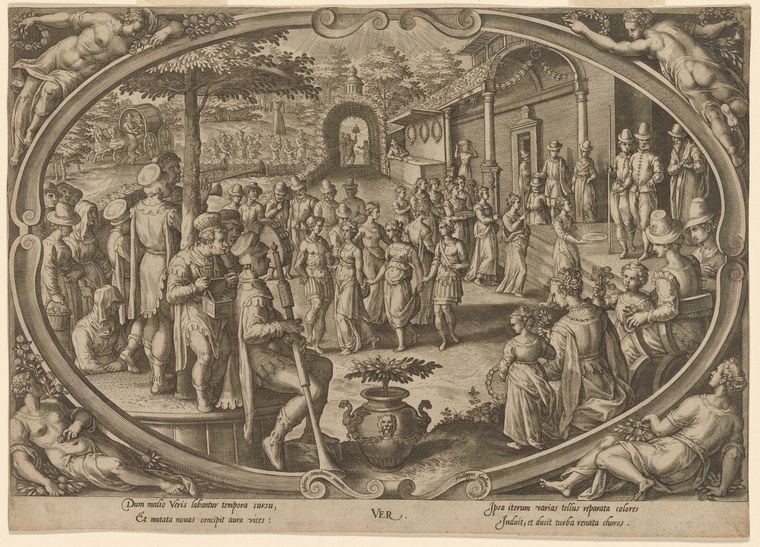
This image provides rare visual evidence of how Renaissance courtiers actually arranged themselves during formal festivities and of the spatial and social conventions governing court dance. The specificity of the costume, the density of figures, and the dual interior-exterior setting offer a more complex picture of court dancing than many single-couple or narrative compositions. For historians of dance, it illustrates the relationship between architecture, dress, and movement in elite entertainment.
What you are looking at
This is an engraving depicting a festive outdoor and indoor celebration, likely a spring festival or court entertainment given the title 'Ver' (Spring). The composition is divided into two spatial zones: a garden scene on the left with figures processing and gathering beneath trees, and an architectural interior on the right showing a more formal gathering within a colonnade or loggia. The central foreground features an ornamental vessel or urn, likely for flowers or wine. Dozens of elegantly dressed figures populate both spaces—men in doublets and hose, women in full-skirted gowns and headdresses typical of sixteenth-century court dress. The figures are engaged in various social interactions: some process in an orderly fashion, others converse in groups, and several appear to be in motion, suggesting dancing or ceremonial procession. The scene is framed by an elaborate oval border with scrollwork and putti (cherubs) in the corners, a typical device of Renaissance and early Baroque engraving. The light is evenly distributed across the composition, characteristic of intaglio printing.
The dancing
The figures are rendered with attention to courtly posture and hierarchical spacing. Several women in the right portion appear to be in the early stages of a formal dance—their bodies are upright, their skirts full and arranged for display, their arms at various positions suggesting the measured, stately movement of court dance. The proportions and poses suggest figures trained in courtly deportment rather than folk movement. Men and women are distributed throughout both spaces, suggesting a mixed gathering rather than segregated or gender-specific activity. The density of figures increases toward the architectural interior, where the most formal proceedings appear to take place.
The dance depicted
The image most likely depicts a court dance or a formal festive celebration incorporating dance, consistent with Renaissance and early modern court culture. The orderly procession, the formal dress, the architectural setting, and the oval composition all point to a depiction of courtly entertainment—possibly a masque, festival, or ceremonial dance gathering. The mixed presence of men and women, the upright carriage, and the measured spacing suggest partner dances or group formations typical of Renaissance court practice, such as pavan, galliard, or a processional basse danse. However, without clearer evidence of specific dance positions or holds, the identification remains at the genre level of historic court entertainment rather than a specific named dance.
How it was made
This is an engraving, identifiable by the fine parallel hatching lines used to build tone and shadow, the precision of line work, and the characteristic appearance of intaglio printing. The elaborate border with scrollwork and cherubs, the density of detail across the composition, and the formal framing suggest this was a substantial, ambitious work intended for circulation among educated and courtly audiences. The technique allows for fine detail in dress and architectural elements while maintaining the overall clarity necessary for the narrative and social hierarchies to be readable. The skill evident in the execution suggests a professional workshop product, likely created for a wealthy patron or collector.
About this work
This engraving depicts a spring festival or court entertainment combining procession, social gathering, and dance in both garden and architectural settings. The work captures the elaborate costume, hierarchical arrangement, and formal movement conventions of Renaissance or early Baroque court life. It belongs to a tradition of festive and ceremonial imagery that documented elite social practices and served as both record and model for court behavior. The presence of clearly rendered figures engaged in or about to engage in patterned, formal movement makes this a significant document of how dancing functioned within Renaissance court culture—not as isolated performance but as integrated social and ceremonial practice.
How to look at it
Attend first to the two spatial registers—garden and interior—and notice how the composition mirrors courtly life's movement between formal and informal spaces. Look at the groupings: observe which figures are isolated, which in pairs, and which in processional lines; these arrangements signal the types of social and dance formations at work. Notice the extreme formality of dress and carriage—every figure maintains an upright, composed posture consistent with courtly training. The central vessel and the symmetrical framing draw the eye to the center of festive action, asking you to read this as an organized, hierarchical celebration rather than a spontaneous gathering. The engraver's choice to include both movement and stillness—some figures clearly in motion, others conversing—captures the rhythm of court entertainment, which alternated between formal dances and social intervals.
The artist
The artist is not recorded. The engraving's style, quality of execution, and subject matter are consistent with mid-sixteenth-century Northern European workshop production, possibly German or Flemish. The monogram or signature, if present, is not clearly visible in the available image. The work may be one of a series on the seasons or festive themes, a common publishing venture of the period.
The period
This engraving dates to an era when court dance was undergoing rapid formalization and codification. The Renaissance court, particularly in the sixteenth century, saw the emergence of published dance manuals and the integration of dance into elaborate courtly ceremonies and entertainments. Festivals celebrating the seasons, royal occasions, or allegorical themes were occasions for displaying wealth, order, and cultural sophistication. The mixing of architectural and garden settings reflects the Renaissance ideal of the integrated court as both building and landscape—spaces designed for both ceremony and informal gathering. Engravings of festive and allegorical scenes were widely circulated among courts and collectors, serving as both records and aspirational models.
Where it lives
This work is part of the New York Public Library's collection of prints depicting dance. It is catalogued with minimal metadata; the title 'Ver' and the engraved form are documented, but artist, date, and medium are not recorded in the available catalogue entry.
Dance in this work
Questions about this work
What kind of dance is actually being shown here?
The image does not depict a single, recognizable dance in progress but rather a festive gathering in which dance is one element among procession, conversation, and social display. The formal dress, arrangement, and setting suggest this is Renaissance or early Baroque court culture, where dancing would have included pavan, galliard, or formal processional dances. The specific choreography is not visible; instead, the engraving documents the social and spatial context in which dance occurred.
Why are there so many people, and why are they arranged this way?
The density and hierarchical arrangement reflect the reality of court entertainment, which was a public performance of social order and allegiance. Rank, gender, and role determined placement and participation. The garden and interior settings show how Renaissance courts used both spaces for integrated ceremonies and festivities. The crowd also documents the scale of court life—these events were not intimate but large, orchestrated displays.
How do we know this is about spring?
The title 'Ver' (Latin for Spring) is documented in the catalogue record. The presence of trees, flowers (suggested by the central vessel), and outdoor gathering reinforce a seasonal theme. This engraving likely belonged to a series on the seasons, a common allegorical subject in Renaissance art and literature.
Could this be a specific famous event?
Without artist attribution or date, and given the allegorical title, this is more likely a generic depiction of an ideal court festival than a record of a specific historical event. However, the style and subject suggest it could document conventions observed in actual sixteenth-century court practice, particularly in German or Flemish courts.
More dance artwork





