49 works in this view — arrow keys or swipe to move between them.
Dance in Art
The Venetian wedding
Unknown artist
- Collection:
- Prints depicting dance
- Source:
- New York Public Library
- Rights:
- Public domain — free to use, share and adapt.
- Recorded as:
- Public Domain
This is one of the few surviving visual records of how Venetian wedding celebrations were structured and how dancing participated in that structure. For historians and dancers studying Renaissance courtly practice, the engraving provides evidence of spatial arrangement, costume, and social role that written records alone cannot supply. It demonstrates how the printed image became a tool for documenting and disseminating knowledge of court ceremony across Europe.
What you are looking at
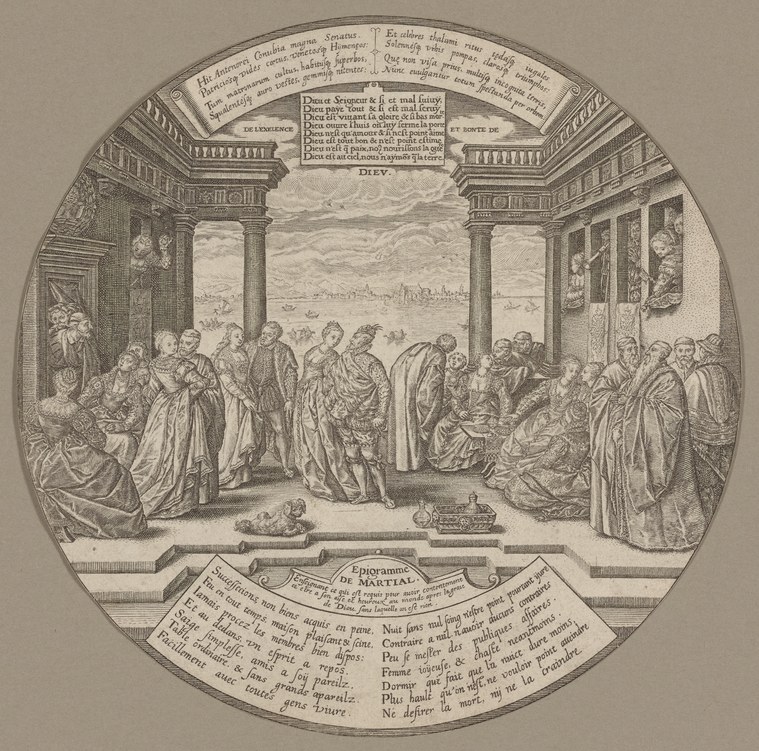
This is a circular engraving depicting an elaborate Venetian wedding feast within a classical colonnade. The scene is viewed from above in a flattened perspective, showing two rows of columns framing a long table laden with food and vessels. Around the table and throughout the space, approximately thirty figures in Renaissance dress—men in doublets and hose, women in long gowns with headdresses—are arranged in patterns that suggest both formal ceremony and social interaction. Some figures stand in clusters, others gesture toward the central table, and several appear to be moving or dancing. The lighting is uniform, rendered through fine hatching and line work typical of Northern European engravings. The architectural frame is precise and orthogonal, creating a sense of ordered ceremony. Beyond the colonnade, a distant landscape with water and buildings suggests Venice itself. Latin text in cartouches at the top and bottom frames the scene with explanatory inscriptions.
The dancing
The figures are rendered with careful attention to Renaissance silhouette and bearing. Several pairs show physical proximity and turned-body postures consistent with courtly interaction or dance frame, though the flattened perspective and engraving technique obscure precise hold or footwork. Groups cluster in what may be dance formations or processional order. The figures in the foreground show varied arm positions—some gesturing openly, others held at the sides or raised—typical of courtly deportment rather than energetic movement. Their weight distribution and stance suggest statues or posed moments rather than captured motion, which is characteristic of formal Renaissance feast imagery.
The dance depicted
The image most likely depicts a formal Venetian wedding celebration, possibly incorporating dancing as part of the ceremonial entertainment. Venetian weddings of the Renaissance and early modern period regularly featured dancing during banquets, typically balli (formal courtly dances) executed by select participants and observed by the assembled company. The arrangement of figures in the circular composition and the apparent grouping patterns suggest the formalized social dances of the Renaissance—possibly allemandes, pavanes, or galliards—though the flattened perspective and engraving convention make specific identification of steps or choreography impossible. This is a documentary record of an event type rather than evidence of a particular dance style being performed.
How it was made
This is a finely executed engraving, likely produced in the Northern European tradition of the 16th or 17th century (the technique and style suggest that period, though the catalogue record does not confirm it). The use of line, hatching, and carefully controlled density of marks creates both architectural precision and spatial depth within a two-dimensional format. Engravings of this type were produced for circulation among the educated elite—clients, artists, and collectors—and served as documentary records of significant events and as models for artistic practice. The circular format is notable, lending the scene the quality of a view through an aperture or of a contained ceremonial space. The Latin inscriptions suggest a learned audience and a didactic or commemorative purpose.
About this work
This engraving documents a formal Venetian wedding celebration, recording the architecture, dress, and choreography of early modern court festivity. It is a primary visual source for understanding how dance functioned within aristocratic life—not as a spectacle but as one element of a complex ceremonial ensemble that included feasting, conversation, and social display. The work sits at the intersection of architectural documentation, social history, and dance practice, showing how engravings served as vehicles for recording the ephemeral event of the court dance for posterity and for circulation among those who could not attend.
The image is valuable precisely because it treats dance as incidental to the larger spectacle rather than as the focal point—a reminder that early modern courtly dance was embedded in ritual, hierarchy, and the performance of social order rather than existing as an autonomous art form. The composition records an ideology of formality and control that shaped how dancing bodies were supposed to move and appear within courtly space.
How to look at it
Attend first to the architectural frame and the precise ordering of the space—this is not a naturalistic scene but a constructed display of hierarchy and ceremony. Then observe the distribution of figures: who stands where, whose body language is active and whose is passive, how clusters of people relate to the central table. Notice the dress, which marks rank and region. Look for any figures whose posture or proximity to another suggests a dance frame or partnering, though the engraving's formal convention means that even if people are dancing, they are rendered as composed and controlled. The Latin text at top and bottom likely provides crucial information about the event, the participants, or the occasion being commemorated.
The period
Venice in the 16th and 17th centuries was a republic structured around merchant aristocracy and elaborate ceremonial display. Weddings of prominent families were major civic events, and elaborate feasts with music and dancing were expected elements of the celebration. Renaissance dancing manuals from Italy and Northern Europe (by Guglielmo Ebreo, Thoinot Arbeau, and others) codified the balli and branles that would have been performed at such events. The circulation of engraved images of court scenes—including feasts, tournaments, and processions—was itself a courtly practice, allowing distant courts to model their own ceremonies on Venetian precedent. By the early 17th century, such images had become a standard genre for documenting court life.
Where it lives
This engraving is held in the NYPL's Prints collection, which specializes in engravings, etchings, and lithographs documenting social, ceremonial, and artistic subjects. It arrived in the collection as part of a broader effort to document visual culture and courtly practice across Europe. The collection's strength in Northern European prints of the Renaissance and early modern period reflects the historical importance of printmaking in those regions and the material survival of such works.
Dance in this work
Questions about this work
Is anyone actually dancing in this picture?
Possibly, but it is impossible to say with certainty. The engraving records a wedding feast at which dancing would have occurred, and the arrangement of some figures suggests groupings that could be dancing couples or sets. However, the formal flat perspective and the classical engraving technique work against capturing motion convincingly. The image records the event type and the space rather than frozen action.
How do we know this is Venetian?
The title in the catalogue record identifies it as depicting a Venetian wedding. The distant cityscape beyond the colonnade shows water and architecture that could represent Venice. The Latin inscriptions may contain the location and occasion, though a full translation would be needed to confirm.
What kind of dances would have been performed at a Venetian wedding of this period?
Renaissance Italian manuals document formal balli, which were choreographed group dances of great complexity, and also the more social bassadanza and saltarello. Northern European traditions included the pavane, galliard, and branle. Venetian ceremonies would likely have featured Italian styles, possibly executed by professional dancers or by members of the aristocracy for display. The dances would have been serious, formally structured, and designed to demonstrate the dancers' rank and training.
Why is the perspective so flattened and strange?
This is a convention of Northern European engraving used to show spatial complexity and to allow the viewer to see all the figures and architectural elements clearly. Rather than rendering the scene in perspective as the eye would see it, the artist has tilted the picture plane so that all the figures and the table are legible. This makes it easier to document who was present and how the space was organized, which appears to be the primary goal of the image.
More dance artwork





