49 works in this view — arrow keys or swipe to move between them.
Dance in Art
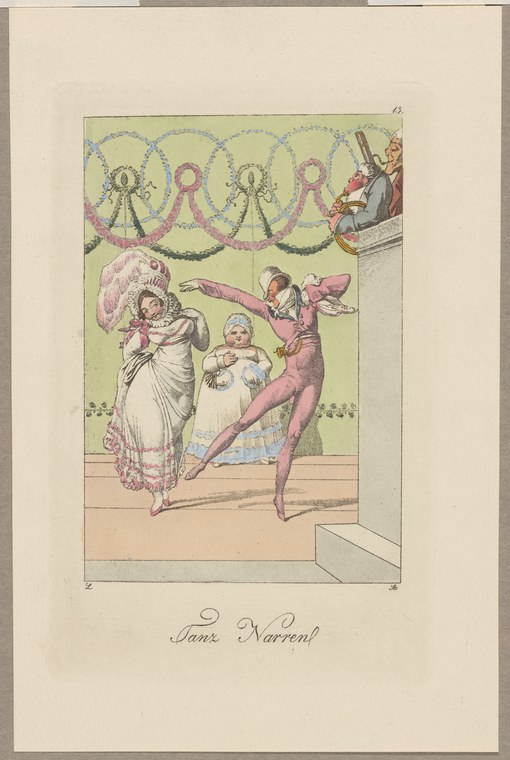
Tanz Narren
Unknown artist
- Collection:
- Prints depicting dance
- Source:
- New York Public Library
- Rights:
- Public domain — free to use, share and adapt.
- Recorded as:
- Public Domain
This print documents a style of theatrical dance and physical comedy now invisible—the carnivalesque lifting and display dances of the 18th-century stage. It shows that what we call 'dance' in this period was not always the formalized steps of ballet or the social courtesies of ballroom, but rather acrobatic play, character transformation, and visual spectacle. For historians of performance and embodiment, this image is evidence of how the body was moved and displayed on stage for laughter and delight.
What you are looking at
A hand-colored engraving depicts three figures in a theatrical interior space with draped curtains overhead. At center, a woman in classical dress—a white diaphanous gown with pink drapery—is being lifted or supported by two semi-nude male figures painted in rose-pink tones. The figure on the left appears to be a satyr or faun, recognizable by his wild hair and partially draped costume; the figure on the right is a winged putto or cherub. The woman's pose is languid and theatrical, her body curved in an elegant arc. The space is shallow and stage-like, with swags and bows of rope or ribbon in gray-green overhead, and architectural framing that suggests a proscenium. The color palette is soft and delicate—pale yellows, pinks, greens, and whites—typical of late 18th-century hand-coloring.
The dancing
The woman's body is lifted horizontally or nearly so, supported under her torso and legs by the two male figures. Her arms are relaxed or slightly extended, and her head tilts back in a gesture of abandonment or ecstasy. The satyr on the left leans forward with bent knees and flexed arms, bearing weight; the putto on the right hovers or leaps upward to support her legs, his small wings spread. The composition suggests neither a partnered waltz nor a folk dance but a theatrical lifting or aerial pose—a moment of joyful suspension or play.
The dance depicted
The title *Tanz Narren* (Fools' Dance or Dance of Fools) suggests carnivalesque or theatrical foolery, likely referring to a genre of entertainment dance popular in 18th-century European theater where comic or demimonde characters—satyrs, cherubs, nymphs—performed in mythological or fantastical tableaux. The woman is not a partner being led but a body being physically elevated and displayed, characteristic of theatrical spectacle or burlesque. The pose and figures point toward a fusion-commercial or theatrical dance tradition—pantomime, opera ballet, or popular stage entertainment—rather than a ballroom or folk dance. The satyr and putto suggest this is not naturalistic dance but character performance within a theatrical frame.
How it was made
This is a hand-colored engraving, recognizable by its fine linear detail, the way the drapery and facial features are defined by controlled line-work, and the application of watercolor wash in discrete zones (whites in the gown, pinks in the bodies, greens in the swags). The technique was standard for popular theatrical prints in the late 18th century and allowed for affordable reproduction and hand-finishing in small workshops. The control of the engraved line and the delicate hand-coloring indicate this was made for a paying audience—theater-goers, collectors of prints, or patrons of dance spectacle. The signature 'Tanz Narren' and the print's presentation (mounted on mat card) suggest it was sold as a single sheet or in a series of dance or theatrical scenes.
About this work
This is a hand-colored engraving of a theatrical dance scene, most likely from the late 18th century, depicting a moment of joyful physical comedy between a woman, a satyr, and a putto. The composition and figures belong to a tradition of theatrical spectacle and carnival entertainment that merged pantomime, operatic dance, and folk burlesque in popular European entertainment. The engraving preserves a fleeting moment of stage business—the lifting and display of a female body in a scene of mythological mischief—and reveals how dance in this period was inseparable from costume, character, and visual joke. It is evidence of a now-lost performance tradition and the visual culture of theater-going in the 18th century.
How to look at it
Attend to the moment the engraver chose: not the beginning or end of a step, but the moment of suspension and weightlessness—the woman held aloft by her unlikely helpers. The satyr's bent knees and forward lean show the effort of lifting; the putto's upward reach and wings suggest effortless flight. The woman's relaxed, arched posture shows trust and abandon. This is not documentary of technique but theater of the body—a visual joke played out through the contrast between the woman's classical grace and the satyr's comic strain. The swags overhead frame the moment and declare it as staged spectacle, not street carnival.
The period
The late 18th century saw a flourishing of theatrical prints—hand-colored engravings documenting scenes from popular plays, operas, and comic pantomimes. These prints were sold cheaply and served as souvenirs and advertisements for performances. The figure of the satyr or faun was a stock character in theatrical comedy and mythological burlesque, often used to represent libertine desire, mischief, and physical comedy. The Enlightenment enthusiasm for classical mythology and the simultaneous rise of popular theater meant that scenes like this—blending Arcadian fantasy with acrobatic display—were commercially viable and widely circulated. The composition and delicate hand-coloring align with the aesthetic preferences of the 1770s–1790s.
Where it lives
This engraving is held in the New York Public Library as part of its collection of theatrical and dance prints. The holding reflects the NYPL's mission to preserve visual documentation of performance and popular culture. The mount and presentation suggest this was a single-sheet print, likely sold to theatergoers or collectors of theatrical imagery in the late 18th century.
Dance in this work
Questions about this work
What does 'Tanz Narren' mean?
'Tanz Narren' translates from German as 'Fools' Dance' or 'Dance of Fools.' The title signals that this is a scene of comic, mischievous play rather than serious or formal dance. The 'fools' may be the satyr and putto, who cavort with the woman, or the dancers themselves, who are performing foolish or ribald entertainment.
Is this a real dance step or purely theatrical invention?
This appears to be theatrical spectacle rather than a codified dance step. The lifting and aerial pose suggest acrobatic theater or burlesque pantomime—a moment of physical comedy staged for visual effect. While partnering and lifts existed in 18th-century dance, the explicit presence of mythological characters and the theatrical framing indicate this is stage entertainment, not ballroom or courtly dance.
Who performed dances like this?
Professional theater dancers, opera dancers, and pantomime performers in European theaters of the late 18th century would have executed these scenes. Satyrs and cherubs were often played by male dancers or acrobats, while the female roles called for actresses with both grace and comic timing. These were commercial entertainments, performed in urban theaters and seen by paying audiences of mixed social rank.
Why is this print hand-colored?
Hand-coloring was the primary method of producing color prints in the 18th century and early 19th century. The engraved line was printed in black ink, and the color was applied by hand, usually in a small workshop. This made each print slightly unique and allowed producers to sell them at a range of prices depending on the quality of coloring. The delicate, watercolor-like finish indicates this was a higher-quality example, likely aimed at educated collectors or theater patrons.
More dance artwork





