49 works in this view — arrow keys or swipe to move between them.
Dance in Art
Waltzer au mouchoir
Unknown artist
- Collection:
- Prints depicting dance
- Source:
- New York Public Library
- Rights:
- Public domain — free to use, share and adapt.
- Recorded as:
- Public Domain
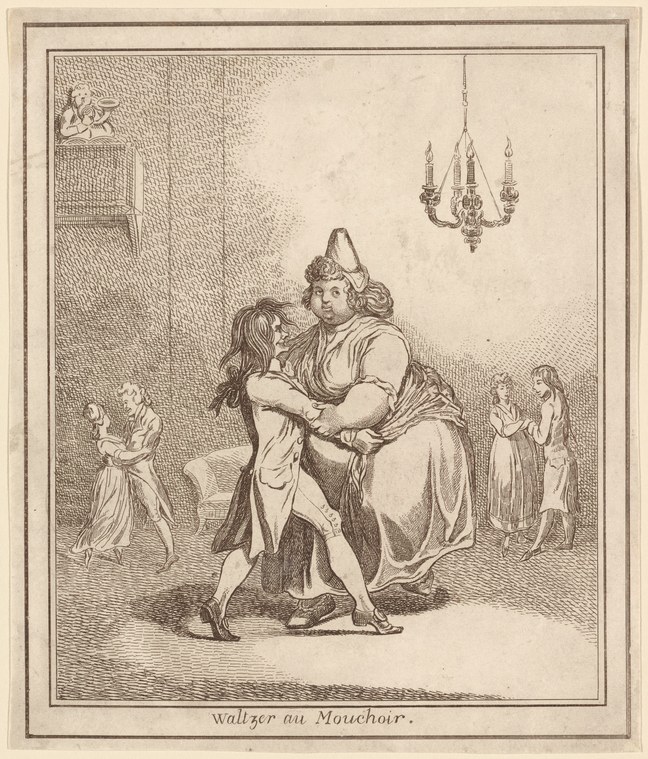
This is one of the clearest visual records of the waltzer au mouchoir, a real and named variant of the waltz that has left few traces in the historical record. The image shows how the handkerchief functioned as both a movement prop and a visual focus, and it documents the buoyancy and lift characteristic of waltz movement in this period—crucial evidence for understanding how the waltz was actually danced and understood in its early decades.
What you are looking at
An engraving depicts a lively dance scene in an interior setting, likely a ballroom or salon. A stout woman in center stage, wearing a flowing draped dress and an elaborate feathered headdress, dances with a younger male partner who wears lighter clothing. She holds a handkerchief (mouchoir) aloft in one hand—the defining prop of the dance. Around them, other figures in period dress observe and participate: a woman to the left, several figures to the right in the background, and a small cherub or putto sketched in the upper left corner. A chandelier hangs overhead, establishing an intimate indoor venue. The mood is playful and theatrical, rendered in the fine crosshatching typical of 18th-century engraving.
The dancing
The central female dancer is in a lifted, buoyant stance, her weight distributed as if mid-turn or mid-leap, her body angled toward her partner. The male dancer supports or guides her, standing at an angle to her body. Both dancers' arms are raised and mobile—particularly the woman's waving handkerchief hand, which is the focal point of the composition. The surrounding spectators are static or in conversational poses, framing the active pair at center. The scale and proportions suggest this is a social dance for two, with audience engagement typical of ballroom entertainment.
The dance depicted
This is a waltz with handkerchief (waltzer au mouchoir), a playful ballroom variant of the waltz popular in late 18th and 19th-century Europe. The title explicitly identifies the form, and the handkerchief is its essential distinguishing prop—the dancer typically waved or flourished it while executing waltz steps in a closed or semi-closed hold. The handkerchief could be dropped, tossed, or used to playfully engage spectators, making it a more theatrical and flirtatious version of the formal waltz. The engraving captures the characteristic buoyancy and lift of waltz movement, and the central female figure's exuberant carriage and prominent headpiece suggest this is meant to be a focal performer rather than a dance of equals—consistent with the genre's courtship and display conventions.
How it was made
This is an engraving on paper, executed in fine lines and dense crosshatching to create tonal depth and volume. The technique allows precise detail in costume, facial expression, and spatial setting, and the small size and reproductive nature of the medium suggest it was made for circulation as a print—likely published as a single sheet or in a collection of dance or theatrical scenes. Engravings of this period were accessible to a middle-class audience and often documented popular ballroom and stage practices, making them valuable records of dance fashion and form.
About this work
Waltzer au mouchoir is a document of a specific and charming variant of the waltz—a dance with handkerchief—rendered as a moment of sociable performance in a ballroom setting. The engraving captures not just the steps but the spirit of the dance: the prominence of the prop, the theatrical pleasure of the movement, the presence of an audience, and the gendered dynamics of ballroom courtship in which the woman is displayed and elevated. The work sits at the intersection of social dance and theatrical spectacle, typical of how 18th-century ballroom culture understood dance as both intimate and performed.
How to look at it
Attend to the handkerchief: it is the work's subject and its point of visual interest. Notice how the artist has positioned it in the woman's raised hand, waving upward—this is not accidental but the defining gesture of the dance. Watch the woman's posture: she is lifted and buoyant, not grounded, which captures the characteristic rising action of the waltz. The male dancer's supporting role and the spectators' attentive poses frame this as a display, not a social exchange—a performance of a dance, not merely the dance itself.
The period
The waltz emerged from the Ländler and other Alpine folk dances in the late 18th century and spread rapidly through European ballrooms, arriving in Vienna and Paris by the 1790s. It was initially controversial for its close hold and fast rotations, but by the early 19th century it had become the dominant social dance of the European ballroom. Variants and novelties—including the waltzer au mouchoir, the waltzer with a hat, and other prop-based waltzes—emerged as the dance became more established and performers sought to refresh and theatricalise it. This engraving likely dates to the early 19th century, when the waltz was at the height of fashion and prints of dance scenes were a popular form of entertainment documentation.
Where it lives
Held by the New York Public Library as part of its collection of prints depicting dance. The work is an engraving, a reproducible medium, and likely one of many impressions; the absence of a recorded artist, date, and publication information suggests it was either catalogued from the print itself (which may carry no colophon) or is part of a larger collection catalogued collectively.
Dance in this work
Questions about this work
What is the handkerchief for?
The handkerchief was the defining prop of this dance, waved or flourished by the dancer (usually the woman) as she and her partner executed waltz steps. It served both a movement function—giving the dancer's hand an ornamental focus—and a flirtatious or courtship function, allowing the dancer to playfully engage with spectators or her partner. It transformed the waltz from a relatively austere form into a more theatrical and playful social display.
Is this a stage dance or a ballroom dance?
Technically, it is a ballroom dance—a social form danced by amateurs in a ballroom setting. However, this engraving records it as a performed or displayed dance, not as intimate social exchange. The presence of an audience, the theatrical dress and headdress of the central figure, and the celebratory framing suggest this is ballroom dancing understood as entertainment, blurring the line between ballroom and theatrical practice.
Why is the woman so much larger than the others?
Scale and prominence in 18th-century prints were conventions of importance and focus, not realism. The central female dancer is enlarged to make her the optical and narrative center of the scene. This was standard practice in ballroom imagery and reflects both the conventions of print composition and the period's understanding of the waltz as a display dance in which the woman was the primary visual object.
More dance artwork





