49 works in this view — arrow keys or swipe to move between them.
Dance in Art
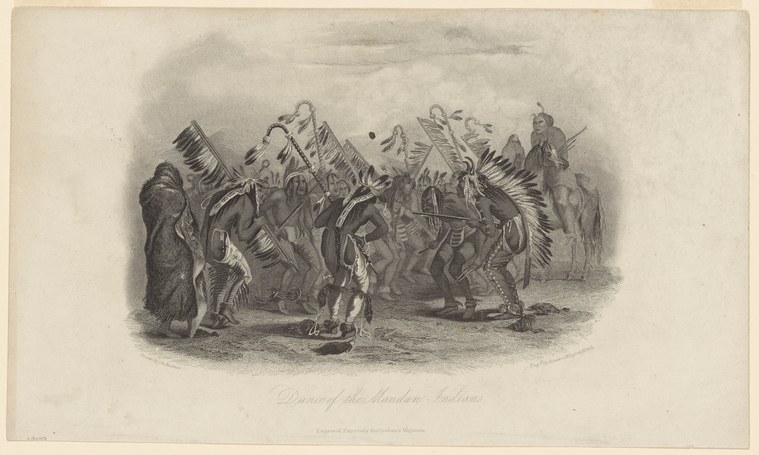
Dance of the Mandan Indians
Unknown artist
- Collection:
- Prints depicting dance
- Source:
- New York Public Library
- Rights:
- Public domain — free to use, share and adapt.
- Recorded as:
- Public Domain
Dancers and historians should attend to this work because it documents a form of collective, proximate movement—a non-balletic, non-European grammar of the body—at a moment when such documentation was rare and often distorted. The engraving also reveals the medium itself as interpretive: what we see is not the Mandan dance but the dance as filtered through the printmaker's technique, assumptions, and the conventions of early 19th-century scientific illustration. Understanding how Indigenous dance was seen and recorded by outsiders is as important as understanding the dance itself.
What you are looking at
A tightly clustered group of Native American dancers occupies the center of this engraving, their bodies pressed close in what appears to be a ceremonial or social gathering. The figures wear feathered headdresses and draped clothing that suggests early 19th-century documentation. The composition is intimate and energetic, with multiple bodies leaning and turning into one another. The artist has used light and shadow to create volume and movement, with the dancers emerging from a hazy ground and receding into undefined space. The engraving technique has rendered the scene with fine cross-hatching that conveys both the texture of clothing and the emotional intensity of the moment—this is not a formal, posed arrangement but a capture of active, communal movement.
The dancing
The dancers are arranged in no formal line or couple formation. Instead, bodies interpenetrate the composition at various angles—some upright, others leaning sharply inward. Arms are raised and extended, creating a sense of collective gesture rather than synchronized movement. The weight appears distributed low and grounded rather than lifted or balletic. Figures interweave without the defined holds of European court dance; the relationship between dancers is tactile and proximate rather than structured. At least six to eight figures are identifiable, with the composition suggesting more beyond the frame.
The dance depicted
This work documents a Mandan ceremony or social dance, though which specific dance or occasion remains unclear from the image alone. The Mandan were a Plains Indian nation, and their dances served ceremonial, social, and spiritual functions—from healing rites to celebrations of hunts or warfare. The composition suggests a group dance in which participants move in close physical proximity rather than in set formations. The raised arms and energetic posture are consistent with many Native American powwow and ceremonial dances, but without contextual documentation, the specific dance type cannot be named with confidence. The engraving captures what appears to be a moment of collective rather than individual expression.
How it was made
This is a steel or copper engraving, likely made in the early 19th century, executed with fine parallel lines (hatching and cross-hatching) to create tone and shadow. The technique allows considerable detail in clothing and physiognomy and was standard for wide circulation in books, newspapers, and periodicals of the period. The soft, atmospheric effect achieved through the hatching suggests this may be a later or hand-colored version, though the image here is rendered in grayscale. Such engravings were often made from field sketches or from the work of artists who had traveled west, and they served to introduce Euro-American audiences to Indigenous life—though filtered through the conventions and assumptions of European printmaking.
About this work
This is a historical record of Mandan dance practice, rendered as an engraving in a documentary mode that became standard for ethnographic illustration in the 19th century. The image sits at a crucial moment in American visual culture: the period when westward expansion and increased contact with Plains nations led to intense artistic and scientific interest in Indigenous life. The work belongs in a gallery about dance because it documents both the physical vocabulary of a specific cultural tradition and the broader 19th-century project of capturing, studying, and circulating knowledge of Native American ceremonial and social practices. It is also a record of how dance was translated and presented to non-Indigenous audiences through the technology and aesthetic conventions of European printmaking.
How to look at it
Attend to the moment the artist chose: not a pose or a formation, but a swirl of motion in which the dancers are shown overlapping and leaning into one another. Notice how the engraver used hatching and shadow to suggest energy and proximity rather than clarity of individual figures. The composition resists the formal clarity of European court-dance engravings; instead, it emphasizes chaos, collectivity, and emotional intensity. This choice itself is interpretive—a record of how the artist (or the artist's source) understood Indigenous dance as fundamentally different from the contained, geometric movement of ballroom tradition.
The artist
The artist is not recorded. The style and technique suggest a professional engraver working in the early-to-mid 19th century, likely in the eastern United States. If the image derives from field documentation, it may have been based on sketches by artists who traveled west—such as George Catlin, Karl Bodmer, or others documenting Native American life for eastern audiences. The print tradition of ethnographic documentation was well established by this period, and such images circulated widely in newspapers, books, and museums.
The period
This engraving dates to a period of intense Euro-American interest in Plains Indian cultures, coinciding with the height of westward expansion and the U.S. government's systematic documentation of Indigenous nations. In the visual arts, the 1820s–1840s saw a flood of ethnographic and expedition imagery, much of it generated by artists traveling with military surveys and trading companies. In dance, this was a period when Native American ceremonies—long practiced in relative isolation—became subjects of outsider observation, often misunderstood or aestheticized according to European pictorial conventions. The engraving format itself speaks to a mass-market documentary impulse: these images were meant to educate and fascinate a growing Euro-American readership eager for knowledge (or spectacle) of the frontier.
Where it lives
This work is held in the New York Public Library's collection of prints depicting dance. It is catalogued as historical documentary material and is part of the broader 19th-century archive of ethnographic and expedition imagery through which Euro-American audiences encountered Indigenous cultures.
Dance in this work
Questions about this work
Did the Mandan actually dance like this?
The image shows movement and proximity consistent with many Native American group dances and ceremonies, but it is filtered through the printmaker's eye and the conventions of 19th-century European illustration. The Mandan did dance ceremonially and socially, and close-proximity group formations were common, but we cannot assume this image is an unmediated record. It is as much about how Euro-American artists understood and depicted Indigenous movement as it is about the movement itself.
Why is the artist unknown?
Many 19th-century engravings were made anonymously or by skilled artisans working from others' sketches or designs. Without a clear signature, inscription, or publication mark visible on this print, attribution is difficult. The image may have been based on field sketches by a named artist (such as Catlin or Bodmer) but engraved by a different hand in a printshop.
What does this image tell us about dance history?
It documents the existence and visibility of Mandan ceremonial and social dance during a period of intense contact and change, and it shows how that dance was translated and circulated through European-American media. It is also evidence of the role of printmaking in shaping public knowledge and imagination about Indigenous cultures—often stereotyping or exoticizing in the process.
Is this an ethnographic record or an artistic interpretation?
Both. The engraving was made in the service of documentary aims—to inform Euro-American audiences about Native American life—but the artist's hand, the printmaking technique, and the conventions of the period all shape what we see. It is a historical document that should be read critically, as a record of how the Mandan were seen and depicted as much as a record of how they danced.
More dance artwork





