49 works in this view — arrow keys or swipe to move between them.
Dance in Art
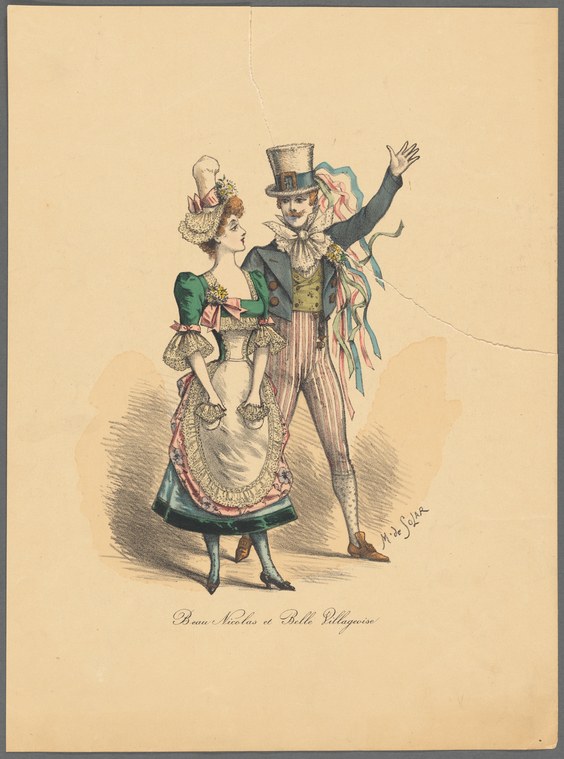
Beau Nicolas et belle villageoise
Unknown artist
- Collection:
- Prints depicting dance
- Source:
- New York Public Library
- Rights:
- Public domain — free to use, share and adapt.
- Recorded as:
- Public Domain
Early 19th-century social dance imagery like this is crucial evidence for understanding how couples actually moved and interposed themselves during the Regency and Romantic periods—not through technical notation, but through visual culture. The print shows us that early ballroom dance was as much theater and courtship display as it was structured partnering, and that instruction and fashion merged seamlessly in popular prints aimed at the aspiring middle classes.
What you are looking at
A stylishly dressed couple in early 19th-century costume occupy the center of this hand-colored engraving. The woman, positioned on the left, wears a high-waisted green Empire-line dress with white lace trim, a decorative bonnet with plumes, and white stockings. She faces toward the right, her posture open and engaged. The man, taller and positioned slightly behind and to her right, wears a dark coat with tails, a tall top hat, striped trousers, and a white cravat with colored ribbon accents; his right arm is raised in an expansive, welcoming gesture, his left hand near his chest. Both figures stand on a stage-like shallow ground plane rendered with light hatching. The composition is spare—cream-colored paper dominates, allowing the figures and their expensive fabrics to command full attention. The energy is playful and flirtatious, the moment frozen mid-interaction rather than mid-step.
The dancing
The two dancers stand roughly in closed proximity but not in a strict closed frame. The woman's weight appears settled, her body angled to face her partner; the man leans slightly forward, his raised right arm extended outward in a theatrical flourish that suggests courtship or invitation. Neither figure shows the rigid posture of formal ballroom hold—instead they occupy a social, conversational distance that reads as a moment of approach or flourished greeting. The man's gesture is deictic and performative, characteristic of early 19th-century social dance deportment where arm work was ornamental and expressive rather than structural to the partnership.
The dance depicted
This is almost certainly a depiction of early 19th-century European social dance, most likely a contredanse or quadrille—the preferred social dances of the Regency and Romantic periods. The title 'Beau Nicolas et belle villageoise' (Handsome Nicholas and the pretty village girl) suggests a named couple in a popular dance narrative, possibly from a printed dance instruction manual or theatrical scene. The woman's costume places her as a 'village' type, a stock figure in Romantic-era dance imagery, while the man's finery and theatrical bearing mark him as a refined suitor. The raised-arm gesture was characteristic of the courtly flourishes and ornamental arm positions seen in French and English contredanse manuals of the 1820s–1840s. The image captures the social and flirtatious nature of the dance rather than technical footwork.
How it was made
This is a hand-colored engraving, evidenced by the fine parallel hatching visible in the shadow areas, the sharp linear definition of the figures, and the characteristic plate line visible at the edges. The coloring—applied by hand in watercolor or hand-tinting medium—is selective and deliberate: the woman's green dress and bonnet ornaments, the man's striped trousers, the warm cream of the paper. This technique was standard for popular dance instruction sheets and theatrical costume prints circulating in early 19th-century Europe, particularly France and England. Hand coloring made such prints more legible for instruction and more appealing as fashionable commodities, and their circulation in this form suggests the work was aimed at dancing masters, amateurs learning steps, or buyers interested in current fashions and social manners.
About this work
This is a hand-colored engraving of a Regency or early Romantic-era couple frozen in a moment of social-dance courtship. The title, costume, and theatrical setting place it within the tradition of dance instruction prints and fashionable imagery of the 1820s–1840s, when the contredanse and quadrille dominated European ballrooms. The artist captures not the technical execution of steps but the social performance of the dance—the moment of approach, the ornamental gesture, the flirtation conducted through movement and posture. The work belongs in a gallery of dance in art because it documents how the body, costume, and interaction were staged and understood during a foundational period of ballroom culture.
How to look at it
Look first at the gesture and the distance between the figures: the man's raised arm is not part of the dance's technical vocabulary but a moment of social theater, a courtly address. Notice that the woman is not in a tight partnership frame, but standing openly, her body angled to receive his attention—this is the moment before the dance proper, or a flourish within it. Observe how the costumes carry narrative meaning: her 'village' dress and his fashionable finery tell a story about who these people are meant to be. The composition's spare setting and attention to fine detail in fabric and trim—the way light plays on the striped trousers, the intricacy of the lace—reflects the priorities of Regency-era taste: elegance, precision, and the performance of social status through movement.
The period
This print dates to the height of the European vogue for named, narrative couple dances within the contredanse and quadrille families. The early 19th century saw explosive growth in dance instruction prints, particularly in France and England, where Paris remained the arbiter of fashion and dance style. Such prints often featured named or typed couples—the suitor, the village maiden, the coquette—performing recognizable social dances in fashionable dress. The Regency period (1811–1820 in England) and the corresponding years in France were marked by an almost obsessive documentation of ballroom life through fashion plates, dance manuals, and satirical prints. By the 1820s–1840s, when this print likely dates, the quadrille and cotillion had begun to eclipse the contredanse in fashion, but prints continued to use the same visual language of couples in ballroom dress engaging in named interactions.
Where it lives
The work is held in the New York Public Library's collection of prints depicting dance, a collection that preserves popular instruction sheets, theatrical prints, and social-dance imagery from across the 18th and 19th centuries. This item is catalogued without a recorded artist, date, or medium, which is common for such prints when their origin in commercial production is forgotten; the NYPL record reflects its status as an ephemeral artifact of popular culture.
Dance in this work
Questions about this work
What kind of dance is this?
Almost certainly a contredanse or early quadrille, the dominant social dances of the Regency and Romantic periods in Europe. The title 'Beau Nicolas et belle villageoise' suggests a named couple performing a recognizable social dance, possibly from a dance instruction manual or theatrical scene. The raised-arm gesture and open stance are characteristic of French and English social dance of the 1820s–1840s.
Who made this print?
The artist is not recorded in the catalogue. The style and quality suggest a professional engraver working for a Parisian or London publisher, but without a signature or archival record, attribution remains unknown. It was almost certainly a commercial product intended for dance instruction or fashionable amusement.
Why is the woman called a 'villageoise'?
In Romantic-era dance imagery, the 'village girl' was a stock type—refined and virtuous, but marked as rustic or simple in contrast to the urban suitor. The costume and title place her in this narrative tradition, which was popular in dance prints, theatrical dances, and fashionable imagery throughout the 19th century.
What does the man's raised arm tell us about the dance?
Early 19th-century social dance emphasized ornamental arm work and courtly flourishes. The raised arm is not a technical step but a social gesture—a moment of theatrical courtesy and flirtation. This shows us that ballroom dance was understood as performance and courtship display, not merely as structured partnering.
More dance artwork





