49 works in this view — arrow keys or swipe to move between them.
Dance in Art
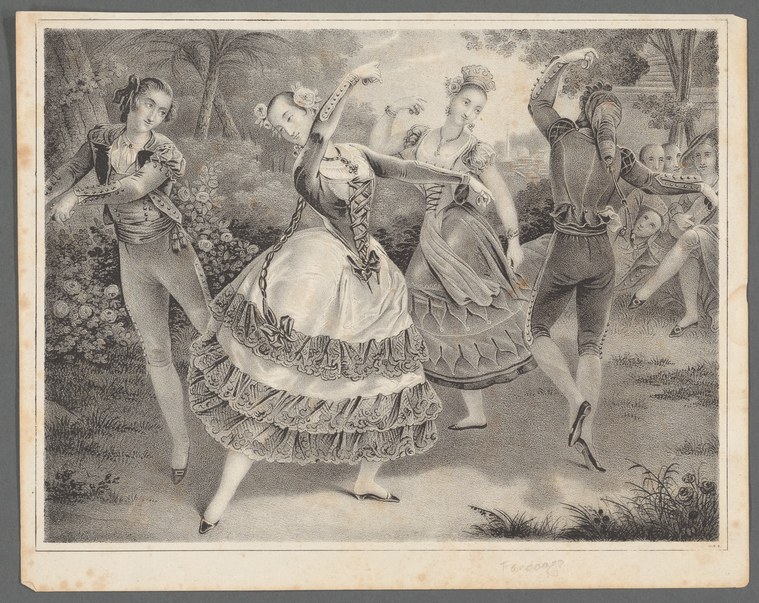
Two couples in a landscape, with onlookers and a guitarist at right
Unknown artist
- Collection:
- Prints depicting dance
- Source:
- New York Public Library
- Rights:
- Public domain — free to use, share and adapt.
- Recorded as:
- Public Domain
The engraving documents the minuet at the height of its fashion as a social practice, preserving in precise visual detail the carriage, arm placement, and spatial relationships that defined the dance for dancers of the period. It shows that trained dance technique—épaulement, turnout, opposition—was valued in the drawing room, not just on stage, and that women's movement within that frame was celebrated as both elegant and accomplished.
What you are looking at
A pastoral outdoor scene depicts four elegantly dressed figures in a lively dance. Two couples occupy the center: a woman in a voluminous white dress with deep ruffled hem, corseted waist, and long sleeves gestures dynamically with one arm raised; her male partner in dark coat and breeches faces her in an attentive pose. To the left, another couple—the woman in a patterned dress and the man in period coat—engage with the central pair. At right, a seated guitarist with a stringed instrument provides musical accompaniment. Additional onlookers, including what appear to be attendants or chaperones, occupy the background. The setting is an arcadian landscape with trees, architectural structures visible in the distance, and dappled light characteristic of 18th-century pastoral convention. The entire composition suggests an intimate but formal outdoor entertainment, rendered in fine engraved line work that captures the fabric's texture and the figures' animated poses.
The dancing
The central female dancer dominates the composition through extended arm gesture and contrapposto weight shift, one leg forward in what appears to be an épaulement—the characteristic spiral turn of upper body against lower body. The male partner stands en face, arms open in a receiving posture. The second couple maintains a looser spatial relationship. The guitarist sits apart, slightly lower in the composition, his instrument and posture carefully rendered. All figures display the upright carriage, turned-out legs, and deliberate arm positions of trained social dance. The artist has captured the essential tension of partner dance: the woman's agency in movement matched against the man's attentive frame.
The dance depicted
This appears to depict a minuet or similar haute danse of the 18th century, most likely the 1750s–1770s based on the costume silhouettes and the presence of the seated musician. The elaborate white dress, the formal postures, the open outdoor ballroom setting, and the precise arm and leg placement all point to minuet vocabulary, possibly a moment of individual figure work within a larger set dance. The male partner's open frame and watching stance is consistent with the Baroque-era minuet's emphasis on the woman's individual display supported by the man's stable presence. The composition suggests this is a fashionable social dance performed at leisure rather than at court, though the formality of dress and movement argues for trained dancers.
How it was made
The work is a finely detailed line engraving, likely hand-colored or possibly a hand-colored print, executed with considerable technical skill in rendering fabric texture, anatomical proportion, and atmospheric depth. The fine parallel hatching and subtle tonal gradations suggest the work of a trained engraver of the mid-to-late 18th century, when such prints were widely circulated as documents of fashion, deportment, and social practice. The technique allowed for wide distribution and served as a visual instruction manual for aspiring dancers and their teachers. The rendering of the woman's face in profile and the careful articulation of each figure's feet indicate an artist familiar with dance convention.
About this work
This engraving documents the minuet or a closely related haute danse of the mid-18th century in its social context—not as spectacle but as intimate entertainment. It belongs in a dance history because it records both the physical vocabulary of the dance and its place in courtship and leisure among the fashionable classes. The work is valuable precisely because it captures a specific moment of movement: the woman's spiraling turn and raised arm amid the formal constraint of the male partner's frame, a balance that defined Baroque social dance for a century.
How to look at it
Attend to the woman's upper body and arm position: the spiral of the épaulement, the raised arm, and the head turn compose the moment of maximum individual display, the instant when the minuet became about displaying the dancer's grace to onlookers. Notice too the male partner's stillness and watchfulness—his frame is the architectural support that permits her freedom. The choice to depict the couple mid-figure, neither in an opening nor a closing position, suggests the artist wanted to capture the essence of the dance's dynamic: the woman's controlled spiral motion held within the man's careful attention.
The period
This work was created during the golden age of the minuet in European society, when the dance dominated social occasions among the aristocracy and wealthy merchant classes. The 1750s–1770s saw intense codification of minuet technique in printed dance manuals (Rameau, Tomlinson, Magny), and prints like this served as visual companions to those texts. Simultaneously, the pastoral aesthetic in visual arts—the celebration of arcadian leisure—provided a natural frame for depicting dance as refined pleasure rather than labor or ceremony. The engraved print was the dominant medium for circulating models of fashionable deportment and dress.
Where it lives
The work is held in the New York Public Library's collection of prints depicting dance. It is catalogued as an engraving of unknown artist and date, though stylistic and costume evidence suggests a mid-to-late 18th-century origin and probable French or English production.
Dance in this work
Questions about this work
Is this the minuet?
Almost certainly. The upright posture, turned-out legs, formal arm positions, corseted dress of the woman, and the seated musician all point to the minuet or a very closely related haute danse of the 1750s–1770s. The artist has captured the characteristic posture and the moment of individual display that defined the dance.
Who danced the minuet?
By the mid-18th century, the minuet was danced by the aristocracy and the wealthy merchant classes across Europe. It was taught by professional dance masters and performed both socially and on stage. The elegant dress and outdoor leisure setting in this print suggest trained dancers of the fashionable classes performing in a private or semi-private context.
What are all those other people doing?
The secondary figures are onlookers, chaperones, and attendants—the social scaffolding of 18th-century dance. The minuet was performed for an audience, and the presence of watching figures was part of the pleasure and propriety of the occasion. The seated musician supplies the music, essential to the dance's execution.
Why is the woman's arm raised?
This is part of the minuet's arm vocabulary, likely part of an individual figure or a transition between positions. The raised arm, combined with the turned head and the spiraling upper body, shows the dancer's control and grace—precisely what the minuet was designed to display.
More dance artwork





