49 works in this view — arrow keys or swipe to move between them.
Dance in Art
Le maitre a dancer
Unknown artist
- Collection:
- Prints depicting dance
- Source:
- New York Public Library
- Rights:
- Public domain — free to use, share and adapt.
- Recorded as:
- Public Domain
For dancers and historians, this engraving is valuable as a snapshot of what constituted 'performance' and 'entertainment' in early modern Europe—a period when the boundary between formal dance, street spectacle, and animal act was fluid. It demonstrates how dance was not confined to court or theater but was part of a much broader and messier popular visual culture. The work also raises questions about embodiment, mimicry, and the mechanics of teaching movement—topics central to dance history—while doing so through satire and comedy.
What you are looking at
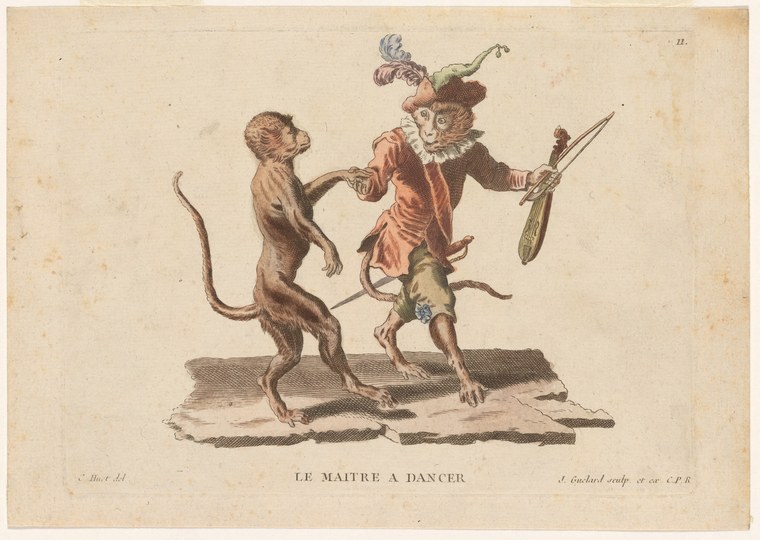
A costumed figure in early modern dress—a red jerkin, green hose, and a feathered cap—dances with a monkey who mirrors his posture. Both stand on a stone platform against a plain background. The human dancer holds one of the monkey's paws while gesturing expressively with his free arm, which extends outward holding what appears to be a fan or prop. His body is in a playful, exaggerated pose—knees bent, torso twisted—suggesting comic performance rather than formal technique. The monkey, standing upright on hind legs, adopts a complementary stance, creating a visual joke of partnership. The engraving captures a moment of theatrical entertainment, likely from a commedia dell'arte or carnival context, where the humor lies in the animal mimicking human dance and dress.
The dancing
The human dancer's weight is shifted to one leg with the opposite knee bent, creating a dynamic asymmetrical silhouette. His arms are extended in an open, expressive frame—one grasping the monkey's paw, the other gesturing outward. The monkey stands upright in an almost anthropomorphic mirror of this pose, its posture a deliberate parody of human movement. There are only two 'figures,' but the composition treats them as equal partners in a comic dialogue. The hold is not a ballroom frame but a theatrical one, emphasizing playful interaction rather than technical precision.
The dance depicted
This is unlikely to depict a specific identifiable dance form. Instead, it is a theatrical sketch or engraving documenting a form of street or carnival entertainment common in early modern Europe, particularly in Italian commedia dell'arte tradition. The 'dance' is performance art—comedic, mimetic, and reliant on the incongruity of dressing and training an animal to mimic human behavior. The title 'Le Maître à Dancer' (The Master Dancer) is ironic: the master is teaching or performing with an animal pupil, inverting the normal hierarchy of instruction. This would have been entertainment for popular audiences rather than a codified dance style.
How it was made
This is a hand-colored engraving (the title cartouche bears artist initials and publication details typical of 18th-century French print production). The line work is crisp and precise, characteristic of copper-plate engraving, with delicate cross-hatching used to model form and fabric texture. The coloring—applied by hand after printing—is restrained and selective, emphasizing the costume's theatrical quality. As a print, this work was reproduced and circulated widely among educated audiences, suggesting it documented a recognizable spectacle of its time. The technique allowed for relatively inexpensive mass production compared to painting, making it an ideal vehicle for satirical or novelty subjects.
About this work
This hand-colored engraving depicts a figure in early modern costume performing or dancing with a monkey, a subject that blends theatrical performance, animal mimicry, and comic social commentary. The work sits within the tradition of European satirical prints and carnival imagery, where animals trained to imitate human behavior—especially dance and formal dress—were sources of entertainment and moral instruction. The title 'Le Maître à Dancer' puns on the inversion of roles: the human 'master dancer' is partnered with an animal, inverting the usual relationship between teacher and pupil, adult and child, civilized and wild. This is not a document of an actual dance style but evidence of how dance, costume, and spectacle were used in early modern popular entertainment.
How to look at it
Focus on the deliberate parallelism of the two figures' poses—the artist has taken care to make the monkey's posture echo the dancer's, creating visual comedy through mirroring. Notice the specific gesture of the extended arm and open hand: this is not courtly restraint but exaggerated, theatrical expression. The costume details—the feathered cap, the fabric folds, the prop—are rendered with precision, anchoring the fantastical subject in the material reality of early modern dress. The stone platform grounds both figures and suggests a performance space, however humble, rather than a natural or domestic setting.
The period
This engraving dates to the 18th century (based on printing technique and style). It emerges from a long European tradition of animal entertainment and satirical prints, itself influenced by Italian commedia dell'arte, which had popularized stock comic characters and physical comedy across the continent from the 16th century onward. The early modern period saw a flourishing of printed satirical imagery in France and the Low Countries, often aimed at educated but not elite audiences. The image of an animal trained to ape human behavior (literally and figuratively) was a recurrent motif in such prints, serving as commentary on social pretension, the boundaries of nature and culture, and the power of instruction and performance.
Where it lives
This work is held in the New York Public Library's collection of prints depicting dance. It is cataloged as part of a broader series of European satirical and entertainment-related prints, many documenting performance practices and popular spectacles of the 17th–18th centuries.
Dance in this work
Questions about this work
Is this depicting an actual dance that people performed?
No. This is a theatrical entertainment or street spectacle—likely commedia dell'arte or carnival—where an animal was trained to mimic human movement and dress. The 'dance' here is performance art and satire, not a codified dance form like a minuet or gavotte. It documents popular entertainment rather than formal dance practice.
Why is the monkey in these clothes?
The humor depends on the animal's mimicry of human behavior and dress. By clothing and training the monkey to 'dance,' the performer (and the artist) make a visual joke about the line between human and animal, civilization and nature, and the absurdity of pretension. It's both entertainment and satire.
Who made this print and when?
The artist is not recorded in the catalogue, though the engraving technique and hand coloring suggest 18th-century French production. The initials in the cartouche ('S. Muret delt.' and 'J. Cocchet sculp.') likely identify the designer and engraver, but full attribution would require archival research.
What would people have used this for?
As a mass-produced print, this would have circulated among educated audiences—collectors, travelers, people curious about foreign or novel entertainments. It served as a record of a spectacle (whether real or fantastical), a source of amusement, and possibly social commentary on manners and pretension.
More dance artwork





