49 works in this view — arrow keys or swipe to move between them.
Dance in Art
Bakst [dust jacket?]
Unknown artist
- Collection:
- Prints depicting dance
- Source:
- New York Public Library
- Rights:
- Public domain — free to use, share and adapt.
- Recorded as:
- Public Domain
This sketch reveals how Ballets Russes designers thought about the dancing body: not as a neutral vehicle for classical form, but as a readable character capable of exaggeration, comedy, and physical invention. The work shows us a rehearsal room or design studio moment—the kind of quick notation that choreographers and dancers used to communicate and collaborate, now rare and precious as documentary evidence of creative process.
What you are looking at
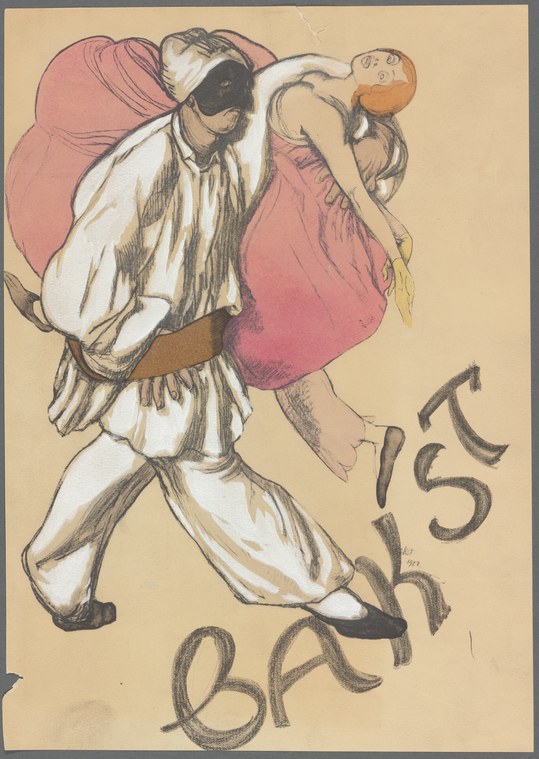
A figure in Russian theatrical costume, rendered in colored pencil or crayon with pen outline, carries an exaggerated burden across the composition. The dancer wears a white embroidered shirt with voluminous sleeves and a brown belt, topped with a massive pink or magenta bundle—perhaps a sack or cushion—balanced precariously on one shoulder. The figure strides forward in a dynamic, almost comic pose, legs splayed in exaggerated effort, as if struggling under tremendous weight. The face is rendered in mask-like fashion with bold lines. The composition is tilted and energetic, with the figure occupying most of the cream-colored paper. Text reading "BAKST" appears prominently in the lower right in the artist's own hand, along with what may be a price or lot number ("75"). The style suggests a quick character study or costume sketch rather than a formal finished work.
The dancing
A single figure dominates, shown in a wide-legged stance with knees bent to absorb the weight of the burden above. The left arm hangs down while the right arm extends upward, gripping or steadying the massive bundle. The torso twists slightly, and the head is thrown back in exaggerated strain. The posture reads as acrobatic or character-based rather than balletic—the body is contorted, the legs splayed in a way that suggests folk or comedic performance rather than formal dance training. The figure's weight appears to be on the balls of the feet, the legs active.
The dance depicted
This appears to be a costume and character study for a Russian theatrical production, most likely from the Ballets Russes circle or a related avant-garde company. The exaggerated posture and folk costume suggest a character role—possibly from a Slavic-themed ballet or a comical servant character in a narrative work. The artist has frozen a moment of comic struggle, capturing the theatrical exaggeration and character invention typical of early 20th-century Russian stage design. The work documents how bodies were used for effect in these productions, privileging visual impact and character over classical technique.
How it was made
This is a drawing in colored crayon or colored pencil with pen outline on laid or cream paper, characteristic of theatrical design sketches of the early 20th century. The technique allowed rapid notation of costume, color, and character gesture without requiring the time or expense of paint. Such sketches were working documents—used by directors, choreographers, and costume makers to communicate intent. The informal, notational quality and the artist's signature suggest this is either a preliminary study or a small finished work meant for the archive or for reproduction in a company publication.
About this work
This is a colored costume and character study for a figure in Russian avant-garde theatre or ballet, signed by the artist as "BAKST" and dated or catalogued "75." The work captures a single moment of exaggerated theatrical strain—a figure buckling under an enormous pink burden, rendered in dynamic, comic exaggeration. It exemplifies the Ballets Russes approach to character design: the body as expressive instrument, pushed beyond classical form into grotesque, readable effect. The sketch documents both the visual ingenuity of Russian stage design and the physical vocabulary of early 20th-century theatrical dance.
The work sits at the intersection of dance, theatre, and visual art—too expressive and too deliberately designed to be mere illustration, but functional enough to be a working document. It captures a philosophy of performance in which the dancer's body is part of a total theatrical design, where costume, gesture, and character are inseparable.
How to look at it
Attend first to the moment the artist chose: not a moment of grace or balance, but one of strained effort and comic excess. The massive pink burden is the focal point, but follow the body's response—the splayed legs, the twisted torso, the extended arm. Notice how the artist has used the white shirt to frame the figure, and how the brown belt anchors the waist. The pen outline gives the figure definition and cartoon-like clarity, while the colored crayon allows areas of soft shading and blur. This is a sketch made to communicate fast—to show the director and dancer the character's physical truth in a single, unforgettable image. The exaggeration is not accident; it is the point.
The artist
The signature "BAKST" and the style of this work suggest attribution to Léon Bakst (1866–1924), the legendary Russian stage designer of the Ballets Russes. Bakst was renowned for his bold, expressive costume designs and his role in shaping the visual world of Diaghilev's company. His designs were characterized by vivid color, historical invention, and an understanding of how fabric and silhouette could enhance movement and characterization. He worked across ballet, theatre, and opera, and his sketches—rapid, notational, urgent—are among the most revealing documents of early 20th-century performance practice. If this is indeed Bakst, it represents his working method: the sketch as thinking tool.
The period
This work dates to the height of the Ballets Russes era (roughly 1909–1929), when Russian theatre design was at its most adventurous and influential. The company's approach to spectacle—integrating avant-garde art, music, and movement—made designers like Bakst as famous as choreographers and dancers. In this period, costume and character were not decorative afterthoughts but integral to choreographic invention. The exaggerated, comic physicality suggested in this sketch reflects the period's embrace of grotesque, modernist aesthetics alongside classical form. Russian theatrical practice, drawing on folk traditions, commedia dell'arte, and modernist experiment, created a vocabulary of physical types and characters that Bakst and his peers rendered visible.
Where it lives
Held by the New York Public Library in its collection of prints depicting dance. The work is catalogued as "Bakst [dust jacket?]" with a price or lot designation, suggesting it may have circulated as a small print or been part of a published work on theatrical design. The catalogue record provides minimal information, typical of works in large institutional collections where archival detail has not kept pace with cataloguing.
Dance in this work
Questions about this work
Is this actually by Léon Bakst?
The signature reads "BAKST" and the style is consistent with Bakst's theatrical costume sketches, but the catalogue record does not confirm attribution. The work shows the rapid, expressive notation and vivid color typical of his design process. Without documentation, a confident attribution requires expert examination of the original.
What dance or ballet is this from?
The catalogue record does not identify a specific work. The folk costume and comic character suggest a Russian or Slavic-themed ballet, but without archival information it is not possible to name it. The work may be a preliminary study for a character that never reached the stage, or a design for a work now forgotten.
What is the figure carrying?
The massive pink bundle could represent a sack, a cushion, a bolster of cloth, or an abstract theatrical prop. In early 20th-century Russian theatre, such exaggerations often had symbolic or narrative meaning—a peasant's burden, a servant's load, or a comedic obstacle. The ambiguity is characteristic of the period's approach to visual storytelling.
Why is this a dance work and not just theatre?
The figure's posture is fundamentally about what the body can do—strain, balance, move through space under pressure. In the Ballets Russes context, these gestures were choreographed and performed, not merely acted. The sketch documents how a dancer's body was shaped by character and costume to create a singular theatrical moment.
More dance artwork





