49 works in this view — arrow keys or swipe to move between them.
Dance in Art
The mazurka song
Unknown artist
- Collection:
- Prints depicting dance
- Source:
- New York Public Library
- Rights:
- Public domain — free to use, share and adapt.
- Recorded as:
- Public Domain
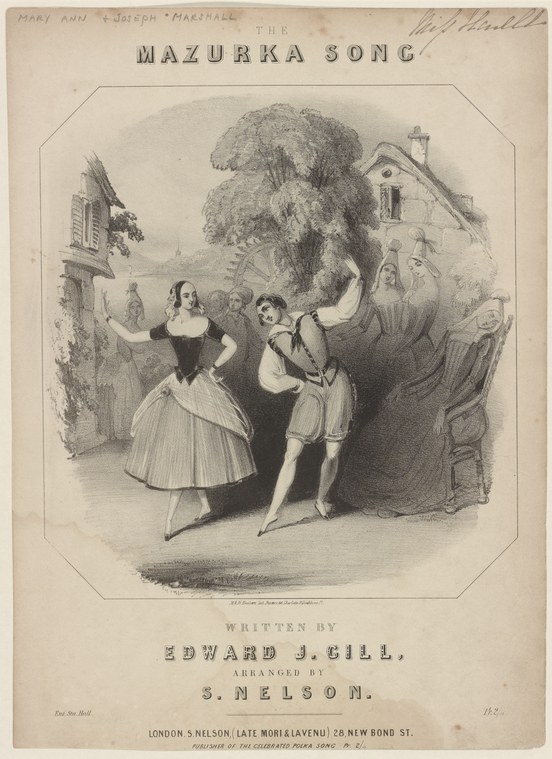
The mazurka was one of the most significant dances of the nineteenth century, carrying Polish national identity into the heart of European aristocratic and bourgeois social life. This print is direct evidence of how the dance was taught, performed, and imagined by the middle-class audience who consumed it—not as scholars but as participants and admirers. The image shows the dance's essential character: the aggressive courtship of the male dancer and the composed, controlled response of the female, a gender dynamic that became so naturalized in ballroom dance that it persists today.
What you are looking at
A theatrical scene of a mazurka, the Polish dance that captivated European ballrooms in the mid-nineteenth century. In the foreground, a woman in a full white tulle skirt with a dark fitted bodice stands in profile, her posture upright and composed. She is partnered with a man in pale breeches and dark coat who leans toward her with characteristic mazurka ardor. To their left, another couple begins to move into the dance, while further back additional figures in evening dress populate what appears to be a parlor or ballroom—the setting rendered in soft gray tones with architectural details (a doorway, a window) that situate this as an interior domestic scene. The composition is oval, in the manner of a theatrical playbill vignette, and the whole has the character of a romantic genre scene staged for middle-class consumption.
The dancing
The lead couple occupies the center in a closed ballroom position, the man's body angled toward his partner with forward momentum characteristic of the mazurka's aggressive, courtship-driven character. The woman's torso is held upright, her arms positioned to receive the man's energy. The silhouettes suggest the characteristic mazurka frame: the man dominating, the woman responsive but controlled. Other dancers in the background are rendered more sketchily but maintain similar partnered positions, suggesting the dance unfolds in the formal social context of a coterie of couples.
The dance depicted
This is a mazurka, the Polish national dance in triple meter that became a fashionable ballroom dance across Europe in the 1830s–1850s and remained popular through the Victorian era. The mazurka was understood as a dance of aristocratic Polish identity and masculine assertion—the man leads with pronounced turns, stamps, and jumps, while the woman executes smaller, more delicate footwork. The image captures the moment of approach and courtship central to the dance's social meaning: the man's forward lean and the woman's composed receptivity embody the dance's gender dynamics. The title *The Mazurka Song* suggests this is a musical piece composed for the dance, likely published as sheet music for amateur performance in parlors like the one depicted.
How it was made
This is a lithographic print, recognizable from the soft, continuous tonal gradations and the characteristic line weight of stone-based printing. The inscription at the base credits Edward J. Gill as composer and S. Nelson as arranger, and gives the London publisher S. Nelson (late Mori & Lavenu) and the address 29 New Bond Street. Lithography allowed rapid, affordable reproduction of theatrical and musical imagery, making such prints ideal for marketing sheet music and creating a visual record of fashionable dances for middle-class consumers who might learn them from such illustrations.
About this work
This is a commercial lithographic print advertising a mazurka composition, likely from the 1840s or 1850s, that captures both the dance itself and its circulation as fashionable entertainment. The image functions simultaneously as a musical cover, a fashion illustration, and a record of ballroom choreography—it is the kind of object that would have adorned a piano or study in a prosperous household, serving to make the mazurka visually and musically present to potential dancers. The print belongs to the visual culture of Victorian domestic dance and to the history of the mazurka's adoption into European high society as a marker of cosmopolitan taste and romantic sensibility.
How to look at it
Attend to the man's posture and the angle of his body toward the woman: this forward, commanding lean is the mazurka's defining gesture and was a point of anxiety and fascination in Victorian conduct literature, which often warned against the dance's excessive familiarity and passion. Notice how the woman's skirt is drawn to show volume and lightness—the full tulle indicates the dance's acrobatic, lively character. The other couples in the background, rendered smaller and less distinct, establish this as a social scene in which the couple in the foreground are exemplary: they demonstrate how a mazurka should be performed.
The artist
Edward J. Gill is credited as composer; S. Nelson as arranger. Nelson operated as a music publisher at 29 New Bond Street, London, in the mid-nineteenth century, producing both sheet music and the lithographic covers that marketed it. Lithographic printing houses in London at this period were industrial-scale operations serving the expanding music and theatrical markets; the print itself was likely executed by a house artist or craftsperson whose name does not appear on the published work.
The period
The mazurka became fashionable in Europe after the 1830 Polish uprising, when the dance arrived in Paris salons as an exotic national symbol. By the 1840s–1850s it was a staple of ballroom instruction and composition—composers from Chopin to Strauss wrote mazurkas. Sheet music for ballroom dances was mass-produced and heavily illustrated; such covers served as a primary way that non-professional dancers encountered choreography and fashion. The mazurka's popularity in this period reflects both the Romantic era's fascination with national character and the Victorian expansion of dancing as a respectable, teachable social practice for the middle classes.
Where it lives
This print is held in the New York Public Library's collection of prints depicting dance. It is a commercial lithograph published in London by S. Nelson as the cover or advertisement for a musical composition. Such prints were produced in the thousands and distributed through music sellers and drawing-room instruction channels.
Dance in this work
Questions about this work
What is a mazurka?
A mazurka is a Polish dance in triple meter (3/4 time) characterized by a strong accent on the second or third beat, pronounced turns and stamps, and a courtship dynamic in which the man leads with aggressive energy and the woman responds with controlled, delicate footwork. It became fashionable across Europe in the 1830s–1850s as a ballroom dance and retained popularity through the Victorian era. Composers from Chopin to Brahms wrote mazurkas for concert use.
How do you dance a mazurka?
In the nineteenth-century ballroom version shown here, couples stood in a closed hold with the man leading. The man performed characteristic mazurka steps—stamps, hops, and turns—with pronounced accent and energy, while the woman executed smaller, lighter footwork in response. The dance emphasized the man's dominance and courtship behavior; contemporary sources note that it was considered more passionate and intimate than other ballroom dances.
What does the print tell us about how the mazurka was taught?
Theatrical and musical prints like this were one of the primary ways that middle-class dancers encountered choreography. The image shows the correct posture, frame, and dress; the musical composition on the sheet music itself would have provided the rhythm and tempo. Dancing masters would teach steps in person, but visual and musical prints allowed amateurs to learn, practice, and perform at home.
Why was the mazurka so popular in Victorian Britain?
The mazurka arrived in London from Paris in the 1830s as an exotic Polish dance, carrying associations with national identity and aristocratic cosmopolitanism. Its relatively modest technical demands and clear gender roles made it suitable for ballroom instruction; its perceived passion and excitement appealed to Romantic-era taste. By the 1850s, it was a staple of any respectable ballroom, taught alongside the waltz and quadrille.
More dance artwork





