49 works in this view — arrow keys or swipe to move between them.
Dance in Art
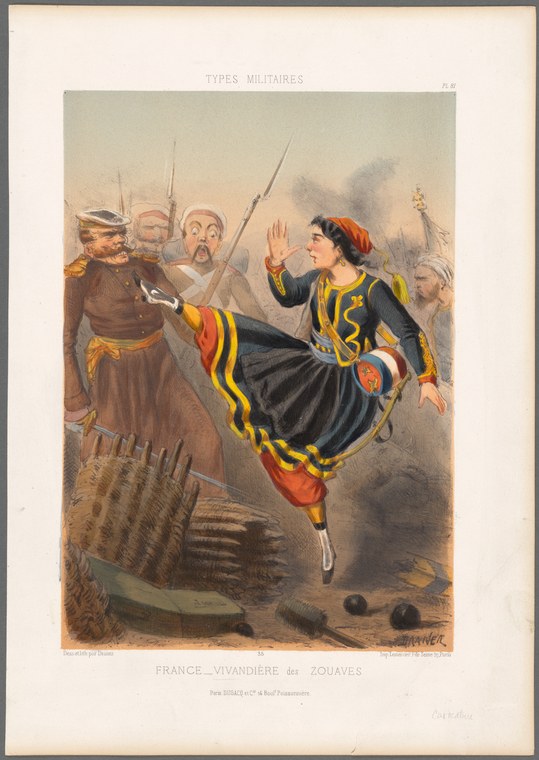
France, Vivandière des Zouaves; Types militaires, pl. 81
Unknown artist
- Collection:
- Prints depicting dance
- Source:
- New York Public Library
- Rights:
- Public domain — free to use, share and adapt.
- Recorded as:
- Public Domain
The vivandière as performer represents a strand of 19th-century popular entertainment and physical culture often absent from histories focused on high ballet. The image shows acrobatic and athletic female movement celebrated in mass-market prints, and documents a figure who crossed the boundary between military life and theatrical spectacle. For historians of social dance and performance, it is evidence of how physical comedy, gender transgression, and military entertainment intersected in the popular imagination.
What you are looking at
A vivid hand-colored lithograph depicts a French vivandière—a woman who followed the military to sell provisions and boost morale—in theatrical combat with two Zouave soldiers during what appears to be a staged military entertainment or carnival scene. The vivandière dominates the center, captured mid-leap with one leg extended high, her body twisting with explosive energy. She wears the distinctive uniform of her role: a short dark jacket with gold and red trim, a red skirt, and a red cap. Her face is animated, mouth open in apparent battle cry or song. The two uniformed soldiers flank her—one at left raising a rifle with bayonet, the other at right in a defensive posture—their expressions shocked or comically alarmed. The background suggests a camp or military encampment, with smoke or mist rising behind the figures and additional uniformed personnel barely visible. The composition freezes a moment of theatrical mock-combat in which the woman, rather than the soldiers, holds the upper hand and the viewer's attention.
The dancing
The vivandière's body is captured in an acrobatic leap, with her weight projected upward and forward, her lower body extended in a high kick or scissors position while her torso twists to face the viewer. Her arms are positioned to balance the dynamic movement—one raised defensively or expressively. The two soldiers are planted in more static, defensive postures; their body language reads as startled reaction rather than aggressive offense. The spatial relationship places the woman at the apex of a triangle, forcing the eye upward; the soldiers are secondary figures responding to her invasion of space.
The dance depicted
This is not a depiction of a codified dance style but rather a theatrical or carnivalesque representation of mock combat performed by a vivandière and soldiers, likely part of military entertainment, festival, or parade spectacle popular in 19th-century France. The vivandière was a real military role with deep historical roots, but she became an increasingly theatrical and romanticized figure in popular culture, literature, and performance—notably in operas and stage comedies. The leap and acrobatic energy suggest a performer trained in or comfortable with gymnastic or acrobatic gesture rather than balletic movement, placing this closer to pantomime or carnival mime than formal dance. The image records a moment of popular physical comedy and gender role reversal in which a woman outwits or overpowers armed men through agility and wit.
How it was made
This is a hand-colored lithograph, identifiable by the characteristic stone-grain texture visible in the background wash and the use of flat color blocks in the costumes and faces. The technique allowed rapid mass production and circulation, and the hand-coloring (likely applied by a workshop team rather than the original artist) gives each impression a slightly individual quality. Lithography was the dominant medium for popular prints and theatrical imagery in 19th-century France, reaching a wide urban and military audience. The bold outlines and simplified modeling are typical of the medium's approach to depicting movement and spectacle.
About this work
This is a theatrical military entertainment scene from what the title labels as a series of 'Types militaires'—popular prints documenting military life and archetypes of the era. The vivandière was a real but increasingly romanticized figure who inhabited the margins of military life; this print captures her as a performer in a staged spectacle of mock combat. The image belongs in a dance collection not because it depicts balletic or formally trained dance, but because it documents a form of physical performance—acrobatic, comedic, and transgressive—that was circulated through popular visual culture and performed in military camps, carnivals, and theatrical venues. It shows how dance and physical play functioned in 19th-century popular entertainment, and how women performers occupied spaces of power and agency through movement and acrobatic skill.
How to look at it
Attend to the moment the artist chose to freeze: not a confrontation, but the instant of the vivandière's physical triumph, captured at the peak of her leap. The composition forces the soldiers into reaction—they are the audience to her performance. Notice how the hand-coloring emphasizes her costume's brightness and distinctiveness; she is visually marked as special, theatrical, set apart. The expression on her face and the soldiers' faces tells the story of the moment—not violence, but play, surprise, and comedic reversal of power. The background smoke and distant encampment ground the action in military life while the theatrical lighting and exaggerated gesture announce this as performance, not combat.
The artist
The artist is not recorded in the catalogue. The work is part of a series 'Types militaires' issued by the Paris publisher Pellerin (visible in the imprint), a major producer of popular lithographs and theatrical prints. Pellerin's house style—bold outlines, vivid hand coloring, emphasis on character and spectacle—is evident throughout. The series was typical of mid-to-late 19th-century popular visual culture in France, capitalizing on public interest in military life, colonial campaigns, and theatrical entertainment.
The period
The vivandière became an iconic figure in European culture during the Napoleonic era and remained popular through the 19th century, appearing in operas (notably Donizetti's *La Fille du régiment*, 1840), literature, and popular prints. This print belongs to the mid-to-late 1800s, when military spectacle and carnival performance were major forms of public entertainment in French urban and garrison life. The mock-combat moment shown here reflects a broader cultural fascination with military theater and the transgressive humor of women outperforming or outwitting armed men—a recurring theme in popular comedy and carnival.
Where it lives
The print is held in the New York Public Library's collection of prints depicting dance. It is a hand-colored lithograph from the mid-to-late 19th century, part of a commercially published series on military types, indicating wide circulation and popular rather than elite audience.
Dance in this work
Questions about this work
What was a vivandière and was this a real role?
Yes. Vivandières were women who followed armies, selling food, drink, and supplies to soldiers and boosting morale through their presence and performance. They were particularly visible in French military life from the 18th century onward. By the 19th century, the role had become increasingly romanticized in popular culture, literature, and theater, and vivandières appeared as theatrical characters in operas and comedies. This print documents that theatrical reinvention.
Is this a real dance or a theatrical performance?
It is theatrical performance rather than a codified dance style. The acrobatic leap, the mock combat with soldiers, and the carnival energy place this closer to pantomime, military spectacle, and street comedy than to ballet or social dance. However, it is a form of physical performance—acrobatic and embodied—that circulated through popular entertainment and belonged to the broader ecosystem of 19th-century performance culture.
What is the 'Types militaires' series?
A series of popular prints published by the Paris house Pellerin, documenting military life, uniforms, ranks, and archetypal figures including vivandières, soldiers, and officers. These were mass-produced hand-colored lithographs meant for broad circulation, sold individually or in collections to a popular urban audience interested in military spectacle and social types.
Why does this belong in a dance collection?
Because it documents a form of physical performance—acrobatic, athletic, and theatrical—that was celebrated in 19th-century popular culture and circulated through mass-market prints. It shows how movement, play, and performance functioned outside the ballet academy, and how women performers used physical skill and acrobatic movement to occupy spaces of agency and transgression. It expands what counts as dance history.
More dance artwork





