49 works in this view — arrow keys or swipe to move between them.
Dance in Art
Maistre à Dancer.
Unknown artist
- Collection:
- Prints depicting dance
- Source:
- New York Public Library
- Rights:
- Public domain — free to use, share and adapt.
- Recorded as:
- Public Domain
This image preserves the appearance and bearing of a Baroque dance professional at a moment when dance was becoming a subject of rigorous written analysis and notation. Dance masters were not merely performers but intellectuals and inventors; this figure shows us how they presented themselves and their authority. For historians and dancers, the print documents the physicality, costume, and teaching role of early modern dance instruction.
What you are looking at
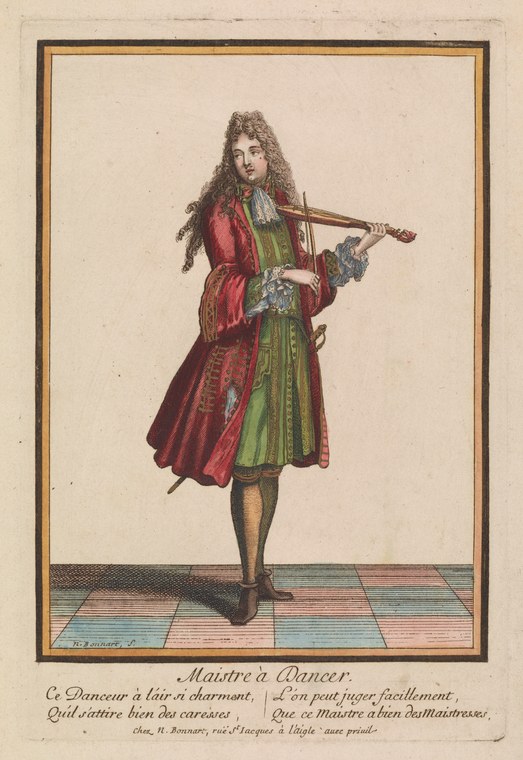
A single figure in three-quarter stance occupies the center of the composition, posed against a plain background with a checkered floor rendered in linear perspective. The dancer wears an elegant ensemble of the late 17th or early 18th century: a deep crimson coat with gold brocade and buttons, a green underdress visible at the skirt, white linen at collar and wrists, and his own long curled hair. He holds a long wooden flute or pipe horizontally in both hands at chest height, angled upward, as though mid-performance. His left leg extends forward in a refined step while his right supports the body; the posture is upright and courtly, with the weight poised and controlled. The figure gazes outward with an alert, pleasant expression. This is a hand-colored engraving printed on cream paper, with a formal frame border and French text inscription below identifying the subject.
The dancing
A single male dancer is shown in profile-to-camera stance with refined classical posture. His weight is balanced on a forward step, the torso upright and elegant, arms held symmetrically to play the pipe instrument. The silhouette is graceful and composed rather than dynamic—this is a moment of formal presentation rather than vigorous movement. The extended left leg and poised carriage suggest the controlled, turnout-based aesthetic of early theatrical dance.
The dance depicted
This is a *Maître à Danser* (dance master), a figure fundamental to the codification of European court dance in the 17th and 18th centuries. The inscription confirms the title and suggests this is a teaching or demonstration figure. The costume and deportment align with the Baroque era, when dance masters were responsible for inventing and preserving the vocabulary of courtly movement—minuets, courantes, sarabandes, and other structured forms. The presence of a musical instrument is characteristic of instruction manuals and dance treatises of the period, where musician and master often worked in concert. The refined, unadorned pose captures the pedagogical moment: the master presenting form and technique as a model to be learned. This is not a narrative scene but a portrait of a professional dancer at work.
How it was made
This is a hand-colored engraving, identified by the fine parallel lines visible in the background and the crisp, uniform line defining the figure. The text is typeset, not engraved, and positioned in a formal rectangular frame with gold and black ruled lines. The hand coloring—applied to the coat, the underdress, the floor, and accent details—was added after printing, as evidenced by the warm, naturalistic palette and slight variations in coverage. Engravings of this type circulated widely as instruction matter and documents of choreographic and costume practice; the hand coloring elevates this from a basic print to a finished, collectible sheet.
About this work
This is a formal portrait of a Baroque dance master, rendered as a hand-colored engraving in the instructional tradition of 17th–18th century dance notation and pedagogy. The figure is shown in full dress, poised in a refined position that combines elegant deportment with the readiness to teach or demonstrate. The work belongs to a rich archive of didactic dance materials—prints, treatises, and choreographic notation—that preserved and standardized the vocabulary of court dance during its period of greatest prestige and codification. Dance masters were highly valued professionals; this image documents both their craft and their status as arbiters of noble movement. The engraving format allowed such materials to circulate among elite amateur dancers and professional practitioners across Europe, making the master's knowledge reproducible and portable.
How to look at it
Observe the dancer's posture and the relationship between his body and the instrument: he is not playing in a state of abandon but in a controlled, demonstrative stance. The extended leg and upright carriage are deliberate. Notice also the floor—rendered in strict linear perspective—which grounds the figure in a defined space, suggesting a studio or salle de danse rather than an outdoor or theatrical setting. The formal composition and the direct address of the figure to the viewer suggest an instructional intent: this is how a master stands; this is how he presents himself.
The artist
The artist is unrecorded in the catalogue. The engraving is signed or attributed at lower left as "M. Bonnart, rue S. Jacques à l'Aigle" (or similar), indicating a Paris-based printmaker, likely from the Bonnart family of engravers who were active in the late 17th and early 18th centuries producing prints of costume, theater, and daily life. This was a commercial practice; such prints were produced for sale to educated consumers and were often bound together in costume or instruction books.
The period
The late 17th and early 18th centuries witnessed the codification of ballet and court dance into a formal, transmissible system. The publication of Raoul-Auger Feuillet's *Chorégraphie* (1700) and related notation systems allowed dances to be recorded and learned from paper. Dance masters became celebrated figures—some rose to prominence at royal courts—and their printed portraits and instruction manuals were in demand among the nobility and gentry. This engraving sits within that documentary tradition: it is both a portrait of professional identity and an artifact of the era when dance became systematized knowledge.
Where it lives
The work is held in the New York Public Library's collection of prints depicting dance. It is an example of the commercial engraving trade in Paris during the period when dance was a subject of lively professional and amateur interest.
Dance in this work
Questions about this work
What is a dance master and why would one be printed?
A dance master (*maître à danser*) was a professional teacher and sometimes choreographer who codified and transmitted the vocabulary of court and theatrical dance. Prints of dance masters and their students were produced as instructional aids, costume references, and documents of professional identity. They circulated among nobles, amateurs, and other practitioners who wished to learn or refine their knowledge.
Why does the figure hold a musical instrument?
In Baroque dance instruction, the musician and the dance master worked in close partnership. The presence of the pipe or flute may indicate the master's role in music-making, or it may be a conventional attribute signaling the union of music and movement. Some instructional prints show masters with instruments to emphasize this link.
What dance form is this?
This is not a depiction of a single named dance but a generic portrait of a master in teaching mode. However, the costume and posture align with the vocabulary of Baroque court dances—minuets, courantes, sarabandes—that would have been the primary content of such instruction. The refined, controlled stance reflects the aesthetic values of those forms.
How was this image used?
Such prints were likely intended for framing and display in a studio, or for binding into instruction books and costume manuals. They served as visual references for the appearance and deportment of skilled dancers and as markers of professional standing. Hand-colored versions were more expensive and were probably owned by wealthier patrons.
More dance artwork





