49 works in this view — arrow keys or swipe to move between them.
Dance in Art
A full-dress party
Unknown artist
- Collection:
- Prints depicting dance
- Source:
- New York Public Library
- Rights:
- Public domain — free to use, share and adapt.
- Recorded as:
- Public Domain
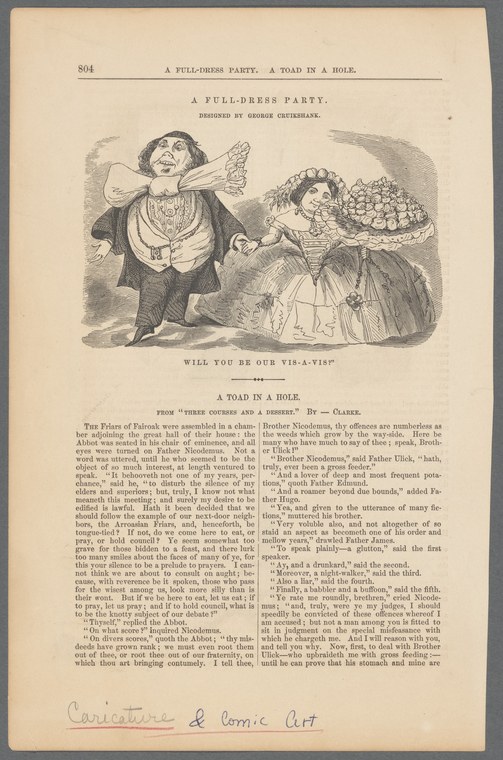
This engraving is a rare example of dance being used as a vehicle for social and fashion satire in Victorian print culture, showing how ballroom dancing was understood as much as a social ordeal as a pleasure. It documents the vis-à-vis quadrille, a specific ballroom formation, and reveals contemporary anxieties about courtship, dress, and the gap between social ideal and social reality.
What you are looking at
A satirical engraving depicting a fashionable evening gathering, likely from the mid-19th century. A rotund, formally dressed man in black coat and trousers stands center-left, his posture stiff and ungainly, while to his right a woman in an elaborate full-skirted ball gown laden with flowers and ornaments adopts an exaggerated pose. The man's expression is comically distressed or bewildered. The composition suggests the awkwardness of formal dancing or courtship ritual, with the couple positioned as if about to dance or engaged in social interaction. The engraving's title, 'Will You Be Our Via-Vis?', references the vis-à-vis quadrille, a popular ballroom formation of the era. The print quality and style are consistent with mid-Victorian satirical publication, likely from Punch or a similar periodical.
The dancing
The man stands with weight unevenly distributed, legs slightly crossed in an ungainly stance that conveys discomfort rather than dance readiness. His upper body angles forward awkwardly. The woman displays the exaggerated posture typical of satirical fashion caricature—an impossibly cinched waist supporting cascading skirts and an ornate bonnet. Neither figure shows the balanced frame or aligned posture required for actual ballroom dancing; instead their bodies communicate social anxiety and the absurdity of rigid formal dress conventions.
The dance depicted
This is satirical commentary on the vis-à-vis quadrille, a formation dance popular in Victorian ballrooms where couples faced each other across the room. The 'Via-Vis' in the title is a pun on the French 'vis-à-vis' (face-to-face). The image mocks both the fashion extremes of the period and the social awkwardness of courtship through dance, suggesting that the formal structure of ballroom dancing made genuine interaction difficult. The artist is not depicting actual dance technique but rather the social machinery that surrounded it.
How it was made
This is an engraving, likely wood-engraved or steel-engraved, a standard reproductive technique for Victorian periodical publication. The fine linework and cross-hatching create tonal variation and allow for rapid printing and wide circulation. The technique was ideally suited to satirical commentary—it could capture fine detail in facial expression and costume while reaching thousands of readers weekly. The speed of engraving also allowed for topical, timely social criticism.
About this work
A Victorian satirical engraving mocking the vis-à-vis quadrille and the fashion extremes that accompanied formal ballroom dancing. The work combines dance history with fashion criticism, using the figure of the awkwardly posed couple to ridicule both courtship conventions and the restrictive dress codes that made dancing itself nearly impossible. The print belongs to a rich tradition of Victorian visual satire that used dance and social ritual as vehicles for social commentary.
This image captures a specific moment in dance history when the ballroom was losing some of its elegance to fashion excess and social pretension. The vis-à-vis quadrille was itself relatively new in mid-Victorian Britain, and satire of its formality and its role in courtship was common in the press. The work documents not just how people danced but how they were perceived to dance—badly, self-consciously, trapped in clothes and conventions.
How to look at it
Attend to the disparity between what the figures are supposed to be doing (engaging in the formal pleasure of ballroom dancing) and what their bodies actually convey (discomfort, awkwardness, entrapment). Note the woman's impossible silhouette—the engraver has exaggerated the already extreme fashions of the era to the point of caricature, making clear that satire is the intent. The man's bewildered expression and stiff posture mirror the woman's artificial pose, suggesting that the real subject is not the dance itself but the social theatre surrounding it.
The artist
The engraving is attributed to George Cruikshank or his circle based on the style notation visible in the catalogue, though the record does not confirm authorship. Cruikshank was the dominant figure in Victorian satirical engraving, known for his exaggerated line work, facility with social commentary, and prolific output. His style—sharp caricature combined with moral or social critique—became the template for mid-19th-century visual satire. Works like this appeared in weekly or monthly periodicals, reaching a broad middle-class audience.
The period
The mid-Victorian period (1840s–1860s) saw a dramatic expansion of the ballroom dance repertoire, with quadrilles in numerous variations becoming standard entertainment at balls and assemblies. Simultaneously, women's fashion reached extremes of silhouette and ornamentation that made actual dancing increasingly difficult—crinolines, tight lacing, and elaborate trimmings were incompatible with free movement. Satire of this contradiction was common in the press. The quadrille itself, imported from France, was seen as a fashionable but rigid and somewhat mechanical dance compared to the romantic abandon of waltzing, making it an easy target for mockery.
Where it lives
This engraving comes from the NYPL's collection of prints depicting dance, indicating it was acquired as a dance-related cultural artifact. It likely appeared in a Victorian periodical such as Punch or a similar illustrated magazine; the page numbering visible (804) suggests it may be from a bound volume or archival collection.
Dance in this work
Questions about this work
What is a via-vis quadrille?
A vis-à-vis quadrille was a formation dance in which couples faced each other across the room, taking turns leading figures while the opposing couple watched and waited. It was a popular Victorian ballroom dance, more structured and less romantic than the waltz. The formation emphasized social hierarchy and courtship ritual, as the progression of figures gave each couple a turn to be watched.
Why is this image funny?
The satire operates on multiple levels: the man's awkward posture and bewildered expression mock male social anxiety about dancing and courtship; the woman's exaggerated silhouette criticizes fashion excess; and the overall composition suggests that formal ballroom etiquette made genuine human interaction nearly impossible. The artist is suggesting that the rigidity of Victorian social convention poisoned the supposed pleasure of the dance.
Who was George Cruikshank?
Cruikshank (1792–1878) was the pre-eminent English satirical engraver and illustrator of the 19th century. His sharp, energetic line work and gift for caricature made him the visual voice of social critique in popular print. He illustrated Dickens, created political satire for periodicals, and set the standard for Victorian visual humor. His work reached thousands through weekly and monthly publications.
What does the costume tell us about the date?
The woman's full-skirted gown with elaborate bonnet and the man's black frock coat are consistent with 1840s–1860s fashion. The exaggerated proportions of the crinoline and the style of the bonnet trim suggest the height of mid-Victorian fashion excess, likely 1850s. The engraving technique and typeface are also consistent with mid-Victorian periodical publication.
More dance artwork





