49 works in this view — arrow keys or swipe to move between them.
Dance in Art
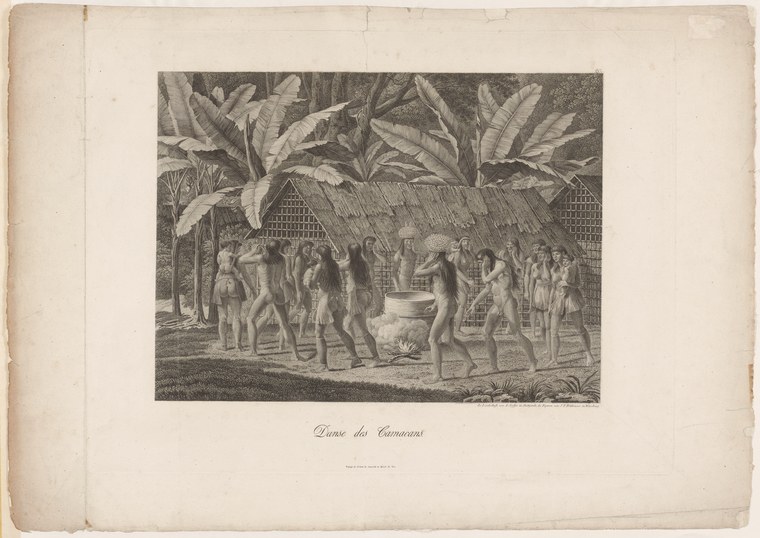
Danse des Camacans
Unknown artist
- Collection:
- Prints depicting dance
- Source:
- New York Public Library
- Rights:
- Public domain — free to use, share and adapt.
- Recorded as:
- Public Domain
For dance historians, this print is significant not as documentation of an actual Camacan dance but as evidence of early European ethnographic curiosity and the conventions by which indigenous movement was translated into European visual language. It demonstrates how dance imagery was used in travel literature and natural history to convey exoticism and cultural difference. The work invites critical questions about the relationship between observation, interpretation, and representation in cross-cultural documentation.
What you are looking at
This engraving depicts a ceremonial or festive gathering of indigenous Amazonian peoples, likely from the 18th century based on the artistic style and ethnographic subject matter. Approximately twenty figures are arranged in a cleared space beneath a large thatched-roof structure with geometric lattice patterns. The figures are unclothed or minimally dressed, consistent with European documentation of Amazonian groups. The composition centers on a central fire or ceremonial focus point around which the figures are positioned. Tall palm fronds frame the upper portion of the composition, creating a naturalistic tropical setting. The scene conveys a moment of community assembly—whether dance, ritual, feast, or social gathering is not definitively clear from the image alone, though the arranged grouping and the title suggest movement or coordinated action.
The dancing
The figures display varied postures suggesting neither formal paired dance holds nor the unified alignment of European ballroom or theatrical dance. Some stand upright with arms at their sides; others appear to gesture or raise their arms in less constrained positions. No two figures adopt an identical pose, and there is no visible hierarchy of positioning or focus. The bodies are rendered generically rather than with anatomical particularity, which was common in 18th-century ethnographic prints. The arrangement is roughly circular or processional rather than linear, and no partnering or contact between dancers is evident.
The dance depicted
The title *Danse des Camacans* identifies the subjects as Camacan people, a Tupian group from what is now Bahia, Brazil. Whether this depicts an actual witnessed dance or a European artist's interpretation of indigenous movement practices cannot be determined from the record. The postures and grouping do not correspond to any documented Amazonian or Brazilian indigenous dance tradition with clear specificity. It is likely a speculative or composite European visualization based on travel accounts or collections, rather than a record of an observed performance. The image is more valuable as evidence of 18th-century European curiosity about indigenous peoples than as documentation of actual dance practice.
How it was made
This is an engraving, identifiable from the parallel hatching lines used to create tone and shadow, the crisp black lines defining form, and the overall monochromatic palette. Engraving was a primary medium for reproducing and circulating images in the 18th century, especially for travel narratives, ethnographic documentation, and naturalistic illustration. The technique allowed fine detail and wide distribution through print runs. The presence of a title and the compositional formality suggest this was a page or plate from a published work, likely an account of exploration or natural history. The print quality and style are consistent with European academic or commercial printmaking of the mid-to-late 18th century.
About this work
This engraving presents a scene titled *Danse des Camacans*, depicting an assembly of indigenous Amazonian figures in a thatched structure. It is an 18th-century ethnographic print, part of a visual tradition in which European artists documented—or reimagined—the customs and practices of non-European peoples. The work belongs in a gallery about dance as a historical artifact of how European printmakers represented indigenous movement and social practice, though the specificity of what is being danced or performed remains ambiguous. The image reveals as much about 18th-century European assumptions and artistic conventions as it does about Amazonian peoples.
How to look at it
Observe the arrangement of figures and the absence of formal partnering or synchronized movement—this is not staged European dance. Notice how the artist uses the thatched structure and tropical vegetation to signal a non-European setting, and how the unclothed or minimal dress was a standard ethnographic marker in European prints. The central focus on the clearing and fire suggests a communal rather than theatrical moment. The title invites you to read this as dance, but the visual evidence is equivocal; consider whether the arrangement might instead depict feasting, ritual, or social assembly.
The period
The 18th century saw a boom in European publications on exploration, natural history, and ethnography, driven by colonial expansion and scientific curiosity. Engraved illustrations were the primary medium for circulating images of distant peoples and places. Dance and festive gathering were common subjects in such works, as they conveyed ideas of indigenous community, ritual, and cultural practice to European audiences. However, these images were typically mediated through European aesthetic conventions and the imagination of artists who had not witnessed the scenes they depicted. The Camacan people themselves were experiencing the catastrophic impacts of Portuguese colonization during this period.
Where it lives
The work is held in the NYPL Prints collection, which catalogs it under the era label "unknown" and the genre "dance." It is a single leaf or page from a larger publication, though the publication itself is not identified in the available record.
Dance in this work
Questions about this work
Did Camacan people actually dance like this?
Probably not. This is a European artist's interpretation, not a documented record. Camacan dance traditions were not systematically recorded by European observers, and this image likely reflects European aesthetic conventions and assumptions about indigenous peoples more than it reflects actual practice.
Who made this print and when?
The artist is not recorded in the available catalogue entry. The style and technique are consistent with 18th-century European engraving, but a precise date cannot be assigned without additional research. It may be from a travel account or natural history volume.
What were Camacan people doing in the 18th century?
The Camacan were a Tupian-speaking group living in what is now Bahia, Brazil. During the 18th century, they were engaged in resistance to Portuguese colonization and enslavement. European images of indigenous life during this period rarely acknowledge the violent context of colonial encounters.
Why would a gallery of dance include this?
Because dance history includes not only the study of actual dance practices but also the history of how dance was imagined, represented, and circulated—especially across cultures and power imbalances. This print is a document of colonial-era visual culture and European attitudes toward indigenous movement.
More dance artwork





