49 works in this view — arrow keys or swipe to move between them.
Dance in Art
Dances of the Viennoise children
Unknown artist
- Collection:
- Prints depicting dance
- Source:
- New York Public Library
- Rights:
- Public domain — free to use, share and adapt.
- Recorded as:
- Public Domain
This image is one of the few surviving visual records of how children's balletic or ballroom-influenced ensemble dance was marketed and understood in the early 19th century. It reveals the shift from court dance and social dancing to staged performance and the commodification of young female bodies as aesthetic objects. For dancers and historians, it documents the emergence of the 'Viennoise' as a recognized entertainment category and shows the formal training methods and costume conventions of mid-century dance academies.
What you are looking at
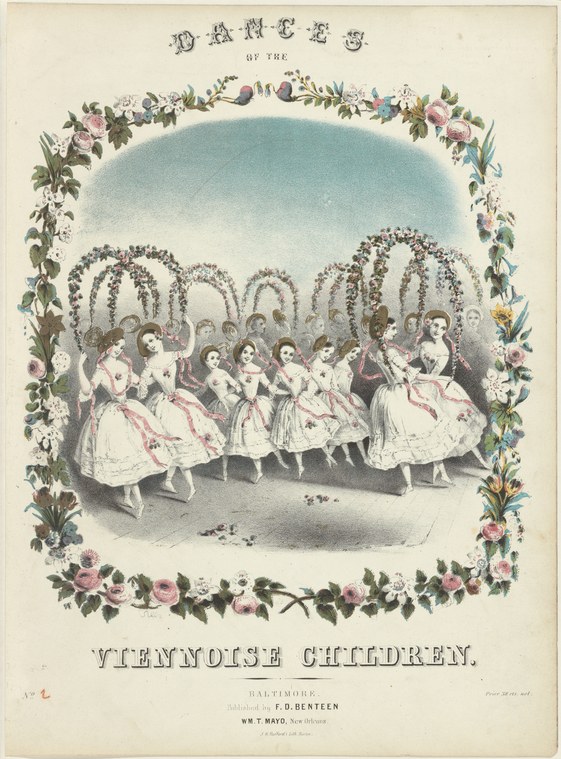
A hand-colored lithograph presents a formal scene of children's dance arranged in concentric arched formations. Eight young female dancers in white dresses with pink silk sashes stand beneath an ornamental bower of flowering vines and birds. The setting is a shallow stage space rendered in pale blue-grey tones, the ground marked by a faint shadow. The dancers are arranged in two nested semicircular lines, creating a gallery effect: those in front stand at rest or in graceful poses, while those behind stand elevated on their positions, their bodies angled to frame the composition. The white dresses are high-waisted with short skirts falling to mid-calf, and each figure wears her hair dressed up in the fashion of the 1840s. The surrounding floral border—roses, morning glories, and small birds—is rendered in delicate watercolor, dominating the frame and creating an album-like, domestic intimacy despite the theatrical subject. This is clearly a print meant for parlor display, not a theatre document.
The dancing
The dancers occupy positions of stillness or gentle preparation rather than vigorous motion. Most stand with upright posture, weight evenly distributed, arms either held softly at the sides or raised in a graceful curve suggesting the classical port de bras of ballet training. Several figures appear to be en attitude or in a light preparatory stance. The arrangement emphasizes symmetry and hierarchy of height rather than a narrative action: the composition reads as a formal group portrait of trained young dancers rather than a captured moment of movement. No dramatic leg extension, turn, or partnering is evident; the focus is on poise and alignment.
The dance depicted
This is most likely a record of a Viennese children's dance ensemble or academy demonstration, probably from the 1840s, depicting what was styled as 'Viennoise' dance—a commercial entertainment form featuring disciplined young performers in balletic or ballroom-influenced group formations. The use of arched bowers and the theatrical framing suggests this was performed in a theatre or concert hall. The title 'Dances of the Viennoise Children' indicates a specific known performance or touring company. The white dress and pink sashes were the standard costume for young female dancers in this period's ballet and ballroom fusion repertory. Without access to period reviews or performance records, the exact choreography and musical accompaniment cannot be determined, but the formal alignment and symmetrical arrangement point to a Romantic-era or transitional late-Baroque group structure—likely quadrille-influenced social dance adapted for stage.
How it was made
This is a hand-colored lithograph, identified by the characteristic graininess of the stone, the soft tonal ranges, and the separate application of watercolor wash over printed forms. The lithographic process allowed rapid and affordable reproduction for theatrical promotion and domestic collection; this print would have been sold as sheet music or theatrical souvenir. The floral border was likely added by hand to each copy, making the piece a hybrid between industrial print and artisanal object. The delicate coloring and composition mark this as a commercial music-hall or entertainment publication, typical of 1840s Baltimore publishing (as indicated by the printer mark F. D. Benteen).
About this work
This lithograph documents a theatrical children's dance spectacle, likely performed in the 1840s by a touring 'Viennoise' ensemble, now known primarily through this promotional print. The work combines the emerging Romantic-era interest in youth, formality, and balletic training with commercial entertainment publishing. The dancers are arranged in geometric formations emphasizing alignment and symmetry over narrative drama, positioned beneath an ornamental floral frame that asserts the image's status as a collectible rather than a theatre document. The work belongs to a moment when children's dance was being professionalized and commercialized as a drawing-room spectacle, and when images of dancers circulated as affordable prints for middle-class homes. It captures not a dance itself but the promotion and aesthetic ideology surrounding early 19th-century children's dance training and performance.
How to look at it
Attend to the formal geometry of the composition: the concentric arches created by the dancers' bodies, the calculated spacing, and the symmetrical mirror arrangement. These features reveal that the choreography was designed for visual spectacle and geometric precision rather than individual virtuosity or narrative drama. Note the stillness of the figures—this is a tableau or processional moment, not a depiction of rapid movement or turn-work. The ornamental border, rendered in more detail and brighter color than the dancers themselves, frames the performers as precious objects within a domestic space, signaling that this print was meant for the parlor rather than the stage. The artist chose to show the ensemble in formation rather than in the midst of active movement, emphasizing the group structure and the costumes.
The artist
The artist is not recorded. The print was published by F. D. Benteen of Baltimore, a music and theatrical print publisher active in the 1840s–50s. Benteen specialized in affordable colored lithographs of theatrical performances, musical groups, and entertainment subjects for domestic sale, making them accessible to middle-class households. The floral border and soft coloring are characteristic of mid-century parlor prints.
The period
The 1840s were a transitional period in dance. Romantic ballet was at its height in European theatre, marked by ethereal, sylphic movement and supernatural themes. Simultaneously, social ballroom dance (waltz, polka, quadrille) was evolving into standardized forms taught in dance academies. Children's dance instruction had become fashionable among the middle classes, and public performances by young dancers were marketed as both refined cultural entertainment and demonstrations of parental investment in their children's accomplishment. In America, touring European dance companies and the publication of theatrical prints created a market for images of dance and dancers. This print belongs to the moment when theatrical dance, commercial entertainment, lithographic reproduction, and domestic consumption were converging.
Where it lives
This print is held in the New York Public Library's collection of prints depicting dance. It is catalogued as a mid-19th-century theatrical promotion and souvenir, published in Baltimore. Such prints were typically distributed to theatres, sold at performances, and purchased by families interested in dance and theatrical entertainment.
Dance in this work
Questions about this work
Was this a real performance or a fictional promotion?
This almost certainly documents a real performance or touring company. The 'Viennoise Children' were known theatrical attractions in the 19th century, and this print was sold as a record and advertisement of their act. The specificity of the title and the professional printing and hand-coloring indicate it was a legitimate theatrical publication, not an invented image.
What is 'Viennoise' dance?
Viennoise typically refers to a style of theatrical entertainment featuring ensemble dance in the manner of Viennese ballroom or balletic style, often performed by young, trained dancers. It was a commercial category in 19th-century theatre, mixing elements of social dance (waltz, quadrille) with balletic training and formation choreography. The term marketed a connection to Vienna and European sophistication.
Why are the dancers in arches?
The arched formation is a visual and compositional choice emphasizing symmetry, ensemble unity, and geometric beauty. It allowed all performers to be visible to the audience and created a framing effect that enhanced the theatrical spectacle. Such formations were typical of 19th-century group dance choreography.
Is this a ballet?
It is a hybrid form—not classical ballet as codified later, but theatrical ensemble dance drawing on balletic training, ballroom conventions, and Romantic-era aesthetics. It represents a moment before the strict division between ballet and ballroom dance became established.
More dance artwork





