49 works in this view — arrow keys or swipe to move between them.
Dance in Art
Le régent: quadrille contredanse
Unknown artist
- Collection:
- Prints depicting dance
- Source:
- New York Public Library
- Rights:
- Public domain — free to use, share and adapt.
- Recorded as:
- Public Domain
The quadrille was the defining social dance of the Regency and Victorian periods, and this image captures the formal elegance and precision that made it dominant across Europe and America for over a century. For dancers and historians, it provides concrete evidence of posture, distance, and decorum in an era where written descriptions are often vague and idealized.
What you are looking at
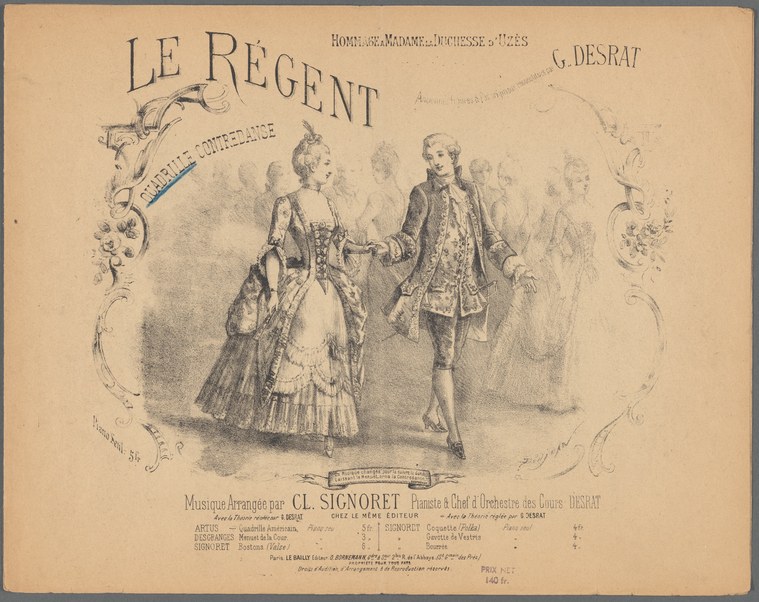
A formal social dance scene set indoors, likely in an 18th-century salon or ballroom. A couple stands at center-right: a woman in an elaborate rococo gown with panniers, tight bodice, and ornate patterned fabric stands opposite a man in formal court dress with embroidered coat and breeches. Behind them, additional couples and spectators recede into shadow, their forms sketched with lighter hatching. The composition is framed by rococo ornamental flourishes—scrollwork and floral motifs frame the scene top and sides, typical of theatrical or operatic title pages of the period. The lighting is diffuse; the artist has used fine cross-hatching and careful tonal gradation to suggest the interior space and the fabric textures of the dancers' clothing.
The dancing
The central couple face each other at a slight distance, with the woman's body angled toward the man. The man's posture is upright and formal; his arms appear to be positioned in the restrained manner of formal court dance. The woman's pose suggests either the beginning of a figure or a moment of presentation—her body is held with balletic composure, the weight settled. Both dancers maintain the vertical, dignified frame characteristic of 18th-century ballroom practice. The supporting couples are merely suggested but appear to follow similar formal positioning.
The dance depicted
This is a quadrille or contredanse of the late 18th century—the title explicitly states "quadrille contredanse," confirming the identification. The quadrille emerged around 1760 and became the dominant ballroom dance of the Regency era and beyond. It was a square dance for four couples, performed to lively orchestral music in 2/4 time, with set figures including chassés, balancés, and promenades. The image captures the formality and decorum of aristocratic ballroom practice, where couples maintained proper distance and upright carriage. The presence of spectators in the background indicates this was an important social event, not merely domestic entertainment.
How it was made
This is a lithograph or engraving (most likely lithograph, given the fine tonal gradation and the date). The technique allows for soft, diffuse tonal modeling and delicate cross-hatching to suggest fabrics and shadow. The ornamental border is integral to the composition, suggesting this was a title page for a published score or theatrical program—a common format for dance music of the period. The quality of reproduction and the formal framing indicate this was intended for a cultivated, urban audience with access to printed music and theater.
About this work
This is a visual record of the quadrille as it was danced in the Regency era, here serving as the cover or title page for a printed composition. The image documents not only the dance itself but the social context in which it was performed: a formal, indoor gathering of the genteel classes, where dance was a central form of entertainment and courtship. The careful attention to costume and posture reveals the artist's understanding of ballroom protocol—the precise angles of arm and body, the distance maintained between partners, the vertical alignment that distinguished this era's dances from both the baroque courtly dances that preceded them and the looser social dances of later periods.
The work belongs to a large body of 18th and 19th-century dance imagery that served simultaneously as advertising, artistic promotion, and historical documentation. Unlike paintings or sculptures of dance, printed images like this one reached a much wider audience—music teachers, amateur musicians, dance masters, and the families who attended assemblies and balls. It is both an artifact of popular culture and a reliable visual testimony to performance practice.
How to look at it
Observe the precise distance and angle between the partners: they do not hold hands, and the woman's arm is not supported by the man—this is characteristic of the quadrille, which alternates between moments of contact and moments of separation. Notice the upright carriage of both dancers: their spines are vertical, their heads held high, their movement restrained. The ornamental frame is not decorative only; it signals that this is a theatrical or operatic genre scene, not a naturalistic document—the artist is presenting an idealized vision of the dance as performance, not as it might appear in an actual crowded ballroom. Look at the spectators in shadow: their presence reminds us that quadrille was a social ritual as much as a dance, a moment of courtship and display watched by the entire assembly.
The artist
The work credits "Musique Arrangée par CL. SIGNORET" (music arranged by Cl. Signoret) and credits for orchestration by Desrat and others, indicating it is a published dance composition rather than a standalone artwork. The engraver or lithographer is not named on the visible portion of the title page, a common practice for commercial prints of this era. The attribution "G. DESRAT" appears at top right; Gustave Desrat was a dance master and author active in Paris in the mid-19th century, known for choreographic publications and dance instruction books.
The period
The quadrille rose to prominence in the 1760s and dominated ballroom culture through the Victorian era. By the Regency period (1811–1820) and beyond, it was the principal dance at formal assemblies, balls, and theaters across Europe. It represented a democratic shift from the baroque court dances: while still formal and requiring instruction, the quadrille was accessible to the middle classes and could be performed in any ballroom without special space or training. The rococo ornamentation of this title page—the scrollwork, the theatrical framing—situates the work within a tradition of operatic and theatrical dance design dating back to the 18th century. By the mid-19th century, when this print was likely made, the quadrille was already being recorded in vast quantities in published music and instructional literature, a sign of both its popularity and its codification into a fixed repertoire.
Where it lives
The work is held in the New York Public Library's Prints collection, which preserves theatrical, musical, and dance-related printed matter from the 18th century onward. The title page format and the credits to composer and arranger indicate this is a published musical score for the quadrille, possibly for orchestra or piano reduction. Such prints were common commercial products, sold to music teachers, amateur musicians, and ballrooms.
Dance in this work
Questions about this work
What is a quadrille?
A quadrille is a square dance for four couples (eight people) performed to orchestral music in 2/4 time, usually consisting of five figures or movements. It emerged in France around 1760 and dominated ballroom culture throughout the 19th century. The dance combined elements of French contredanse and Italian choreography and was seen as both formal enough for court settings and accessible enough for middle-class assemblies.
Why don't the dancers in this image hold hands?
The quadrille alternated between open and closed positions. In some figures, dancers held hands or arms; in others, they moved independently or in parallel. This image appears to capture a moment of separation or transition. The restrained, formal posture was essential to the quadrille's dignity and appeal to the genteel classes.
Who danced quadrilles?
Quadrilles were danced by the middle and upper classes at formal balls, assemblies, and theaters. They required some instruction but were not the exclusive domain of professional dancers or nobility. By the 19th century, quadrille instruction was widely available, and the dance was considered an essential social skill for anyone of genteel background.
Is this a painting, a photograph, or a print?
This is a lithograph or engraving—a printed work, most likely created for publication alongside the musical score. It allowed for mass production and wide distribution. The fine tonal gradations and the ornamental frame suggest lithography, a technique that became popular for commercial prints in the early 19th century.
More dance artwork





