49 works in this view — arrow keys or swipe to move between them.
Dance in Art
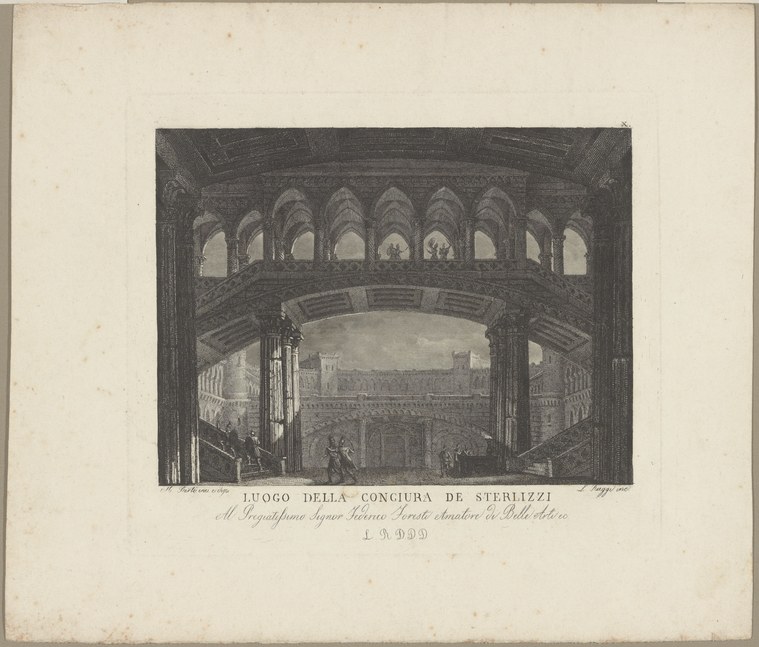
Luogo della congiura de Sterlizzi [i.e., Strelizzi]
Unknown artist
- Collection:
- Prints depicting dance
- Source:
- New York Public Library
- Rights:
- Public domain — free to use, share and adapt.
- Recorded as:
- Public Domain
This engraving preserves evidence of how formal court ceremonies and theatrical events were documented and circulated in the 18th century, showing the role of architectural magnificence in framing ceremonial movement and gathering. For dance historians, the image demonstrates how engravings functioned as records of state occasions and how the spatial arrangement of bodies within monumental interiors was itself part of courtly performance.
What you are looking at
This is an engraving of an interior theatrical space, likely a ballroom or opera house, depicted in perspectival depth. The viewer looks through a proscenium-like architectural frame into a vast hall with a barrel-vaulted ceiling articulated by deep coffers. In the middle distance, a semicircular gallery with arched openings runs across the far wall, creating a sense of architectural grandeur. The floor appears to be a polished dance floor or stage. Figures are present throughout the space—some standing in formal groups, others in movement—distributed across the floor and in the gallery above. The lighting is dramatic, with strong contrasts between shadow and light created by the architecture and the vaulted ceiling. The scene reads as a formal ceremonial or theatrical gathering rather than an intimate social dance, with the monumental perspective emphasizing the importance of the occasion.
The dancing
The figures visible are relatively small given the vast architectural frame, making individual postures difficult to discern with certainty. Groups of standing figures in formal dress occupy the main floor. Some figures appear to be moving or processing through the space; the wear of the engraving and the distance make specific hold, frame, or footwork impossible to confirm. The distribution suggests formal procession or staged ceremony rather than social partner dance.
The dance depicted
This engraving appears to document a ceremonial or courtly event rather than depict a specific named dance. The title refers to the 'Luogo della congiura de Sterlizzi' (the site or place of the Strelizzi conspiracy), suggesting the image records a historical or legendary event set in a formal architectural space—possibly a court ball, state ceremony, or dramatic performance. Without clearer views of dancers' bodies and positioning, identifying a specific dance style is unreliable. The monumental architecture and processional arrangement suggest either a baroque court ballet or a ceremonial state gathering with dance as one element.
How it was made
This is an engraving, almost certainly copper-engraved given the technique and the period characteristics visible in the line work and tonal gradations. The artist has used fine parallel lines (hatching and cross-hatching) to build depth and shadow, particularly in the barrel vault and the recessed ceiling coffers. The architectural precision and the use of linear perspective suggest a trained hand in architectural or theatrical documentation. Engravings of this type—large-scale architectural interiors—were typically produced for dissemination to courts and educated collectors and often documented specific state or ceremonial occasions.
About this work
This engraving records a formal ceremonial or theatrical event in an monumental interior space, likely dating to the 18th century based on the architectural style and engraving technique. The title references the Strelizzi conspiracy, suggesting a historical or legendary incident commemorated through this documented interior setting. The image belongs in a dance history collection as a record of how formal court or state ceremonies used architectural grandeur and the arrangement of bodies in space as a form of spectacle. The work documents the relationship between dance, ceremony, and architecture in early modern European courts.
How to look at it
Approach this image as an architectural document first: the artist's primary task was to render the spatial magnificence of the interior and the perspectival recession. The figures, though present, are subordinate to the building. Notice how the barrel vault and coffers draw the eye backward and create a sense of overwhelming scale. The figures distributed in this space are defined by their position within the architectural frame rather than by individual gesture—their significance lies in how they occupy and are contained by the monumental interior.
The artist
The artist is not recorded. The quality and precision of the perspective and architectural rendering suggest a trained architectural engraver, possibly working for a court or in a major printing centre. Engravings of ceremonial or theatrical interiors were often produced anonymously or under a publisher's name rather than an individual artist's name, making attribution difficult.
The period
This work likely dates to the 18th century, an era when engravings of court ceremonies, architectural interiors, and theatrical events circulated widely among European nobility and educated collectors. Formal court balls and state ceremonies were essential performances of power and courtly order. The Strelizzi conspiracy was a historical event (the conspiracy occurred in 1762 in Russia), suggesting this engraving may document a theatrical or commemorative event inspired by that incident, or may be a fanciful illustration of a historical narrative.
Where it lives
This engraving is held in the New York Public Library's collection of prints depicting dance. The catalogue record provides minimal documentation, and the work is filed under a generic dance label despite the difficulty of identifying a specific dance form in the image.
Dance in this work
Questions about this work
What is the Strelizzi conspiracy and why is it the subject of this engraving?
The Strelizzi were an elite military corps in Russia; a conspiracy involving them occurred in 1762. This engraving likely depicts either a theatrical dramatization of that event or a commemorative state ceremony held in response. Engravings of historical or legendary events set in grand architectural spaces were popular in 18th-century European courts, often serving as records or imaginative reconstructions of important moments.
Can you identify the specific dance being performed?
No. The scale and distance make it impossible to discern dancers' holds, frames, or footwork with certainty. The setting and arrangement suggest a formal court ceremony or state occasion rather than a specific named social or theatrical dance. The architectural and processional elements dominate the composition.
Who created this engraving?
The artist is unknown. The work exhibits the precision and skill of a trained architectural engraver, but such works were often produced anonymously or under a publisher's name. Attribution would require consultation with specialists in 18th-century printmaking and Italian court documentation.
Why would this be in a dance collection?
Ceremonial and courtly gatherings that include dance are part of dance history, as they document how bodies and movement were organized within formal social and political settings. This engraving preserves evidence of the relationship between architecture, ceremonial arrangement, and courtly performance, even if a specific dance cannot be identified.
More dance artwork





