49 works in this view — arrow keys or swipe to move between them.
Dance in Art
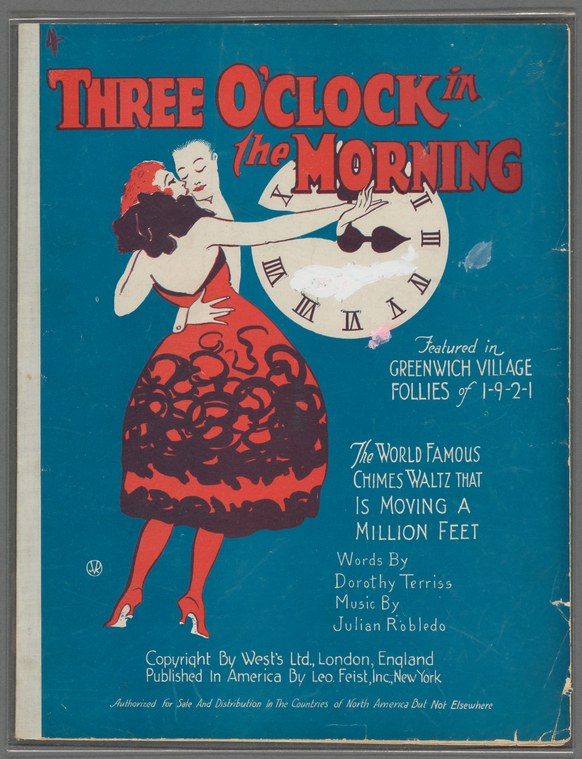
Three o'clock in the morning ... music by Julian Robeldo
Unknown artist
- Collection:
- Prints depicting dance
- Source:
- New York Public Library
- Rights:
- Public domain — free to use, share and adapt.
- Recorded as:
- Public Domain
This work illustrates the commercial circulation of ballroom dance in early twentieth-century America and the role of theatrical revues in defining what 'dancing' meant to the public. The *Greenwich Village Follies* were gatekeepers of taste and trendsetters; a dance featured here would become a standard in ballrooms and nightclubs across the country. The image also reveals the gendered choreography of the era—the woman as object of display and romantic desire, the man as active suitor—and the visual conventions used to market intimacy and glamour.
What you are looking at
A woman in a red dress with an elaborate patterned skirt stands against a bright blue background, holding an oversized clock face. The clock shows approximately three o'clock. She wears a red hat or hair accessory and red heeled shoes, her pose playful and flirtatious—one leg bent, body angled toward the viewer. A male figure in dark clothing leans in from the left, his face close to hers in an intimate gesture. The composition is dynamic and jazzy, typical of 1920s popular entertainment advertising. The printed text identifies this as a song from the *Greenwich Village Follies of 1-9-2-1*, describing it as "the world famous chimes waltz that is moving a million feet."
The dancing
The woman is the focal point, posed in a ballroom or cabaret stance with her weight on one leg, suggesting readiness to move. The man's gesture is one of courtship or seduction—his proximity and inclination toward her face signals the romantic or flirtatious mood. Neither figure is in an active dance frame or hold; this is a posed moment rather than a captured step. The emphasis is on charm and personality rather than technical dance form.
The dance depicted
The work advertises a waltz—specifically what the text calls "the world famous chimes waltz." The song is credited to Julian Robledo (music) and Dorothy Terriss (words), and was featured in the *Greenwich Village Follies of 1921*, a revue staged annually in New York. The title *Three o'Clock in the Morning* became a popular standard. The image suggests a theatrical waltz or ballroom dance as performed in Broadway revues and nightclubs of the early 1920s—intimate, romantic, and designed for popular appeal rather than classical technique. The clock imagery plays on the song's title and was a visual hook for advertising.
How it was made
This is a lithographic print, evidenced by the bold, flat color areas (bright blue background, vivid red costume), the bold sans-serif typography, and the shallow perspective typical of theatrical poster design. Lithography allowed rapid, economical production of eye-catching advertisements for sheet music and theatrical performances, making this an artifact of mass commercial culture. The technique supports bright color saturation and legible text, essential for street-level promotion of entertainment.
About this work
This is a sheet-music cover or theatrical advertisement from 1921, promoting a popular waltz standard from the *Greenwich Village Follies*, an influential Broadway revue series. The image captures the visual language of Jazz Age entertainment: flirtation, modernity, and commercial glamour. The work sits at the intersection of ballroom dance, popular song, and theatrical marketing—a moment when waltz remained central to both formal and social dance, even as syncopated rhythms and theatrical energy were reshaping American performance. It is a primary document of how dance and music were packaged and sold to the public during the early twentieth century.
How to look at it
Notice the clock as both title anchor and compositional device—it fills the upper right and frames the couple's interaction, creating a sense of time and urgency. The woman's pose is not a dance step but a display of availability and allure; she is caught mid-moment, turned toward the viewer and the approaching man. The bright, flat colors and simplified forms are not naturalistic; they are designed to catch the eye on a street or in a store window. The intimacy of the couple's positioning—his face near hers, her relaxed posture—conveys the song's romantic appeal rather than dance technique.
The period
The *Greenwich Village Follies* ran from 1919 to 1925 and were among the most influential American theatrical revue series, rivaling the Ziegfeld Follies in cultural weight. They showcased jazz, popular song, and modern dance movement to urban audiences. The early 1920s saw the waltz coexist with newer rhythms (foxtrot, Charleston, jazz), and theatrical revues were key venues for disseminating and legitimating new steps. Sheet-music covers were major vectors for promotion; a song's cover image shaped how audiences imagined the dance and its context. The lithographic poster was the dominant advertising medium for entertainment in this era.
Where it lives
This work is held in the New York Public Library's collection of prints depicting dance. It is a printed theatrical advertisement or sheet-music cover, not a unique object; multiple copies would have been produced and distributed.
Dance in this work
Questions about this work
Was 'Three o'Clock in the Morning' a real song?
Yes. It became a popular standard and is credited to Julian Robledo (music) and Dorothy Terriss (words). It was featured in the *Greenwich Village Follies of 1921*, a Broadway revue, and the song and image would have helped promote both the show and the sheet music for public purchase and home performance.
What is the Greenwich Village Follies?
An annual revue series (1919–1925) staged in New York, featuring dance, song, comedy, and topical entertainment. The Follies were major cultural events that shaped American taste in music, dance, and theatrical style, and rivaled the Ziegfeld Follies in influence.
Why is the clock so prominent?
It is both the title's visual anchor and a compositional device that creates narrative tension and whimsy. The clock reads three o'clock, linking image directly to song title, and its size and placement draw the eye, making the couple's interaction part of a larger visual concept.
Is this a waltz?
Yes, the text explicitly identifies it as 'the world famous chimes waltz.' The waltz remained popular in both ballroom and theatrical contexts through the 1920s, and theatrical revues were key venues for disseminating new or re-energized versions of traditional dances.
More dance artwork





