49 works in this view — arrow keys or swipe to move between them.
Dance in Art
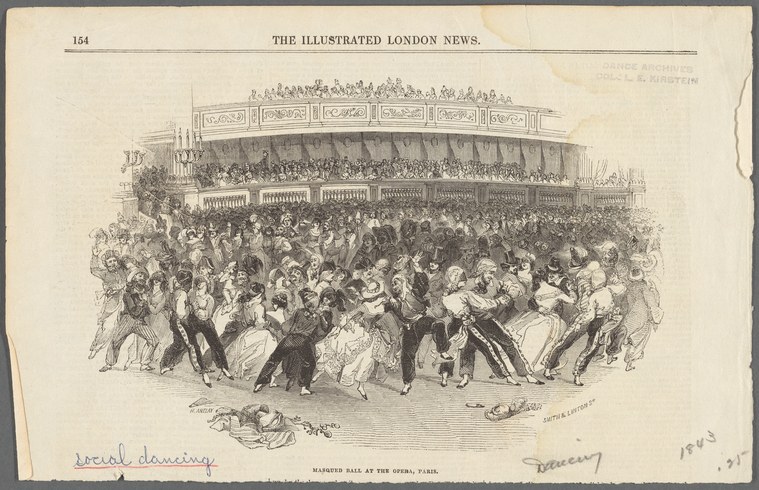
Masqued ball at the Opera, Paris
Unknown artist
- Collection:
- Prints depicting dance
- Source:
- New York Public Library
- Rights:
- Public domain — free to use, share and adapt.
- Recorded as:
- Public Domain
This image documents ballroom dancing not as a technical or artistic practice but as the central social technology of nineteenth-century elite life—a system for managing courtship, displaying status, and performing belonging. For dancers and historians, it demonstrates how completely ballroom dancing was embedded in ritual, architecture, and social hierarchy, and how the dance was inseparable from the gaze of an audience of peers.
What you are looking at
This is a bird's-eye view of a crowded ballroom at the Opéra in Paris, captured in the moment of a masquerade ball. The composition presents an almost theatrical density of figures: hundreds of dancers and spectators fill the floor, with additional crowds visible in the galleries above, separated by ornate architectural divisions. The scale emphasizes the social spectacle—this is not a moment of intimate dancing but the collective performance of Parisian high society. The figures are rendered in the style of nineteenth-century social illustration, with crisp lines distinguishing the gentlemen in dark coats and the women in white gowns, many holding fans. The architectural setting is clearly palatial, with decorated panels above and multiple levels of viewing galleries, reinforcing the Opéra as the stage for elite social performance. The overall effect is one of controlled chaos: orderly enough that individual couples can be discerned dancing, chaotic enough that the eye cannot follow any single narrative.
The dancing
The dancers occupy the center and foreground in pairs or small groups, predominantly in closed ballroom holds—men with dark coats and women in light dresses facing one another. The artist has suggested movement through slight angles of the bodies and the sweep of the women's skirts, though the density of the crowd obscures clear footwork. Many figures on the periphery appear stationary, observing rather than dancing, with fans raised and heads turned. The gesture throughout is formal and controlled; this is not exuberant movement but the decorous performance of ballroom etiquette. Couples are interspersed with clusters of onlookers, creating a rhythm of action and observation across the floor.
The dance depicted
This depicts the social ballroom dancing—most likely Waltz, Polka, or Quadrille—that formed the entertainment at elite Parisian masquerade balls in the nineteenth century. The masquerade context (several figures wear masks or costumes) was typical of carnival-season balls at the Opéra, where the anonymity of disguise gave a frisson of license to otherwise rigidly formal social dancing. The formality of the dress, the architectural grandeur, and the mixed character of the crowd (dancers, musicians' gallery implied above, servants, spectators) all point to a ball of significant social standing, likely from the mid-nineteenth century. The image documents not the dance itself as physical technique but dancing as social ceremony—the performance of eligibility, taste, and status within the hierarchies of Parisian society.
How it was made
This is a wood engraving or steel engraving, a reproductive print technique that was the dominant medium for news and social illustration in the nineteenth-century periodical press. The fine lines, the ability to render both architectural detail and crowded human figures with equal clarity, and the overall composition suggest a wood block cut. The technique allowed rapid printing of multiple impressions, making this image a mass-produced illustration circulating through illustrated newspapers like *The Illustrated London News*. The engraved line creates an effect of careful documentary observation while actually allowing considerable interpretive freedom in the rendering of human gesture and crowd emotion.
About this work
This is a social-documentary engraving of a masquerade ball at the Paris Opéra, presented as a spectacle of elite ballroom dancing in the mid-nineteenth century. The image belongs in a dance gallery not because it depicts dance technique but because it records how ballroom dancing functioned in its original social context—as the central ceremony of high-society entertainment, governed by strict codes of dress, decorum, and partnering. The composition transforms the ballroom floor into a legible social document: every figure's position, costume, and posture speaks to status, intention, and participation in a carefully choreographed social order.
The work is a valuable historical record of how ballroom dance was practiced, valued, and consumed in nineteenth-century Paris. It shows the dancer not in isolation but as one performer within a larger machine of social display—one that required music, architecture, hierarchical seating, the presence of spectators, and the participation of both partners and observers. For historians of social dance, the engraving offers evidence of the scale, formality, and public character of ballroom culture at its height.
How to look at it
The viewer should first observe the overall composition: how the artist has used the bird's-eye perspective to make the ballroom legible as a social system rather than a sequence of individual dances. Then look at the costume: the uniformity of dark male dress and white female dress, and the variation in masks and ornament, which tells you about the conventions of gender, status, and anonymity at work. Finally, attend to the distribution of figures—where the dancers are concentrated, where the spectators cluster, how the architectural frame divides active from observing space. The artist has chosen the moment not of climax but of continuous circulation: the ball in motion, with couples constantly forming, dissolving, and reforming.
The artist
The engraver is not recorded in the catalogue. The style and composition are consistent with the work of the illustrators employed by *The Illustrated London News* and similar periodicals in the 1840s–1860s, when detailed social and architectural engravings were a signature of the medium. The artist was likely a professional staff engraver or contributor working from sketches or eyewitness accounts of the actual ball, translating a momentary event into a legible, reproducible image for mass circulation.
The period
This engraving dates from the era when ballroom dancing reached the height of its cultural prestige and social regulation in Europe. The mid-nineteenth century saw the standardization of dances like the Waltz and Polka into a codified system of partnering and movement, enforced through dancing masters and the social authority of institutions like the Opéra. The masquerade tradition at the Paris Opéra was a survival of eighteenth-century carnival culture, adapted to nineteenth-century respectability; the balls were famous events extensively covered in the illustrated press. The image reflects both the democratization of illustration (the Illustrated London News began publication in 1842 and pioneered the use of wood engraving for news coverage) and the persistence of ballroom dancing as the dominant form of socially sanctioned movement for the upper classes.
Where it lives
The work is held in the Prints collection at the New York Public Library and derives from their *Prints depicting dance* collection. It is a mass-produced periodical illustration, likely extracted from a bound volume of *The Illustrated London News* or a similar contemporary source, and survives in multiple impressions.
Dance in this work
Questions about this work
Is everyone dancing in this picture?
No. The floor is organized into zones of active dancers and clusters of spectators, observers, and people moving between conversations. Ballroom culture required an audience; being present and watching was an essential part of the social performance. The architecture—the galleries above and the clustering of figures—shows how the ball was designed to accommodate both participation and observation.
Why does the picture say 'masqued'?
The masquerade ball was a specific tradition at the Paris Opéra, held during carnival season, where masks and disguises gave participants a temporary freedom from the rigid social conventions that normally governed ballroom dancing. Some figures in the engraving wear masks or fantastical costumes; the disguise was the point of the event. It allowed social mixing and flirtation that would have been unthinkable at ordinary balls.
What dances are being danced here?
The engraver does not show clear enough detail to identify specific dances with certainty, but the formal closed partnerships and the mix of couples suggest Waltz, Polka, and possibly Quadrille—the standard repertoire of elite ballroom dancing in the 1850s–1860s. All would have been danced in this same space, to the same orchestra, as part of a single evening's entertainment.
How was this picture made?
This is a wood engraving, a reproductive print made by incising a design into the end-grain of a hardwood block and using it to print multiple copies. The technique was the dominant method for producing illustrations for newspapers and magazines in the nineteenth century, and allowed images like this to circulate to thousands of readers. It was fast, reliable, and could render both fine detail and crowded scenes.
More dance artwork





