49 works in this view — arrow keys or swipe to move between them.
Dance in Art
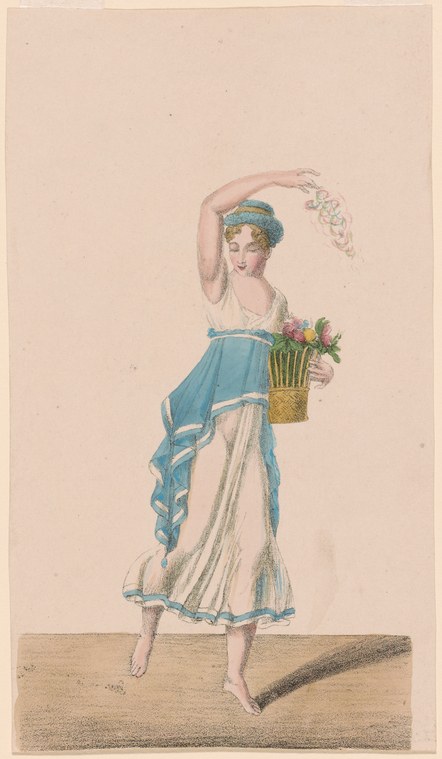
Jeune éphésienne semant des fleurs (choeurs) dans Olimpie, tragédie lyrique, ballet du 3e acte
Unknown artist
- Collection:
- Prints depicting dance
- Source:
- New York Public Library
- Rights:
- Public domain — free to use, share and adapt.
- Recorded as:
- Public Domain
As a theatrical print, this is documentary evidence of how classical roles were costumed and posed in French lyric theatre during a formative period in ballet history. It captures the aesthetic of neoclassical revival on stage and the persistent influence of pantomimic gesture in theatrical dance before the technical vocabulary of Romantic ballet became dominant. For researchers of 18th-century stage practice, such prints are primary sources recording the visual appearance and physical codes of performance.
What you are looking at
A single young woman stands barefoot in classical contrapposto pose against a plain pale background, her weight shifted onto her left leg. She wears a high-waisted white chemise or slip dress and a blue drapery wound around her hips and trailing over her left arm. A golden basket filled with flowers and greenery sits at her right hip. Her right arm is raised gracefully overhead, her gaze directed upward, and her left hand gestures toward or holds the blue fabric. Her hair is styled up and bound with a jeweled circlet. The figure appears suspended in a moment of offering or scattering—consistent with the title's reference to sowing flowers. The composition is intimate and vertical, emphasizing the elongation of the body and the classical reference of the pose.
The dancing
A single female dancer in a classical standing position with weight on the back leg. Her arms are in an open, expressive frame: the raised right arm extended overhead with a graceful curve, the left arm supporting the flowing blue drapery. The body is upright and aligned, with no turnout apparent in the feet, but the overall carriage is aristocratic and composed. The gesture is one of offering or scattering, consistent with an allegorical or mythological character. No partner or ensemble is present.
The dance depicted
This appears to represent a character or allegorical figure from French lyric theatre or opera-ballet, specifically a scene from a tragedy set in ancient Ephesus (as the title states). The figure is likely Ephesian Youth or a similar symbolic character, and the pose suggests a moment of dramatic mime or classical pantomime rather than virtuosic dance. The barefoot stance and Greco-Roman costume point to a late 18th-century French aesthetic interpretation of classical antiquity, common in theatrical spectacle of that period. The image captures a moment of stillness and gesture rather than dynamic movement, suggesting this is a posed or tableau moment within a longer dramatic sequence.
How it was made
This is a hand-colored engraving or etching, characteristic of late 18th-century theatrical prints. The technique allowed for mass production of affordable images for distribution to the theatrical public and collectors of dance imagery. The fine linear work in the drapery and the controlled application of watercolor or ink wash demonstrate skilled printmaking. Such prints served as souvenirs of celebrated performances and were important documentary records of costume and pose in an era before photography.
About this work
This is a theatrical costume print documenting a character or role from a French lyric tragedy, most likely from the mid-to-late 18th century. The work belongs to a substantial tradition of engraved theatrical imagery circulated during the Enlightenment, when opera-ballet and tragédie lyrique were major art forms. The print records not only costume but also the classical physical vocabulary and allegorical gesture language of the stage. For historians of dance and theatre, such prints are often the only visual record of how performers moved, stood, and inhabited classical roles in this crucial period.
How to look at it
The artist has chosen a moment of emotional or allegorical significance—the act of sowing or scattering flowers—rather than a moment of dynamic movement. The barefoot stance and upright carriage place the figure in the classical tradition; the raised arm and upward gaze are conventions of theatrical pathos or supplication. The blue drapery is not casual but dramatically rendered, echoing the drapery studies of antique sculpture. Notice how the figure is centered and isolated: this is a portrait of a role and a moment, not a narrative scene with multiple actors or a ballroom full of dancers.
The period
This work dates to the era of tragédie lyrique and opera-ballet in France, when theatrical spectacle combined sung drama, orchestral music, choreographed ensemble scenes, and allegorical or mythological narrative. The barefoot classical pose and Greco-Roman drapery reflect the late 18th-century enthusiasm for antique sources and the aestheticizing of ancient Greek and Roman subjects on stage. The figure's stillness and gesture-based approach to characterization represents pre-Romantic theatrical idiom, in which the body's principal eloquence lay in mime and expressive arm movement rather than in the virtuosic footwork that would come to define Romantic ballet.
Where it lives
This print comes from the New York Public Library's collection of prints depicting dance, a major repository of theatrical imagery from this period. The print is a document of theatrical production and likely served as a souvenir or record of a specific performance, or as a template for future stagings of the work.
Dance in this work
Questions about this work
Is this a portrait of a real dancer?
No; this is a costume and character print, documenting a role in a theatrical production rather than a named performer. Such prints often do not identify the original dancer. The image records the pose, costume, and physical vocabulary of the role itself.
What is Olimpie?
Olimpie is a tragédie lyrique (a major French theatrical genre combining dance, music, and drama). The title indicates this print shows a chorus member or allegorical figure from the third act, specifically a young Ephesian character scattering flowers. Tragédies lyriques typically included ensemble dance scenes, processions, and allegorical interludes.
Why is she barefoot?
Barefoot dancing in Greco-Roman costume was a convention of late 18th-century neoclassical theatre, signaling antiquity and elevated or tragic content. Soft slippers or bare feet were used to evoke ancient statuary and to distinguish theatrical classicism from the heeled shoes of courtly baroque dance.
What does the pose tell us about 18th-century dance?
The stillness, upright carriage, and emphasis on arm gesture show that theatrical dance of this era valued pantomimic expressiveness and classical beauty of line. Before Romantic ballet's focus on speed, turnout, and pointe work, the classical body was primarily rendered through restrained grace and eloquent gesture.
More dance artwork





